


Page 440 - Hematology_ Basic Principles and Practice ( PDFDrive )
P. 440
Chapter 29  Inherited Bone Marrow Failure Syndromes  361


            promotes eIF6 removal from the 60S subunit by a mechanism that   failure in patients with SDS. A group from Boston used iPSCs from
            requires  guanosine  triphosphate  (GTP)  binding  and  hydrolysis  by   patients with SDS and demonstrated an alternative mechanism for
            EFL1. SBDS interacts with multiple proteins with diverse molecular   cell death. During differentiation of iPSCs to promyelocytes protease
            functions; many of them are involved in ribosome biogenesis, such   levels  are  increased  and  apoptosis  is  enhanced.  Supplementing  the
            as RPL4, and DNA metabolism, such as RPA70.           culture media with protease inhibitors provides a rescue.
              SBDS is critical for cell survival. When SBDS is lost in SDS BM   Two other abnormalities have been identified in SDS. When the
            cells or in SBDS-knockdown K562 and HeLa cells, the cells undergo   averages of telomere lengths adjusted for age are compared with those
            accelerated  apoptosis.  The  accelerated  apoptosis  in  BM  cells  and   of control participants, a tendency toward shortening of telomeres is
            SBDS-knockdown cells seems to be through the Fas pathway and not   found in patient leukocytes, reflecting premature cellular aging. This
            through the Bax/Bcl-2/Bcl-XL pathway. SBDS deficiency in primary   may represent either an inherent defect in telomere maintenance or
            SDS cells and in SBDS-knockdown cells results in abnormal accu-  compensatory stem cell hyperproliferation. In addition to an inherent
            mulation of functional Fas (transcript 1) at the plasma membrane   hematopoietic defect, it has also been shown that the BM stroma is
            level.                                                markedly defective in terms of its ability to support and maintain
                                                  +
              Interestingly,  knocking  down  SBDS  in  CD34   hematopoietic   normal hematopoiesis.
            stem cells/early progenitors and in cell lines increased the levels of
            ROS, and antioxidants reduced Fas-mediated cell death and improved
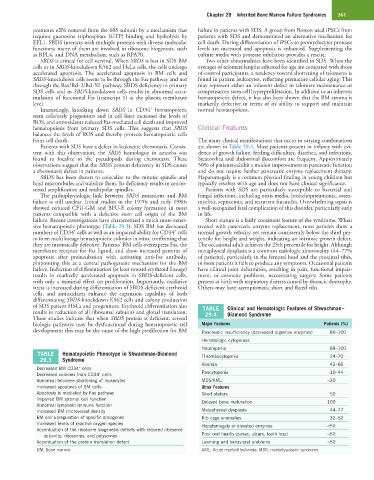
            hematopoiesis  from  primary  SDS  cells.  This  suggests  that  SBDS   Clinical Features
            balances the levels of ROS and thereby protects hematopoietic cells
            from cell death.                                      The many clinical manifestations that occur in varying combinations
              Patients with SDS have a defect in leukocyte chemotaxis. Consis-  are shown in Table 29.4. Most patients present in infancy with evi-
            tent  with  this  observation,  the  SBDS  homologue  in  amoeba  was   dence of growth failure, feeding difficulties, diarrhea, and infections.
            found  to  localize  to  the  pseudopods  during  chemotaxis.  These   Steatorrhea and abdominal discomfort are frequent. Approximately
            observations suggest that the SBDS protein deficiency in SDS causes   50% of patients exhibit a modest improvement in pancreatic function
            a chemotaxis defect in patients.                      and do not require further pancreatic enzyme replacement therapy.
              SBDS has been shown to colocalize to the mitotic spindle and   Hepatomegaly is a common physical finding in young children but
            bind microtubules and stabilize them. Its deficiency results in centro-  typically resolves with age and does not have clinical significance.
            somal amplification and multipolar spindles.            Patients  with  SDS  are  particularly  susceptible  to  bacterial  and
              The  pathophysiologic  link  between  SBDS  mutations  and  BM   fungal infections, including otitis media, bronchopneumonia, osteo-
            failure is still unclear. Initial studies in the 1970s and early 1980s   myelitis, septicemia, and recurrent furuncles. Overwhelming sepsis is
            showed  reduced  CFU-GM  and  BFU-E  colony  formation  in  most   a well-recognized fatal complication of this disorder, particularly early
            patients  compatible  with  a  defective  stem  cell  origin  of  the  BM   in life.
            failure. Recent investigations have characterized a much more exten-  Short stature is a fairly consistent feature of the syndrome. When
            sive hematopoietic phenotype (Table 29.3). SDS BM has decreased   treated with pancreatic enzyme replacement, most patients show a
                                                          +
                         +
            numbers of CD34  cells as well as an impaired ability for CD34  cells   normal growth velocity yet remain consistently below the third per-
            to form multilineage hematopoietic colonies in vitro, confirming that   centile for height and weight, indicating an intrinsic growth defect.
            they are intrinsically defective. Patients’ BM cells overexpress Fas, the   The occasional adult achieves the 25th percentile for height. Although
            membrane receptor for Fas ligand, and show increased patterns of   metaphyseal dysplasia is a common radiologic abnormality (44–77%
            apoptosis  after  preincubation  with  activating  anti-Fas  antibody,   of patients), particularly in the femoral head and the proximal tibia,
            pinpointing this as a central  pathogenetic  mechanism  for the  BM   in most patients it fails to produce any symptoms. Occasional patients
            failure. Induction of differentiation (at least toward erythroid lineage)   have clinical joint deformities, resulting in pain, functional impair-
            results  in  markedly  accelerated  apoptosis  in  SBDS-deficient  cells,   ment,  or  cosmetic  problems,  necessitating  surgery.  Some  patients
            with only a minimal effect on proliferation. Importantly, oxidative   present at birth with respiratory distress caused by thoracic dystrophy.
            stress is increased during differentiation of SBDS-deficient erythroid   Others may have asymptomatic short and flared ribs.
            cells,  and  antioxidants  enhance  the  expansion  capability  of  both
            differentiating SBDS-knockdown K562 cells and colony production
            of SDS patient HSCs and progenitors. Erythroid differentiation also   TABLE   Clinical and Hematologic Features of Shwachman–
            results in reduction of all ribosomal subunits and global translation.   29.4  Diamond Syndrome
            These studies indicate that when SBDS protein is deficient, several
            biologic pathways may be dysfunctional during hematopoietic cell   Major Features              Patients (%)
            development; this may be the cause of the high predilection for BM   Pancreatic insufficiency (decreased digestive enzymes)  86–100
                                                                   Hematologic cytopenias
                                                                   Neutropenia                               88–100
             TABLE   Hematopoietic Phenotype in Shwachman-Diamond   Thrombocytopenia                         24–70
              29.3   Syndrome
                                                                   Anemia                                    42–66
                           +
             Decreased BM CD34  cells
                                 +
             Decreased colonies from CD34  cells                   Pancytopenia                              10–44
             Abnormal telomere shortening of leukocytes            MDS/AML                                  ≈30
             Increased apoptosis of BM cells                       Other Features
             Apoptosis is mediated by Fas pathway                  Short stature                             50
             Impaired BM stromal cell function                     Delayed bone maturation                  100
             Abnormal lymphoid immune function
             Increased BM microvessel density                      Metaphyseal dysplasia                     44–77
             BM cell upregulation of specific oncogenes            Rib cage anomalies                        32–52
             Increased levels of reactive oxygen species           Hepatomegaly or elevated enzymes         <50
             Accentuation of the ribosome biogenesis defects with reduced ribosome
               subunits, ribosomes, and polysomes                  Poor oral health (caries, ulcers, tooth loss)  >50
             Accentuation of the protein translation defect        Learning and behavioral problems         >50
             BM, Bone marrow.                                      AML, Acute myeloid leukemia; MDS, myelodysplastic syndrome.

