


Page 441 - Hematology_ Basic Principles and Practice ( PDFDrive )
P. 441
362    Part IV  Disorders of Hematopoietic Cell Development


           The  majority  of  patients  have  deficits  in  cognitive  abilities  at   vitro  in  SDS,  neutrophil  recruitment  into  abscesses  or  empyemas
        varying levels of severity. These include delayed language develop-  ensues robustly in vivo.
        ment, low intellectual ability, impaired visual-motor integration, and
        failure  to  achieve  higher  order  language  functioning  and  problem   Immune Dysfunction.  Impaired immune function can be signifi-
        solving. About one-fifth of the children have behavioral challenges   cant  in  SDS  and  underlie  recurrent  infections  even  if  adequate
        such  as  attention  deficit  hyperactivity  disorder,  pervasive  develop-  numbers  of  neutrophils  are  present.  Patients  have  various  B-cell
        mental disorder, or oppositional defiant disorder.    abnormalities, including one or more of the following: low immuno-
           Some  additional  clinical  features  are  seen  very  infrequently  in   globulin G (IgG) or IgG subclasses, low percentage of circulating B
        SDS.  Endocrine  abnormalities  include  insulin-dependent  diabetes,   lymphocytes,  decreased  in  vitro  B-cell  proliferation,  and  lack  of
        growth  hormone  deficiency,  hypogonadotropic  hypogonadism,   specific antibody production. Patients may also have T-cell abnor-
        hypothyroidism, and delayed puberty. Cardiomyopathies have been   malities, including a low percentage of circulating T lymphocytes or
        noted in some cases. Urinary tract anomalies, renal tubular acidosis,   subsets  or  NK  cells,  and  decreased  in  vitro  T-cell  proliferation.
        and cleft palate also occur.                          Inverted CD4:CD8 ratios have also been described.

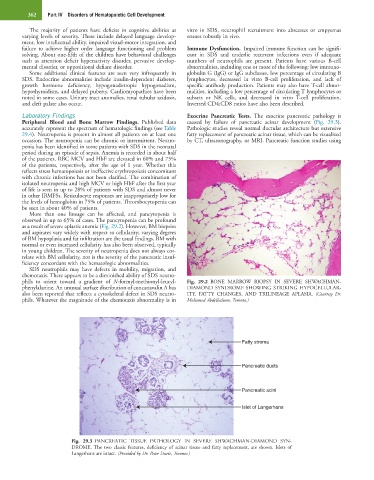
        Laboratory Findings                                   Exocrine  Pancreatic  Tests.  The  exocrine  pancreatic  pathology  is
        Peripheral  Blood  and  Bone  Marrow  Findings.  Published  data   caused  by  failure  of  pancreatic  acinar  development  (Fig.  29.3).
        accurately represent the spectrum of hematologic findings (see Table   Pathologic studies reveal normal ductular architecture but extensive
        29.4). Neutropenia is present in almost all patients on at least one   fatty replacement of pancreatic acinar tissue, which can be visualized
        occasion. The neutropenia can be chronic or intermittent. Neutro-  by CT, ultrasonography, or MRI. Pancreatic function studies using
        penia has been identified in some patients with SDS in the neonatal
        period during an episode of sepsis. Anemia is recorded in about half
        of the patients. RBC MCV and HbF are elevated in 60% and 75%
        of  the  patients,  respectively,  after  the  age  of  1  year.  Whether  this
        reflects stress hematopoiesis or ineffective erythropoiesis concomitant
        with chronic infections has not been clarified. The combination of
        isolated neutropenia and high MCV or high HbF after the first year
        of life is seen in up to 28% of patients with SDS and almost never
        in other IBMFSs. Reticulocyte responses are inappropriately low for
        the levels of hemoglobin in 75% of patients. Thrombocytopenia can
        be seen in about 40% of patients.
           More  than  one  lineage  can  be  affected,  and  pancytopenia  is
        observed in up to 65% of cases. The pancytopenia can be profound
        as a result of severe aplastic anemia (Fig. 29.2). However, BM biopsies
        and aspirates vary widely with respect to cellularity; varying degrees
        of BM hypoplasia and fat infiltration are the usual findings. BM with
        normal or even increased cellularity has also been observed, typically
        in young children. The severity of neutropenia does not always cor-
        relate with BM cellularity, nor is the severity of the pancreatic insuf-
        ficiency concordant with the hematologic abnormalities.
           SDS  neutrophils  may  have  defects  in  mobility,  migration,  and
        chemotaxis. There appears to be a diminished ability of SDS neutro-
        phils  to  orient  toward  a  gradient  of  N-formyl-methionyl-leucyl-  Fig.  29.2  BONE  MARROW  BIOPSY  IN  SEVERE  SHWACHMAN-
        phenylalanine. An unusual surface distribution of concanavalin A has   DIAMOND SYNDROME SHOWING STRIKING HYPOCELLULAR-
        also been reported that reflects a cytoskeletal defect in SDS neutro-  ITY,  FATTY  CHANGES,  AND  TRILINEAGE  APLASIA.  (Courtesy  Dr.
        phils. Whatever the magnitude of the chemotaxis abnormality is in   Mohamed Abdelhaleem, Toronto.)


                                                                                Fatty stroma


                                                                                Pancreatic ducts


                                                                                Pancreatic acini

                                                                                Islet of Langerhans


                        Fig.  29.3  PANCREATIC  TISSUE  PATHOLOGY  IN  SEVERE  SHWACHMAN-DIAMOND  SYN-
                        DROME. The  two  classic  features,  deficiency  of  acinar  tissue  and  fatty  replacement,  are  shown.  Islets  of
                        Langerhans are intact. (Provided by Dr. Peter Durie, Toronto.)

