


Page 626 - Hematology_ Basic Principles and Practice ( PDFDrive )
P. 626
Chapter 39  Megaloblastic Anemias  535


            folate receptors on embryonic neural tube and neural crest cells as   way  to  improve  overall  folate  status  in  women  at  risk  for  NTD
            well as the critical bursts of proliferative activity and the need for   occurrence. By January 1998, fortification of foods (i.e., rice, flour,
            folate to support cell proliferation have been discussed earlier. Thus   pasta, macaroni, breads, and cake with folic acid at 140 µg/100 g of
            it is critical for a woman to have enough folate in her body before   food) was part of American law. This level was chosen to ensure that
            conception  (periconceptionally)  to  ensure  sufficient  availability  for   women of childbearing age would have an increase in folic acid intake
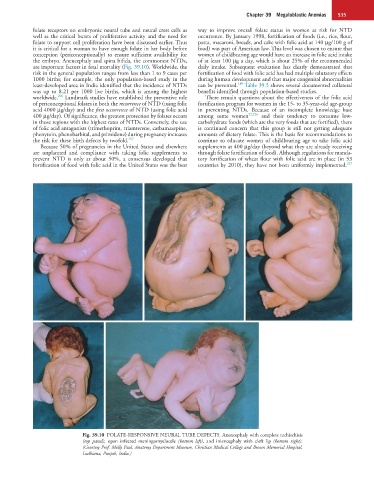
            the embryo. Anencephaly and spina bifida, the commonest NTDs,   of at least 100 µg a day, which is about 25% of the recommended
            are important factors in fetal mortality (Fig. 39.10). Worldwide, the   daily  intake.  Subsequent  evaluation  has  clearly  demonstrated  that
            risk in the general population ranges from less than 1 to 9 cases per   fortification of food with folic acid has had multiple salutatory effects
            1000  births;  for  example,  the  only  population-based  study  in  the   during human development and that major congenital abnormalities
                                                                               189
            least-developed area in India identified that the incidence of NTDs   can be prevented.  Table 39.5 shows several documented collateral
            was  up  to  8.21  per  1000  live  births,  which  is  among  the  highest   benefits identified through population-based studies.
                    206
            worldwide.  Landmark studies have established the preventive role   There remain questions about the effectiveness of the folic acid
            of periconceptional folates in both the recurrence of NTD (using folic   fortification program for women in the 15- to 35-year-old age-group
            acid 4000 µg/day) and the first occurrence of NTD (using folic acid   in  preventing  NTDs.  Because  of  an  incomplete  knowledge  base
            400 µg/day). Of significance, the greatest protection by folates occurs   among  some  women 22,226   and  their  tendency  to  consume  low-
            in those regions with the highest rates of NTDs. Conversely, the use   carbohydrate foods (which are the very foods that are fortified), there
            of folic acid antagonists (trimethoprim, triamterene, carbamazepine,   is  continued  concern  that  this  group  is  still  not  getting  adequate
            phenytoin, phenobarbital, and primidone) during pregnancy increases   amounts of dietary folate. This is the basis for recommendations to
            the risk for these birth defects by twofold. 207      continue  to  educate  women  of  childbearing  age  to  take  folic  acid
              Because 50% of pregnancies in the United States and elsewhere   supplements at 400 µg/day (beyond what they are already receiving
            are  unplanned  and  compliance  with  taking  folic  supplements  to   through folate fortification of food). Although regulations for manda-
            prevent  NTD  is  only  at  about  50%,  a  consensus  developed  that   tory fortification of wheat flour with folic acid are in place (in 53
                                                                                                                  227
            fortification of food with folic acid in the United States was the best   countries by 2010), they have not been uniformly implemented.


                            Fig. 39.10  FOLATE-RESPONSIVE NEURAL TUBE DEFECTS. Anencephaly with complete rachischisis
                            (top  panel),  open  infected  meningomyelocele  (bottom  left),  and  iniencephaly  with  cleft  lip  (bottom  right).
                            (Courtesy Prof. Molly Paul, Anatomy Department Museum, Christian Medical College and Brown Memorial Hospital,
                            Ludhiana, Punjab, India.)

