


Page 622 - Hematology_ Basic Principles and Practice ( PDFDrive )
P. 622
Chapter 39  Megaloblastic Anemias  531


              Cobalamin  deficiency  eventually  develops  in  10%  to  20%  of   thyroiditis (11%), vitiligo (8%), Addison disease, idiopathic hypo-
            patients  8  years  after  partial  gastrectomy;  a  minority  (about  5%)   parathyroidism,  primary  ovarian  failure,  myasthenia  gravis,  type  1
            develops frank clinical manifestations of cobalamin deficiency with   diabetes mellitus, and adult hypogammaglobulinemia. 15,22
            megaloblastic anemia. The cause is multifactorial, and contributing   Autoimmune gastritis progresses over decades to atrophic body
            factors  include  decreased  IF  secretion,  hypochlorhydria,  intestinal   gastritis and pernicious anemia. Serum anti-IF antibodies are highly
            bacterial overgrowth of cobalamin-consuming organisms, and associ-  specific  (100%)  for  pernicious  anemia,  but  the  sensitivity  is  only
            ated iron deficiency. The degree of cobalamin deficiency depends on   about 50%. Earlier, the clinical use of antiparietal cell antibodies was
            the  size  of  the  remaining  gastric  remnant.  It  is  more  common  in   limited because of low specificity. This necessitated use of additional
            Bilroth II than in Bilroth I surgery, and in subtotal than in partial   surrogate markers (high serum gastrin and low pepsinogen I levels)
            gastrectomy. Morbidly obese patients treated surgically with gastric   that reflected loss of acid- and IF-secreting parietal (oxyntic) cells.
            bypass also have more food-cobalamin malabsorption than patients   However, newer enzyme-linked immunosorbent assays (ELISA) for
                                                                                                                 +
                                                                                                                    +
                                           22
            treated  with  vertical  banded  gastroplasty.   Even  after  laparoscopic   antiparietal cell antibodies, which are directed against gastric H /K
            Roux-en-Y  gastric  bypass,  and  despite  multivitamin  supplementa-  ATPase, are 30% more sensitive than previous (immunofluorescence)
            tion, iron deficiency was seen in one-half of patients and cobalamin   assays. A reanalysis of the clinical utility of combining anti-IF and
                                          166
            deficiency seen in one-quarter at 3 years ; therefore these patients   newer antiparietal cell antibody tests to noninvasively diagnose perni-
                                                                                                              169
            probably  need  higher  oral  cobalamin  (or  addition  of  parenteral)   cious  anemia  points  to  this  approach  as  very  promising.   Thus
            therapy.                                              among 81 patients with biopsy-proven atrophic body gastritis and
                                                                  pernicious  anemia,  combining  anti-IF  antibodies  (37%  sensitivity;
            Absent Intrinsic Factor Secretion and                 100% specificity) with newer antiparietal cell antibodies (sensitivity
                                                                  91%; specificity 90%) significantly increased their diagnostic perfor-
            Pernicious Anemia                                     mance for pernicious anemia, yielding overall 73% sensitivity while
                                                                  maintaining 100% specificity. 169
            A common cause of cobalamin malabsorption is pernicious anemia,   Juvenile pernicious anemia can manifest in the second decade with
            an autoimmune disease in which the fundamental defect is atrophy   severe cobalamin deficiency in conjunction with many of the associ-
            of the gastric (parietal cell) oxyntic mucosa that eventually leads to   ated endocrinopathies and autoantibodies observed in adults. 15
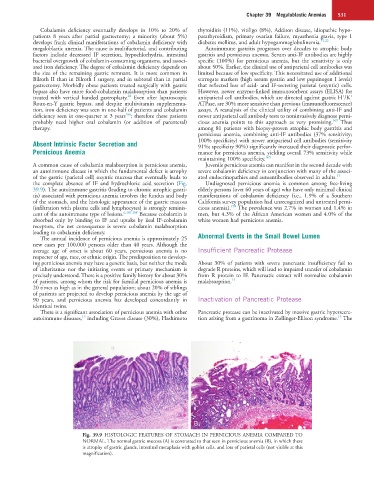
            the  complete  absence  of  IF  and  hydrochloric  acid  secretion  (Fig.   Undiagnosed  pernicious  anemia  is  common  among  free-living
            39.9). The autoimmune gastritis (leading to chronic atrophic gastri-  elderly persons (over 60 years of age) who have only minimal clinical
            tis) associated with pernicious anemia involves the fundus and body   manifestations  of  cobalamin  deficiency  (i.e.,  1.9%  of  a  Southern
            of the stomach, and the histologic appearance of the gastric mucosa   California survey population had unrecognized and untreated perni-
                                                                             170
            (infiltration with plasma cells and lymphocytes) is strongly reminis-  cious anemia).  The prevalence was 2.7% in women and 1.4% in
            cent of the autoimmune type of lesions. 6,167,168  Because cobalamin is   men, but 4.3% of the African American women and 4.0% of the
            absorbed  only  by  binding  to  IF  and  uptake  by  ileal  IF-cobalamin   white women had pernicious anemia.
            receptors,  the  net  consequence  is  severe  cobalamin  malabsorption
            leading to cobalamin deficiency.
              The annual incidence of pernicious anemia is approximately 25   Abnormal Events in the Small Bowel Lumen
            new cases per 100,000 persons older than 40 years. Although the
            average  age  of  onset  is  about  60  years,  pernicious  anemia  is  no   Insufficient Pancreatic Protease
            respecter of age, race, or ethnic origin. The predisposition to develop-
            ing pernicious anemia may have a genetic basis, but neither the mode   About  30%  of  patients  with  severe  pancreatic  insufficiency  fail  to
            of  inheritance  nor  the  initiating  events  or  primary  mechanism  is   degrade R proteins, which will lead to impaired transfer of cobalamin
            precisely understood. There is a positive family history for about 30%   from  R  protein  to  IF.  Pancreatic  extract  will  normalize  cobalamin
            of patients, among whom the risk for familial pernicious anemia is   malabsorption. 15
            20 times as high as in the general population; about 20% of siblings
            of patients are projected to develop pernicious anemia by the age of
            90  years,  and  pernicious  anemia  has  developed  concordantly  in   Inactivation of Pancreatic Protease
            identical twins.
              There is a significant association of pernicious anemia with other   Pancreatic protease can be inactivated by massive gastric hypersecre-
                            15
                                                                                                                15
            autoimmune diseases,  including Graves disease (30%), Hashimoto   tion arising from a gastrinoma in Zollinger-Ellison syndrome.  The


                          A                                     B
                            Fig. 39.9  HISTOLOGIC FEATURES OF STOMACH IN PERNICIOUS ANEMIA COMPARED TO
                            NORMAL. The normal gastric mucosa (A) is contrasted to that seen in pernicious anemia (B), in which there
                            is atrophy of gastric glands, intestinal metaplasia with goblet cells, and loss of parietal cells (not visible at this
                            magnification).

