


Page 633 - Hematology_ Basic Principles and Practice ( PDFDrive )
P. 633
542    Part V  Red Blood Cells


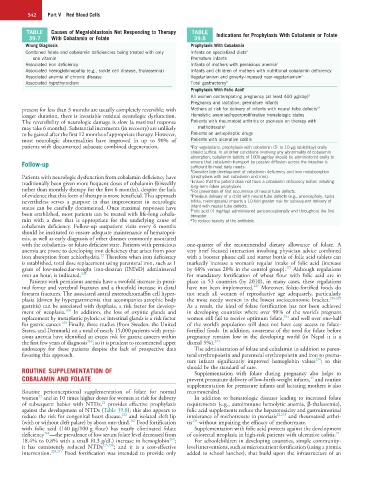
          TABLE   Causes of Megaloblastosis Not Responding to Therapy   TABLE   Indications for Prophylaxis With Cobalamin or Folate
          39.7    With Cobalamin or Folate                      39.8
         Wrong Diagnosis                                       Prophylaxis With Cobalamin
         Combined folate and cobalamin deficiencies being treated with only   Infants on specialized diets a
            one vitamin                                        Premature infants
         Associated iron deficiency                            Infants of mothers with pernicious anemia a
         Associated hemoglobinopathy (e.g., sickle cell disease, thalassemia)  Infants and children of mothers with nutritional cobalamin deficiency
         Associated anemia of chronic disease                  Vegetarianism and poverty-imposed near-vegetarianism a
         Associated hypothyroidism                             Total gastrectomy b
                                                               Prophylaxis With Folic Acid c
                                                               All women contemplating pregnancy (at least 400 µg/day) d
                                                               Pregnancy and lactation, premature infants
        present for less than 3 months are usually completely reversible; with   Mothers at risk for delivery of infants with neural tube defects e,f
        longer duration, there is invariable residual neurologic dysfunction.   Hemolytic anemias/hyperproliferative hematologic states
        The reversibility of neurologic damage is slow (a maximal response   Patients with rheumatoid arthritis or psoriasis on therapy with
        may take 6 months). Substantial increments (in recovery) are unlikely   methotrexate g
        to be gained after the first 12 months of appropriate therapy. However,   Patients on antiepileptic drugs
        most  neurologic  abnormalities  have  improved  in  up  to  90%  of   Patients with ulcerative colitis
        patients with documented subacute combined degeneration.  a For vegetarians, prophylaxis with cobalamin (5- to 10-µg tablet/day) orally
                                                               should suffice. In all other conditions involving any abnormality of cobalamin
                                                               absorption, cobalamin tablets of 1000 µg/day should be administered orally to
        Follow-up                                              ensure that cobalamin transport by passive diffusion across the intestine is
                                                               sufficient to meet daily needs.
                                                               b Consider late development of cobalamin deficiency and iron malabsorption
        Patients with neurologic dysfunction from cobalamin deficiency have   (prophylaxis with oral cobalamin and iron).
                                                                Ensure that the patient does not have a cobalamin deficiency before initiating
        traditionally been given more frequent doses of cobalamin (biweekly   c long-term folate prophylaxis.
        rather than monthly therapy for the first 6 months), despite the lack   d For prevention of first occurrence of neural tube defects.
        of evidence that this form of therapy is more beneficial. This approach   e Previous delivery of a child with neural tube defects (e.g., anencephaly, spina
        nevertheless  serves  a  purpose  in  that  improvement  in  neurologic   bifida, meningocele) imparts a 10-fold greater risk for subsequent delivery of
        status can be carefully documented. Once maximal responses have   infant with neural tube defects.
                                                               f
                                                                Folic acid (4 mg/day) administered periconceptionally and throughout the first
        been established, most patients can be treated with life-long cobala-  trimester.
        min  with  a  dose  that  is  appropriate  for  the  underlying  cause  of   g To reduce toxicity of the antifolate.
        cobalamin  deficiency.  Follow-up  outpatient  visits  every  6  months
        should be instituted to ensure adequate maintenance of hematopoi-
        esis, as well as early diagnosis of other diseases commonly associated
        with the cobalamin- or folate-deficient state. Patients with pernicious   one-quarter  of  the  recommended  dietary  allowance  of  folate.  A
        anemia are prone to developing iron deficiency that arises from poor   very brief focused interaction involving physician advice combined
                                  22
        iron absorption from achlorhydria.  Therefore when iron deficiency   with a booster phone call and starter bottle of folic acid tablets can
        is established, total dose replacement using parenteral iron, such as 1   markedly  increase  a  woman’s  regular  intake  of  folic  acid  (increase
                                                                                               272
        gram  of  low-molecular-weight  iron-dextran  (INFeD)  administered   by 68% versus 20% in the control group).  Although regulations
        over an hour, is indicated. 265                       for  mandatory  fortification  of  wheat  flour  with  folic  acid  are  in
           Patients with pernicious anemia have a twofold increase in proxi-  place  in  53  countries  (by  2010),  in  many  cases,  these  regulations
                                                                                    227
        mal femur and vertebral fractures and a threefold increase in distal   have  not  been  implemented.   Moreover,  folate-fortified  foods  do
        forearm fractures. The associated antral enterochromaffin cell hyper-  not  reach  all  women  of  reproductive  age  adequately,  particularly
        plasia (driven by hypergastrinemia that accompanies atrophic body   the most needy women in the lowest socioeconomic bracket. 228,229
        gastritis) can be associated with dysplasia, a risk factor for develop-  As  a  result,  the  ideal  of  folate  fortification  has  not  been  achieved
                      168
        ment  of  neoplasia.   In  addition,  the  loss  of  oxyntic  glands  and   in  developing  countries  where  over  90%  of  the  world’s  pregnant
                                                                                              191
        replacement by metaplastic pyloric or intestinal glands is a risk factor   women still fail to receive optimum folate,  and well over one-half
                     168
        for gastric cancer.  Finally, three studies (from Sweden, the United   of the world’s population still does not have easy access to folate-
        States, and Denmark) on a total of nearly 15,000 patients with perni-  fortified foods. In addition, awareness of the need for folate before
        cious anemia have identified an excess risk for gastric cancers within   pregnancy  remains  low  in  the  developing  world  (in  Nepal  it  is  a
                              266
        the first few years of diagnosis ; so it is prudent to recommend upper   dismal 5%). 273
        endoscopy  for  these  patients  despite  the  lack  of  prospective  data   The administration of folate and cobalamin in addition to paren-
        favoring this approach.                               teral erythropoietin and parenteral erythropoietin and iron to prema-
                                                                                                        274
                                                              ture  infants  significantly  improved  hemoglobin  values ;  so  this
        ROUTINE SUPPLEMENTATION OF                            should be the standard of care.
                                                                 Supplementation  with  folate  during  pregnancy  also  helps  to
        COBALAMIN AND FOLATE                                  prevent premature delivery of low-birth-weight infants,  and routine
                                                                                                      15
                                                              supplementation for premature infants and lactating mothers is also
        Routine  periconceptional  supplementation  of  folate  for  normal   recommended.
              22
        women  and in 10 times higher doses for women at risk for delivery   In  addition  to  hematologic  diseases  leading  to  increased  folate
                                  22
        of  subsequent  babies  with  NTDs,   provides  effective  prophylaxis   requirements (e.g., autoimmune hemolytic anemia, β-thalassemia),
        against the development of NTDs (Table 39.8); this also appears to   folic acid supplements reduce the hepatotoxicity and gastrointestinal
                                         223
        reduce the risk for congenital heart disease,  and isolated cleft lip   intolerance of methotrexate in psoriasis 22,275  and rheumatoid arthri-
                                            267
                                                                276
        (with or without cleft palate) by about one-third.  Food fortification   tis  without impairing the efficacy of methotrexate.
        with  folic  acid  (140 µg/100 g  flour)  has  nearly  eliminated  folate   Supplementation with folic acid protects against the development
                268
        deficiency —the prevalence of low serum folate level decreased from   of colorectal neoplasia in high-risk patients with ulcerative colitis. 22
                                                        269
        18.4% to 0.8% with a small (0.3 g/dL) increase in hemoglobin ;   For schoolchildren in developing countries, simple community-
        it  has  consistently  reduced  NTDs 215,270 ;  and  it  is  a  cost-effective   level interventions, such as micronutrient fortification (using a premix
        intervention. 228,271   Food  fortification  was  intended  to  provide  only   added to school lunches), that build upon the infrastructure of an

