


Page 714 - Hematology_ Basic Principles and Practice ( PDFDrive )
P. 714
606    Part V  Red Blood Cells


        There is an increased risk for venous thrombosis with an approxi-  Sickle Cell–β-Thalassemia
        mately  twofold  increase  in  risk  and  sickle  trait  explaining  7%  of
                                       29
        thrombotic episodes in African Americans.  Armed forces recruits in   The  gene  frequency  of  β-thalassemia  among  African  Americans  is
                                                                                                  8
        basic training with the sickle cell trait have a substantially increased,   0.004,  one-tenth  that  of  the  sickle  cell  gene,   and  hence  there
        age-dependent risk of exercise-related sudden death. 30  is one-tenth the prevalence of compound heterozygous sickle cell–β-
           Despite the known complications, past experiences with discrimi-  thalassemia in this population. Sickle cell–β-thalassemia is divided
                                                                           +
        nation  in  the  employment  market  and  health  insurance  industry   into sickle cell–β -thalassemia and sickle cell–β°-thalassemia, which
        provide  reminders  that  the  rare  clinical  events  in  sickle  cell  trait   have,  respectively,  reduced  or no  amounts  of Hb  A present. Most
                                                                                                               +
        provide no real justification for regarding it as anything but a benign   β-thalassemia  mutations  among  African  Americans  result  in  β -
                                                                                 +
                      31
        carrier  condition.   Newborn  screening  programs  detect  a  large   thalassemia.  Sickle  cell–β -thalassemia  is  subclassified  according  to
        number  of  infants  with  sickle  cell  trait;  for  these  parents,  genetic   the percentage of Hb A present: type I has 3% to 5%, type II has
        counseling is essential. Parents should understand that their child has   8% to 14%, and type III has 18% to 25%. Eighty percent of African
        a benign hereditary condition with some risks as above but that there   American α-thalassemia mutations are attributable to the promoter
        is a risk for a subsequent child to be born with SCD.  region  mutations  (−88  [C  to T]  and  −29[A  to  G])  that  result  in
           In individuals who appear to have sickle cell trait but are symp-  a  type  III  phenotype.  Compound  heterozygous  sickle  cell–β°-
        tomatic,  the  laboratory  diagnosis  must  be  verified.  Hemoglobins   thalassemia occurs infrequently.
        other than S that polymerize may account for reports of “sickle cell   In  sickle  cell–β-thalassemia,  the  RBCs  are  hypochromic  and
        trait” associated with clinical problems. Examples are heterozygous   microcytic. The ISCs present on the peripheral blood smear are more
                                                                                                               +
        Hb S Antilles and Hb Quebec-CHORI. In the latter case, the Hb   numerous  in  sickle  cell–β°-thalassemia  than  in  sickle  cell–β -
        variant was distinguished from Hb A using mass spectroscopy.  thalassemia. The hematologic and clinical severity is a function of the
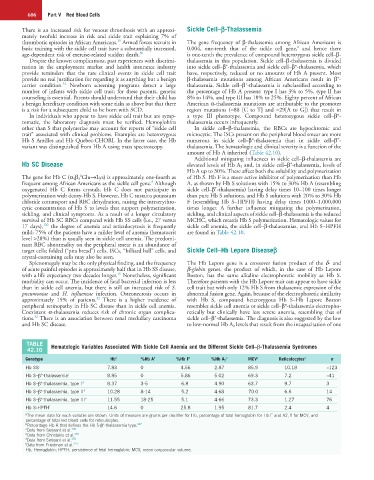
                                                              amount of Hb A inherited (Table 42.10).
                                                                 Additional mitigating influences in sickle cell–β-thalassemia are
        Hb SC Disease                                         elevated levels of Hb A 2  and, in sickle cell–β -thalassemia, levels of
                                                                                                +
                                                              Hb A up to 30%. These affect both the solubility and polymerization
                           6
        The gene for Hb C (α 2 β 2 Glu→Lys) is approximately one-fourth as   of Hb S. Hb F is a more active inhibitor of polymerization than Hb
                                                   8
        frequent among African Americans as the sickle cell gene.  Although   A, as shown by Hb S solutions with 15% to 30% Hb A (resembling
                                                                       +
        oxygenated  Hb  C  forms  crystals,  Hb  C  does  not  participate  in   sickle cell–β -thalassemia) having delay times 10–100 times longer
        polymerization with deoxy-Hb S. However, Hb C sustains potassium   than pure Hb S solutions, and Hb S solutions with 20% to 30% Hb
        chloride cotransport and RBC dehydration, raising the intraerythro-  F  (resembling  Hb  S–HPFH)  having  delay  times  1000–1,000,000
        cytic concentration of Hb S to levels that support polymerization,   times  longer.  A  further  influence  mitigating  the  polymerization,
        sickling, and clinical symptoms. As a result of a longer circulatory   sickling, and clinical aspects of sickle cell–β-thalassemia is the reduced
        survival of Hb SC RBCs compared with Hb SS cells (i.e., 27 versus   MCHC, which retards Hb S polymerization. Hematologic values for
               130
        17  days),   the  degree  of  anemia  and  reticulocytosis  is  frequently   sickle cell anemia, the sickle cell–β-thalassemias, and Hb S–HPFH
        mild: 75% of the patients have a milder level of anemia (hematocrit   are found in Table 42.10.
        level >28%) than is usually seen in sickle cell anemia. The predomi-
        nant RBC abnormality on the peripheral smear is an abundance of
        target cells; folded (“pita bread”) cells, ISCs, “billiard ball” cells, and   Sickle Cell–Hb Lepore Diseaseβ
        crystal-containing cells may also be seen.
           Splenomegaly may be the only physical finding, and the frequency   The  Hb  Lepore  gene  is  a  crossover  fusion  product  of  the  δ-  and
        of acute painful episodes is approximately half that in Hb SS disease,   β-globin  genes,  the  product  of  which,  in  the  case  of  Hb  Lepore
                                       16
        with a life expectancy two decades longer.  Nonetheless, significant   Boston,  has  the  same  alkaline  electrophoretic  mobility  as  Hb  S.
        morbidity can occur. The incidence of fatal bacterial infection is less   Therefore patients with the Hb Lepore trait can appear to have sickle
        than in sickle cell anemia, but there is still an increased risk of S.   cell trait but with only 12% Hb S from thalassemic expression of the
        pneumoniae  and  H.  influenzae  infection.  Osteonecrosis  occurs  in   abnormal fusion gene. Again, because of the electrophoretic similarity
                                 32
        approximately  15%  of  patients.   There  is  a  higher  incidence  of   with  Hb  S,  compound  heterozygous  Hb  S–Hb  Lepore  Boston
        peripheral retinopathy in Hb SC disease than in sickle cell anemia.   resembles sickle cell anemia or sickle cell–β°-thalassemia electropho-
        Coexistent  α-thalassemia  reduces  risk  of  chronic  organ  complica-  retically  but  clinically  have  less  severe  anemia,  resembling  that  of
                                                                       +
            32
        tions.  There is an association between renal medullary carcinoma   sickle cell–β -thalassemia. The diagnosis is also suggested by the low
        and Hb SC disease.                                    to low-normal Hb A 2  levels that result from the incapacitation of one
          TABLE   Hematologic Variables Associated With Sickle Cell Anemia and the Different Sickle Cell–β-Thalassemia Syndromes
          42.10
         Genotype                    Hb a      %Hb A b     %Hb F b    %Hb A 2 a   MCV a     Reticulocytes a  n
         Hb SS c                    7.83       0            4.56       2.87       85.9        10.18         ≈123
         Hb S–β°-thalassemia c      8.85       0            5.86       5.02       69.3        7.2           ≈41
         Hb S–β -thalassemia, type I d  8.37   3-5          6.8        4.90       63.7        9.7           3
              +
         Hb S–β -thalassemia, type II d  10.28  8-14        5.2        4.68       70.0        6.6           14
              +
         Hb S–β -thalassemia, type III e  11.55  18-25      5.1        4.66       73.3        1.27          76
              +
         Hb S-HPFH f                14.6       0            25.8       1.95       81.7        2.4           4
         a The mean data for each variable are shown. Units of measure are grams per deciliter for Hb, percentage of total hemoglobin for Hb F and A2, fl for MCV, and
         percentage of total red blood cells for reticulocytes.
                                   +
         b Percentage Hb A that defines the Hb S-β -thalassemia type. 247
         c Data from Serjeant et al. 249
         d Data from Christakis et al. 248
         e Data from Serjeant et al. 250
         f Data from Friedman et al. 251
         Hb, Hemoglobin; HPFH, persistence of fetal hemoglobin; MCV, mean corpuscular volume.

