


Page 712 - Hematology_ Basic Principles and Practice ( PDFDrive )
P. 712
604    Part V  Red Blood Cells


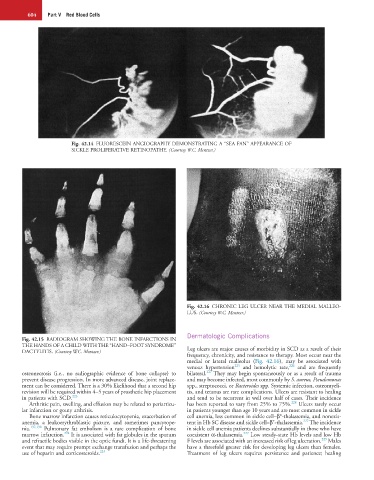
                        Fig. 42.14  FLUORESCEIN ANGIOGRAPHY DEMONSTRATING A “SEA FAN” APPEARANCE OF
                        SICKLE PROLIFERATIVE RETINOPATHY. (Courtesy W.C. Mentzer.)


                                                              Fig. 42.16  CHRONIC LEG ULCER NEAR THE MEDIAL MALLEO-
                                                              LUS. (Courtesy W.C. Mentzer.)


                                                              Dermatologic Complications
        Fig. 42.15  RADIOGRAM SHOWING THE BONE INFARCTIONS IN
        THE HANDS OF A CHILD WITH THE “HAND–FOOT SYNDROME”    Leg ulcers are major causes of morbidity in SCD as a result of their
        DACTYLITIS. (Courtesy W.C. Mentzer.)
                                                              frequency, chronicity, and resistance to therapy. Most occur near the
                                                              medial  or  lateral  malleolus  (Fig.  42.16),  may  be  associated  with
                                                                              225
                                                                                                226
                                                              venous  hypertension   and  hemolytic  rate,   and  are  frequently
                                                                     227
        osteonecrosis  (i.e.,  no  radiographic  evidence  of  bone  collapse)  to   bilateral.  They may begin spontaneously or as a result of trauma
        prevent disease progression. In more advanced disease, joint replace-  and may become infected, most commonly by S. aureus, Pseudomonas
        ment can be considered. There is a 30% likelihood that a second hip   spp., streptococci, or Bacteroides spp. Systemic infection, osteomyeli-
        revision will be required within 4–5 years of prosthetic hip placement   tis, and tetanus are rare complications. Ulcers are resistant to healing
        in patients with SCD. 223                             and tend to be recurrent in well over half of cases. Their incidence
                                                                                                228
           Arthritic pain, swelling, and effusion may be related to periarticu-  has been reported to vary from 25% to 75%.  Ulcers rarely occur
        lar infarction or gouty arthritis.                    in patients younger than age 10 years and are most common in sickle
           Bone marrow infarction causes reticulocytopenia, exacerbation of   cell anemia, less common in sickle cell–β°-thalassemia, and nonexis-
                                                                                          +
                                                                                                    227
        anemia,  a  leukoerythroblastic  picture,  and  sometimes  pancytope-  tent in Hb SC disease and sickle cell–β -thalassemia.  The incidence
        nia. 137,138   Pulmonary  fat  embolism  is  a  rare  complication  of  bone   in sickle cell anemia patients declines substantially in those who have
                                                                                 227
                      224
        marrow infarction.  It is associated with fat globules in the sputum   coexistent α-thalassemia.  Low steady-state Hb levels and low Hb
                                                                                                          229
        and refractile bodies visible in the optic fundi. It is a life-threatening   F levels are associated with an increased risk of leg ulceration.  Males
        event that may require prompt exchange transfusion and perhaps the   have a threefold greater risk for developing leg ulcers than females.
        use of heparin and corticosteroids. 224               Treatment  of  leg  ulcers  requires  persistence  and  patience;  healing

