


Page 794 - Hematology_ Basic Principles and Practice ( PDFDrive )
P. 794
680    Part VI  Non-Malignant Leukocytes


        and as an immune adjuvant in patients with autoimmune disorders   Connective Tissue Disorder
        and colorectal cancer.
           Severe neutropenia is increasingly recognized in patients treated   Connective tissue disorders, such as SLE and RA, have been associ-
        with rituximab. This neutropenia is unusual for its late onset, gener-  ated with monocytosis in the context of chronic inflammation.
        ally  about  3  months  after  the  last  rituximab  dose.  It  occurs  with
        underlying autoimmune disorders, B-cell malignancies, and stem cell
        transplants—basically in all situations in which rituximab is used—  Hematopoietic Malignancies
        often occurring while the underlying illness is in complete remission.
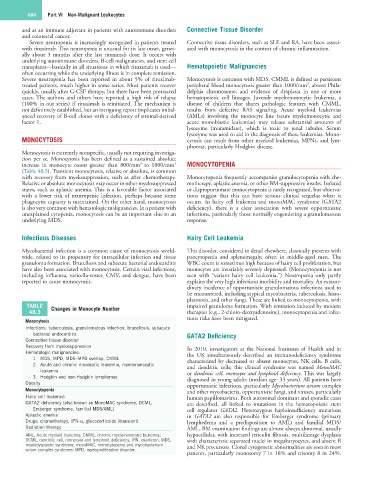
        Severe  neutropenia  has  been  reported  in  about  5%  of  rituximab-  Monocytosis is common with MDS. CMML is defined as persistent
                                                                                                     3
        treated patients, much higher in some series. Most patients recover   peripheral blood monocytosis greater than 1000/mm , absent Phila-
        quickly, usually after G-CSF therapy, but there have been protracted   delphia  chromosome,  and  evidence  of  dysplasia  in  one  or  more
        cases. The authors and others have reported a high risk of relapse   hematopoietic  cell  lineages.  Juvenile  myelomonocytic  leukemia,  a
        (100% in our series) if rituximab is reinitiated. The mechanism is   disease  of  children  that  shares  pathologic  features  with  CMML,
        not definitively established, but an intriguing report implicates imbal-  results  from  defective  RAS  signaling.  Acute  myeloid  leukemias
        anced recovery of B-cell clones with a deficiency of stromal-derived   (AMLs)  involving  the  monocyte  line  (acute  myelomonocytic  and
        factor 1.                                             acute  monoblastic  leukemias)  may  release  substantial  amounts  of
                                                              lysozyme  (muramidase),  which  is  toxic  to  renal  tubules.  Serum
                                                              lysozyme was used to aid in the diagnosis of these leukemias. Mono-
        MONOCYTOSIS                                           cytosis can result from other myeloid leukemias, MPNs, and lym-
                                                              phomas, particularly Hodgkin disease.
        Monocytosis is extremely nonspecific, usually not requiring investiga-
        tion  per  se.  Monocytosis  has  been  defined  as  a  sustained  absolute
                                               3
                                                          3
        increase  in  monocyte  count  greater  than  800/mm   to  1000/mm    MONOCYTOPENIA
        (Table 48.3). Transient monocytosis, relative or absolute, is common
        with recovery from myelosuppression, such as after chemotherapy.   Monocytopenia frequently accompanies granulocytopenia with che-
        Relative or absolute monocytosis may occur in other myelosuppressed   motherapy, aplastic anemia, or other BM-suppressive insults. Isolated
        states, such as aplastic anemia. This is a favorable factor associated   or disproportionate monocytopenia is rarely recognized, but observa-
        with  a  lower  risk  of  neutropenic  infection,  perhaps  because  some   tions  suggest  that  this  can  have  serious  clinical  sequelae  when  it
        phagocytic capacity is maintained. On the other hand, monocytosis   occurs. In hairy cell leukemia and monoMAC syndrome (GATA2
        is also very common with hematologic malignancies. In a patient with   deficiency),  there  is  a  clear  association  with  severe  opportunistic
        unexplained cytopenia, monocytosis can be an important clue to an   infections, particularly those normally engendering a granulomatous
        underlying MDS.                                       response.


        Infectious Diseases                                   Hairy Cell Leukemia
        Mycobacterial infection is a common cause of monocytosis world-  This disorder, considered in detail elsewhere, classically presents with
        wide, related to its propensity for intracellular infection and tissue   pancytopenia  and  splenomegaly,  often  in  middle-aged  men.  The
        granuloma formation. Brucellosis and subacute bacterial endocarditis   WBC count is sometimes high because of hairy cell proliferation, but
        have also been associated with monocytosis. Certain viral infections,   monocytes are invariably severely depressed. (Monocytopenia is not
        including influenza,  varicella-zoster, CMV, and  dengue,  have  been   seen  with  “variant  hairy  cell  leukemia.”)  Neutropenia  only  partly
        reported to cause monocytosis.                        explains the very high infectious morbidity and mortality. An extraor-
                                                              dinary incidence of opportunistic granulomatous infections used to
                                                              be encountered, including atypical mycobacteria, tuberculosis, histo-
                                                              plasmosis, and other fungi. These are linked to monocytopenia, with
          TABLE   Changes in Monocyte Number                  impaired granuloma formation. With remission induced by modern
          48.3                                                therapies (e.g., 2-chloro-deoxyadenosine), monocytopenia and infec-
                                                              tious risks have been mitigated.
         Monocytosis
         Infections: tuberculosis, granulomatous infection, brucellosis, subacute
            bacterial endocarditis                            GATA2 Deficiency
         Connective tissue disorder
         Recovery from myelosuppression                       In  2010,  investigators  at  the  National  Institutes  of  Health  and  in
         Hematologic malignancies:                            the  UK  simultaneously  described  an  immunodeficiency  syndrome
            1.  MDS, MPD, MDS–MPD overlap, CMML               characterized by decreased or absent monocytes, NK cells, B cells,
            2.  Acute and chronic monocytic leukemia, myelomonocytic   and  dendritic  cells;  this  clinical  syndrome  was  named  MonoMAC
              leukemia                                        or dendritic cell, monocyte and lymphoid deficiency. This was largely
            3.  Hodgkin and non-Hodgkin lymphomas             diagnosed in young adults (median age: 33 years). All patients have
         Obesity                                              opportunistic infections, particularly Mycobacterium avium complex
         Monocytopenia                                        and other mycobacteria, opportunistic fungi, and viruses, particularly
         Hairy cell leukemia                                  human papillomavirus. Both autosomal dominant and sporadic cases
         GATA2 deficiency (also known as MonoMAC syndrome, DCML,   are  described,  all  linked  to  mutations  in  the  hematopoietic  stem
            Emberger syndrome, familial MDS/AML)              cell  regulator  GATA2.  Heterozygous  haploinsufficiency  mutations
         Aplastic anemia                                      in  GATA2  are  also  responsible  for  Emberger  syndrome  (primary
         Drugs: chemotherapy, IFN-α, glucocorticoids (transient)  lymphedema  and  a  predisposition  to  AML)  and  familial  MDS/
         Radiation therapy                                    AML. BM examination findings are almost always abnormal, usually
         AML, Acute myeloid leukemia; CMML, chronic myelomonocytic leukemia;   hypocellular, with increased reticulin fibrosis, multilineage dysplasia
         DCML, dendritic cell, monocyte and lymphoid deficiency; IFN, interferon; MDS,   with characteristic separated nuclei in megakaryocytes, and absent B
         myelodysplastic syndrome; monoMAC, monocytopenia and mycobacterium   and NK precursors. Clonal cytogenetic abnormalities are seen in most
         avium complex syndrome; MPD, myeloproliferative disorder.
                                                              patients, particularly monosomy 7 in 16% and trisomy 8 in 24%.

