


Page 797 - Hematology_ Basic Principles and Practice ( PDFDrive )
P. 797
Chapter 49  Lymphocytosis, Lymphocytopenia, Hypergammaglobulinemia, and Hypogammaglobulinemia  683


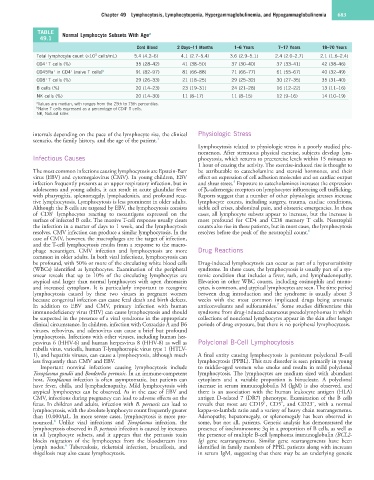
             TABLE   Normal Lymphocyte Subsets With Age a
              49.1
                                              Cord Blood   2 Days–11 Months   1–6 Years     7–17 Years    18–70 Years
                                3
             Total lymphocyte count (×10  cells/mL)  5.4 (4.2–6)  4.1 (2.7–5.4)  3.6 (2.9–5.1)  2.4 (2.0–2.7)  2.1 (1.6–2.4)
                +
             CD4  T cells (%)                35 (28–42)      41 (38–50)      37 (30–40)    37 (33–41)     42 (38–46)
                   +
                        +
             CD45Ra  in CD4  (naive T cells) b  91 (82–97)   81 (66–88)      71 (66–77)    61 (55–67)     40 (32–49)
                +
             CD8  T cells (%)                29 (26–33)      21 (18–25)      29 (25–32)    30 (27–35)     35 (31–40)
             B cells (%)                     20 (14–23)      23 (19–31)      24 (21–28)    16 (12–22)     13 (11–16)
             NK cells (%)                    20 (14–30)      11 (8–17)       11 (8–15)     12 (9–16)      14 (10–19)
             a Values are median, with ranges from the 25th to 75th percentiles.
             b Naive T cells expressed as a percentage of CD4  T cells.
                                          +
             NK, Natural killer.
            intervals depending on the pace of the lymphocyte rise, the clinical   Physiologic Stress
            scenario, the family history, and the age of the patient. 3
                                                                  Lymphocytosis related to physiologic stress is a poorly studied phe-
                                                                  nomenon.  After  strenuous  physical  exercise,  subjects  develop  lym-
            Infectious Causes                                     phocytosis, which returns to preexercise levels within 15 minutes to
                                                                  1 hour of ceasing the activity. The exercise-induced rise is thought to
            The most common infections causing lymphocytosis are Epstein-Barr   be  attributable  to  catecholamine  and  steroid  hormones,  and  their
            virus (EBV) and cytomegalovirus (CMV). In young children, EBV   effect on expression of cell adhesion molecules and on cardiac output
                                                                             5
            infection frequently presents as an upper respiratory infection, but in   and shear stress.  Exposure to catecholamines increases the expression
            adolescents and young adults, it can result in acute glandular fever   of β 2 -adrenergic receptors on lymphocytes influencing cell trafficking.
            with pharyngitis, splenomegaly, lymphadenitis, and profound reac-  Reports suggest that a number of other physiologic stresses increase
            tive lymphocytosis. Lymphocytosis is less prominent in older adults.   lymphocyte  counts,  including  surgery,  trauma,  cardiac  conditions,
            Although the B cells are targeted by EBV, the lymphocytosis consists   sickle cell crises, abdominal pain, and obstetric emergencies. In these
                  +
            of  CD8   lymphocytes  reacting  to  neoantigens  expressed  on  the   cases, all lymphocyte subsets appear to increase, but the increase is
            surface of infected B cells. The massive T-cell response usually clears   most  profound  for  CD4  and  CD8  memory  T  cells.  Neutrophil
            the infection in a matter of days to 1 week, and the lymphocytosis   counts also rise in these patients, but in most cases, the lymphocytosis
            resolves. CMV infection can produce a similar lymphocytosis. In the   resolves before the peak of the neutrophil count. 6
            case of CMV, however, the macrophages are the target of infection,
            and the T-cell lymphocytosis results from a response to the macro-
            phage  neoantigen.  CMV  infection  and  lymphocytosis  are  more   Drug Reactions
            common in older adults. In both viral infections, lymphocytosis can
            be profound, with 50% or more of the circulating white blood cells   Drug-induced lymphocytosis can occur as part of a hypersensitivity
            (WBCs)  identified  as  lymphocytes.  Examination  of  the  peripheral   syndrome. In these cases, the lymphocytosis is usually part of a sys-
            smear  reveals  that  up  to  10%  of  the  circulating  lymphocytes  are   temic condition that includes a fever, rash, and lymphadenopathy.
            atypical and larger than normal lymphocytes with open chromatin   Elevation in other WBC counts, including eosinophils and mono-
            and  increased  cytoplasm.  It  is  particularly  important  to  recognize   cytes, is common, and atypical lymphocytes are seen. The time period
            lymphocytosis  caused  by  these  two  viruses  in  pregnant  women   between  drug  introduction  and  the  syndrome  is  usually  about  3
            because congenital infection can cause fetal death and birth defects.   weeks  with  the  most  common  implicated  drugs  being  aromatic
                                                                                            7
            In  addition  to  EBV  and  CMV,  primary  infection  with  human   anticonvulsants  and  sulfonamides.   Some  studies  differentiate  this
            immunodeficiency virus (HIV) can cause lymphocytosis and should   syndrome from drug-induced cutaneous pseudolymphomas in which
            be suspected in the presence of a viral syndrome in the appropriate   collections of nonclonal lymphocytes appear in the skin after longer
            clinical circumstance. In children, infection with Coxsackie A and B6   periods of drug exposure, but there is no peripheral lymphocytosis.
            viruses,  echovirus,  and  adenovirus  can  cause  a  brief  but  profound
            lymphocytosis. Infections with other viruses, including human her-
            pesvirus 6 (HHV-6) and human herpesvirus 8 (HHV-8) as well as   Polyclonal B-Cell Lymphocytosis
            rubella virus, varicella, human T-lymphotropic virus type 1 (HTLV-
            1), and hepatitis viruses, can cause a lymphocytosis, although much   A final entity causing lymphocytosis is persistent polyclonal B-cell
            less frequently than CMV and EBV.                     lymphocytosis (PPBL). This rare disorder is seen primarily in young
              Important  nonviral  infections  causing  lymphocytosis  include   to middle-aged women who smoke and results in mild polyclonal
            Toxoplasma gondii and Bordetella pertussis. In an immune-competent   lymphocytosis. The lymphocytes are medium sized with abundant
            host, Toxoplasma infection is often asymptomatic, but patients can   cytoplasm  and  a  variable  proportion  is  binucleate.  A  polyclonal
            have fever, chills, and lymphadenopathy. Mild lymphocytosis with   increase in serum immunoglobulin M (IgM) is also observed, and
            atypical lymphocytes can be observed. As in the case of EBV and   there  is  an  association  with  the  human  leukocyte  antigen  (HLA)
            CMV, infections during pregnancy can lead to adverse effects on the   antigen D-related 7 (DR7) phenotype. Examination of the B cells
                                                                                       +
                                                                                             −
                                                                                                       −
            fetus. In children and adults, infection with B. pertussis can lead to   reveals  that  most  are  CD19 ,  CD5 ,  and  CD23 ,  with  a  normal
            lymphocytosis, with the absolute lymphocyte count frequently greater   kappa-to-lambda ratio and a variety of heavy chain rearrangements.
            than 10,000/µL. In more severe cases, lymphocytosis is more pro-  Adenopathy,  hepatomegaly,  or  splenomegaly  has  been  observed  in
                   4
            nounced.   Unlike  viral  infections  and  Toxoplasma  infection,  the   some, but not all, patients. Genetic analysis has demonstrated the
            lymphocytosis observed in B. pertussis infection is caused by increases   presence of isochromosome 3q in a proportion of B cells, as well as
            in  all  lymphocyte  subsets,  and  it  appears  that  the  pertussis  toxin   the presence of multiple B-cell lymphoma immunoglobulin (BCL2-
            blocks  migration  of  the  lymphocytes  from  the  bloodstream  into   Ig)  gene  rearrangements.  Similar  gene  rearrangements  have  been
                      4
            lymph  nodes.   Tuberculosis,  rickettsial  infection,  brucellosis,  and   identified in family members of PPBL patients along with increases
            shigellosis may also cause lymphocytosis.             in serum IgM, suggesting that there may be an underlying genetic

