


Page 1009 - Williams Hematology ( PDFDrive )
P. 1009
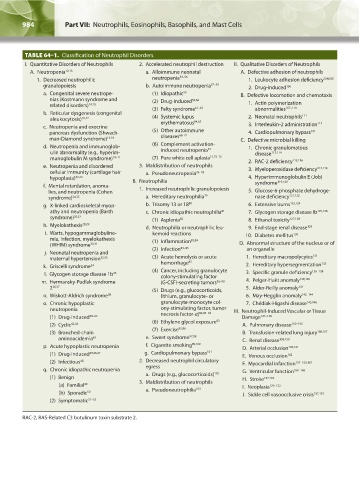
984            Part VII:  Neutrophils, Eosinophils, Basophils, and Mast Cells                                                             CHAPTER 64:  Classification and Clinical Manifestations of Neutrophil Disorders          985


                TABLE 64–1.  Classification of Neutrophil Disorders
                I.  Quantitative Disorders of Neutrophils  2.  Accelerated neutrophil destruction  II.  Qualitative Disorders of Neutrophils
                  A.  Neutropenia 12,13                  a.   Alloimmune neonatal        A.  Defective adhesion of neutrophils
                    1.   Decreased neutrophilic            neutropenia 54–56               1.   Leukocyte adhesion deficiency 104,105
                      granulopoiesis                     b.  Autoimmune neutropenia 57–59  2.  Drug-induced 106
                      a.   Congenital severe neutrope-     (1)  Idiopathic 59            B.   Defective locomotion and chemotaxis
                         nias (Kostmann syndrome and       (2)  Drug-induced 59,60
                         related disorders) 14,15,         (3)  Felty syndrome 61–63       1.   Actin polymerization
                                                                                             abnormalities
                                                                                                        107–110
                      b.   Reticular dysgenesis (congenital                                                  111
                         aleukocytosis) 16,17              (4)   Systemic lupus  64,65     2.  Neonatal neutrophils
                                                              erythematosus
                      c.   Neutropenia and exocrine                                        3.  Interleukin-2 administration 112
                        pancreas dysfunction (Shwach-      (5)   Other autoimmune          4.  Cardiopulmonary bypass 101
                                                                    66–71
                        man-Diamond syndrome) 13,18           diseases                   C.  Defective microbial killing
                      d.   Neutropenia and immunoglob-     (6)   Complement activation-    1.   Chronic granulomatous
                                                                              72
                         ulin abnormality (e.g., hyperim-     induced neutropenia            disease 113,114
                         munoglobulin M syndrome) 19–21    (7)  Pure white cell aplasia 71,73–75  2.  RAC-2 deficiency 115,116
                      e.   Neutropenia and disordered   3.  Maldistribution of neutrophils  3.   Myeloperoxidase deficiency 117,118
                         cellular immunity (cartilage hair   a.  Pseudoneutropenia 76–78
                         hypoplasia) 22,23          B.  Neutrophilia                       4.   Hyperimmunoglobulin E (Job)
                                                                                                     119,120
                      f.   Mental retardation, anoma-  1.  Increased neutrophilic granulopoiesis  syndrome
                        lies, and neutropenia (Cohen                                       5.   Glucose-6-phosphate dehydroge-
                        syndrome) 24,25                  a.  Hereditary neutrophilia 79      nase deficiency 121,122
                      g.   X-linked cardioskeletal myop-  b.  Trisomy 13 or 18 80          6.  Extensive burns 123,124
                         athy and neutropenia (Barth     c.  Chronic idiopathic neutrophilia 81  7.   Glycogen storage disease Ib 125,126
                         syndrome) 26,27                   (1)  Asplenia 82                8.  Ethanol toxicity 127,128
                      h.  Myelokathexis 28,29            d.   Neutrophilia or neutrophilic leu-  9.  End-stage renal disease 129
                       i.   Warts, hypogammaglobuline-     kemoid reactions               10.  Diabetes mellitus 130
                         mia, infection, myelokathexis     (1)  Inflammation 83,84
                         (WHIM) syndrome 30,31                      83–85               D.   Abnormal structure of the nucleus or of
                       j.   Neonatal neutropenia and       (2)  Infection                  an organelle          131
                        maternal hypertension 32,33        (3)   Acute hemolysis or acute   1.  Hereditary macropolycytes
                                                                       83
                      k.  Griscelli syndrome 34               hemorrhage                  2.  Hereditary hypersegmentation 135
                       l.  Glycogen storage disease 1b 35  (4)   Cancer, including granulocyte   3.   Specific granule deficiency 136–138
                                                              colony-stimulating factor
                      m.   Hermansky-Pudlak syndrome          (G-CSF)-secreting tumors 86–89  4.  Pelger-Huët anomaly 139,140
                         2 36,37                           (5)   Drugs (e.g., glucocorticoids,   5.  Alder-Reilly anomaly 141
                      n.  Wiskott-Aldrich syndrome 38         lithium, granulocyte- or    6.  May-Hegglin anomaly 142–144
                      o.   Chronic hypoplastic                granulocyte-monocyte col-   7.  Chédiak-Higashi disease 145,146
                         neutropenia                          ony-stimulating factor, tumor   III.   Neutrophil-Induced Vascular or Tissue
                                                                           83,90–94
                         (1)  Drug-induced 39–42              necrosis factor-α)  83     Damage 147–149
                         (2)  Cyclic 43,44                 (6)   Ethylene glycol exposure  A.  Pulmonary disease 150–155
                                                                    95,96
                         (3)   Branched-chain              (7)  Exercise                 B.  Transfusion-related lung injury 156,157
                           aminoacidemia 45              e.  Sweet syndrome 97,98        C.  Renal disease 158,159
                      p.  Acute hypoplastic neutropenia  f.  Cigarette smoking 99,100    D.  Arterial occlusion 160,161
                         (1)  Drug-induced 39,46,47     g.  Cardiopulmonary bypass 101   E.  Venous occlusion 162
                         (2)  Infectious 48            2.   Decreased neutrophil circulatory   F.  Myocardial infarction 157–163,167
                      q.  Chronic idiopathic neutropenia  egress                102      G.  Ventricular function 164–168
                         (1)  Benign                     a.  Drugs (e.g., glucocorticoids)  H.  Stroke 157,169
                            (a)  Familial 49           3.  Maldistribution of neutrophils  I.  Neoplasia 170–172
                                                                          103
                            (b)  Sporadic 50             a.  Pseudoneutrophilia          J.  Sickle cell vasoocclusive crisis 157,173
                         (2)  Symptomatic 51–53

               RAC-2, RAS-Related C3 botulinum toxin substrate 2.


          Kaushansky_chapter 64_p0983-0990.indd   984                                                                   9/17/15   3:27 PM

