


Page 1238 - Williams Hematology ( PDFDrive )
P. 1238
1212  Part IX:  Lymphocytes and Plasma Cells                       Chapter 80:  Immunodeficiency Diseases            1213


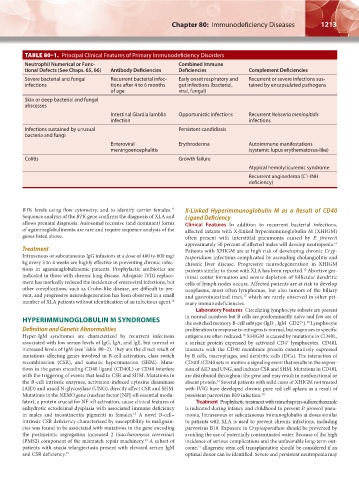
                   TABLE 80–1.  Principal Clinical Features of Primary Immunodeficiency Disorders
                   Neutrophil Numerical or Func-                      Combined Immune
                   tional Defects (See Chaps. 65, 66)  Antibody Deficiencies  Deficiencies    Complement Deficiencies
                   Severe bacterial and fungal   Recurrent bacterial infec-  Early onset respiratory and   Recurrent or severe infections sus-
                   infections                  tions after 4 to 6 months   gut infections (bacterial,   tained by encapsulated pathogens
                                               of age                 viral, fungal)
                   Skin or deep bacterial and fungal
                   abscesses
                                               Intestinal Giardia lamblia   Opportunistic infections  Recurrent Neisseria meningitidis
                                               infection                                      infections
                   Infections sustained by unusual                    Persistent candidiasis
                   bacteria and fungi
                                               Enteroviral            Erythroderma            Autoimmune manifestations
                                               meningoencephalitis                            (systemic lupus erythematosus-like)
                   Colitis                                            Growth failure
                                                                                              Atypical hemolyticuremic syndrome
                                                                                              Recurrent angioedema (C1-INH
                                                                                              deficiency)


                                                                    11
                  BTK levels using flow cytometry, and to identify carrier females.    X-Linked Hyperimmunoglobulin M as a Result of CD40
                  Sequence analysis of the BTK gene confirms the diagnosis of XLA and   Ligand Deficiency
                  allows prenatal diagnosis. Autosomal recessive (and dominant) forms   Clinical Features  In addition to recurrent bacterial infections,
                  of agammaglobulinemia are rare and require sequence analysis of the   affected infants with X-linked hyperimmunoglobulin M (XHIGM)
                  genes listed above.                                   often present with interstitial pneumonia caused by  P.  jirovecii
                                                                        approximately 50 percent of affected males will develop neutropenia.
                                                                                                                          16
                  Treatment                                             Patients with XHIGM are at high risk of developing chronic Cryp-
                  Intravenous or subcutaneous IgG infusions at a dose of 400 to 600 mg/  tosporidium infections complicated by ascending cholangiolitis and
                  kg every 3 to 4 weeks are highly effective in preventing chronic infec-  chronic liver disease. Progressive neurodegeneration in XHIGM
                  tions in agammaglobulinemic patients. Prophylactic antibiotics are   patients similar to those with XLA has been reported.  Abortive ger-
                                                                                                                12
                  indicated in those with chronic lung disease. Adequate IVIG replace-  minal center formation and severe depletion of follicular dendritic
                  ment has markedly reduced the incidence of enteroviral infections, but   cells of lymph nodes occurs. Affected patients are at risk to develop
                  other complications, such as Crohn-like disease, are difficult to pre-  neoplasms, most often lymphomas, but also tumors of the biliary
                  vent, and progressive neurodegeneration has been observed in a small   and gastrointestinal tract,  which are rarely observed in other pri-
                                                                                            17
                  number of XLA patients without identification of an infectious agent. 12  mary immunodeficiencies.
                                                                            Laboratory Features  Circulating lymphocyte subsets are present
                  HYPERIMMUNOGLOBULIN M SYNDROMES                       in normal numbers but B cells are predominantly naïve and few are of
                                                                        the switched memory B-cell subtype (IgD , IgM  CD27 ).  Lymphocyte
                                                                                                               + 18
                                                                                                      –
                                                                                                          –
                  Definition and Genetic Abnormalities                  proliferation in response to mitogens is normal, but responses to specific
                  Hyper-IgM syndromes are characterized by recurrent infections   antigens are often reduced.  XHIGM is caused by mutations in CD40L,
                                                                                            19
                  associated with low serum levels of IgG, IgA, and IgE, but normal or   a surface protein  expressed  by activated  CD4  lymphocytes. CD40L
                                                                                                           +
                  increased levels of IgM (see Table  80–2). They are the direct result of   interacts with the CD40 membrane protein constitutively expressed
                  mutations affecting genes involved in B-cell activation, class switch   by B cells, macrophages, and dendritic cells (DCs). The interaction of
                  recombination (CSR), and somatic hypermutation (SHM). Muta-  CD40L/CD40 sets in motion a signaling event that results in the expres-
                  tions in the genes encoding CD40 ligand (CD40L) or CD40 interfere   sion of AID and UNG, and induces CSR and SHM. Mutations in CD40L
                  with the triggering of events that lead to CSR and SHM. Mutations in   are distributed throughout the gene and may result in nonfunctional or
                  the B-cell intrinsic enzymes, activation-induced cytosine deaminase   absent protein.  Several patients with mild cases of XHIGM not treated
                                                                                   16
                  (AID) and uracil N-glycosylase (UNG), directly affect CSR and SHM.   with IVIG have developed chronic pure red cell aplasia as a result of
                  Mutations in the NEMO gene (nuclear factor [NF]-κB essential modu-  persistent parvovirus B19 infection. 20
                  lator), a protein crucial for NF-κB activation, cause clinical features of   Treatment  Prophylactic treatment with trimethoprim-sulfamethoxazole
                  anhydrotic ectodermal dysplasia with associated immune deficiency   is indicated during infancy and childhood to prevent P. jirovecii pneu-
                  in males and incontinentia pigmenti in females.  A novel B-cell–  monia. Intravenous or subcutaneous immunoglobulin at doses similar
                                                       13
                  intrinsic CSR deficiency characterized by susceptibility to malignan-  to patients with XLA is used to prevent chronic infections, including
                  cies was found to be associated with mutations in the gene encoding   parvovirus B19. Exposure to Cryptosporidium should be prevented by
                  the postmeiotic segregation increased 2 (Saccharomyces cerevisiae)   avoiding the use of potentially contaminated water. Because of the high
                  (PMS2) component of the mismatch repair machinery.  A subset of   incidence of serious complications and the unfavorable long-term out-
                                                           14
                  patients with ataxia telangiectasia present with elevated serum IgM   come,  allogeneic stem cell transplantation should be considered if an
                                                                             21
                  and CSR deficiency. 15                                optimal donor can be identified. Severe and persistent neutropenia may


          Kaushansky_chapter 80_p1211-1238.indd   1213                                                                  9/18/15   10:00 AM

