


Page 1240 - Williams Hematology ( PDFDrive )
P. 1240
1214  Part IX:  Lymphocytes and Plasma Cells                       Chapter 80:  Immunodeficiency Diseases            1215


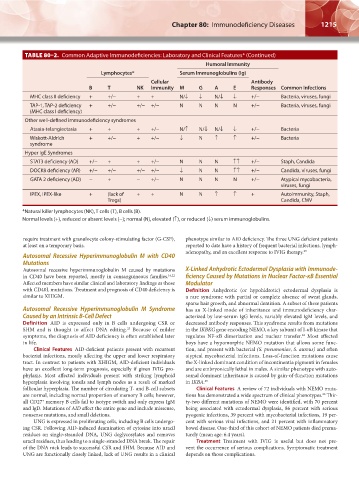
                   TABLE 80–2.  Common Adaptive Immunodeficiencies: Laboratory and Clinical Features* (Continued)
                                                                               Humoral Immunity
                                            Lymphocytes*               Serum Immunoglobulins (Ig)
                                                             Cellular                          Antibody
                                        B     T         NK   Immunity  M     G    A      E     Responses Common Infections
                     MHC class II deficiency  +  +/−    +    +         N/↓   ↓    N/↓    ↓     +/−       Bacteria, viruses, fungi
                      TAP-1, TAP-2 deficiency   +  +/−  +/−  +/−       N     N    N      N     +/−       Bacteria, viruses, fungi
                    (MHC class I deficiency)
                   Other well-defined immunodeficiency syndromes
                     Ataxia-telangiectasia  +  +        +    +/−       N/↑   N/↓  N/↓    ↓     +/−       Bacteria
                      Wiskott-Aldrich   +     +/−       +    +/−       ↓     N    ↑      ↑     +/−       Bacteria
                    syndrome
                   Hyper IgE Syndromes
                     STAT3 deficiency (AD)  +/−  +      +    +/−       N     N    N      ↑↑    +/−       Staph, Candida
                     DOCK8 deficiency (AR)  +/−  +/−    +/−  +/−       ↓     N    N      ↑↑    +/−       Candida, viruses, fungi
                     GATA 2 deficiency (AD)  −  +       −    +/−       N     N    N      N     +/−       Atypical mycobacteria,
                                                                                                         viruses, fungi
                     IPEX, IPEX-like    +     (lack of   +   +         N     N    ↑      ↑     +         Autoimmunity, Staph,
                                              Tregs)                                                     Candida, CMV
                  *Natural killer lymphocytes (NK), T cells (T), B cells (B).
                  Normal levels (+), reduced or absent levels (−); normal (N), elevated (↑), or reduced (↓) serum immunoglobulins.


                  require treatment with granulocyte colony-stimulating factor (G-CSF),   phenotype similar to AID deficiency. The three UNG deficient patients
                  at least on a temporary basis.                         reported to date have a history of frequent bacterial infections, lymph-
                                                                         adenopathy, and an excellent response to IVIG therapy. 23
                  Autosomal Recessive Hyperimmunoglobulin M with CD40
                  Mutations
                  Autosomal recessive hyperimmunoglobulin M caused by mutations   X-Linked Anhydrotic Ectodermal Dysplasia with Immunode-
                  in CD40 have been reported, mostly in consanguineous families. 16,22    ficiency Caused by Mutations in Nuclear Factor-κB Essential
                  Affected members have similar clinical and laboratory findings as those   Modulator
                  with CD40L mutations. Treatment and prognosis of CD40 deficiency is   Definition  Anhydrotic (or hypohidrotic) ectodermal dysplasia is
                  similar to XHIGM.                                      a rare syndrome with partial or complete absence of sweat glands,
                                                                         sparse hair growth, and abnormal dentition. A subset of these patients
                  Autosomal Recessive Hyperimmunoglobulin M Syndrome     has an X-linked mode of inheritance and immunodeficiency char-
                  Caused by an Intrinsic B-Cell Defect                   acterized by low-serum IgG levels, variably elevated IgM levels, and
                  Definition  AID is expressed only in B cells undergoing CSR or   decreased antibody responses. This syndrome results from mutations
                  SHM and is thought to affect DNA editing.  Because of milder   in the IKBKG gene encoding NEMO, a key subunit of I-κB kinase that
                                                     23
                  symptoms, the diagnosis of AID deficiency is often established later   regulates NF-κB dimerization and nuclear transfer.  Most affected
                                                                                                                24
                  in life.                                               boys have a hypomorphic NEMO mutation that allows some func-
                      Clinical Features  AID-deficient patients present with recurrent   tion, and present with bacterial (S. pneumoniae, S. aureus) and often
                  bacterial infections, mostly affecting the upper and lower respiratory   atypical mycobacterial infections. Loss-of-function mutations cause
                  tract. In contrast to patients with XHIGM, AID-deficient individuals   the X-linked dominant condition of incontinentia pigmenti in females
                  have an excellent long-term prognosis, especially if given IVIG pro-  and are embryonically lethal in males. A similar phenotype with auto-
                  phylaxis. Most affected individuals present with striking lymphoid   somal dominant inheritance is caused by gain-of-function mutations
                  hyperplasia involving tonsils and lymph nodes as a result of marked   in IKBA. 25
                  follicular hyperplasia. The number of circulating T- and B-cell subsets   Clinical Features  A review of 72 individuals with NEMO muta-
                  are normal, including normal proportion of memory B cells; however,   tions has demonstrated a wide spectrum of clinical phenotypes.  Thir-
                                                                                                                      26
                  all CD27  memory B cells fail to isotype switch and only express IgM   ty-two different mutations of NEMO were identified, with 70 percent
                        +
                  and IgD. Mutations of AID affect the entire gene and include missense,   being associated with ectodermal dysplasia, 86 percent with serious
                  nonsense mutations, and small deletions.               pyogenic infections, 39 percent with mycobacterial infections, 19 per-
                      UNG is expressed in proliferating cells, including B cells undergo-  cent with serious viral infections, and 21 percent with inflammatory
                  ing CSR. Following AID-induced deamination of cytosine into uracil   bowel disease. One-third of this cohort of NEMO patients died prema-
                  residues on single-stranded DNA, UNG deglycosylates and removes   turely (mean age: 6.4 years).
                  uracil residues, thus leading to a single-stranded DNA break. The repair   Treatment  Treatment with IVIG is  useful  but does not  pre-
                  of the DNA nick leads to successful CSR and SHM. Because AID and   vent the occurrence of serious complications. Symptomatic treatment
                  UNG are functionally closely linked, lack of UNG results in a clinical   depends on those complications.


          Kaushansky_chapter 80_p1211-1238.indd   1215                                                                  9/18/15   10:00 AM

