


Page 1354 - Williams Hematology ( PDFDrive )
P. 1354
1328  Part X:  Malignant Myeloid Diseases                                Chapter 86:  Primary Myelofibrosis          1329


                  STAT3 and STAT5, inhibit colony growth of cells harboring JAK2 and   Hydroxyurea can, inconsistently, decrease the size of the spleen and
                  MPL mutations, and to have therapeutic effects in a nude mouse model   liver, decrease or eliminate constitutional symptoms of night sweats or
                  of JAK2 V617F -induced myeloproliferative disease.  The effects of several   weight loss, and occasionally lead to an increase in hemoglobin con-
                                                    415
                  JAK2 inhibitors have been described. 416–418  Although their effects are   centration, a decrease of platelet counts, and a decrease in the degree
                  somewhat different, the most striking and consistent effect with each   of marrow fibrosis. Patients with myelofibrosis often do not have the
                  agent is a decrease in spleen size and reversal of constitutional symp-  marrow tolerance to chemotherapy of patients with other chronic mye-
                  toms. They often suppress blood cell counts, and thrombocytopenia can   loproliferative diseases. Hydroxyurea can be administered in doses of
                  be dose-limiting. At least initially, the anemia worsens although this   0.5 to 1.0 g/day or 1 to 2 g orally two to three times per week, depending
                  laboratory deterioration may be transient, lasting only for few months.   on the level of pretreatment blood cell counts. Patients should be evalu-
                  Typically, in spite of progression of anemia, most treated patients report   ated for dose adjustment at least every week for 1 month and, if appro-
                  decreased fatigue. The reduction in large spleen size and the improve-  priate, eventually extended to evaluation every 3 months. Although
                  ment in the quality of life of many patients have been dramatic and were   alkylating agents, especially busulfan and other cytotoxic agents, have
                  similar in those with and without a JAK2 mutation. This effect may be   been used successfully, they have largely been replaced by hydroxyurea.
                  explained by the drug’s ability to inhibit JAK1 and JAK2 isoforms, the   Use of alkylating agents has resurfaced with the suggestion that melpha-
                  former having a role in cytokine elaboration. These agents may decrease   lan or busulfan may be useful as therapy. 427,428
                  morbidity and mortality, prolonging survival (see “Course and Progno-
                  sis” below). 419–423                                  Thalidomide and Lenalidomide
                     In 2011, ruxolitinib, an oral JAK2 inhibitor, was approved by the   Thalidomide is poorly tolerated at optimal doses of approximately
                  FDA for use in patients with intermediate or high-risk myelofibrosis. It   800 mg/day. Most patients receive about half that amount and are
                  decreases spleen size, fatigue, night sweats, pruritus, and red cell trans-  tapered to the lowest effective dose. One study of 14 patients found
                  fusion requirements, and can result in weight gain in a significant pro-  the drug was not beneficial and had high toxicity rates.  Other stud-
                                                                                                                 429
                  portion of patients. The principal dose-limiting side effect is a decreased   ies found some decrease in spleen size and improvement in blood
                  platelet count. Although some patients may have worsened anemia or   hemoglobin and platelet counts in a minority of patients receiving up
                  neutropenia, the net effect often was beneficial, with improvement in   to 600 mg/day. 430,431  In subsequent studies, lower doses of thalidomide
                  fatigue and other symptoms. Headache, dizziness, and diarrhea also   (50 mg/day) coupled with prednisone were more tolerable and resulted
                  may occur but are usually manageable without discontinuing the drug.   in improvement of anemia and thrombocytopenia in about half of
                  After 6 months of treatment approximately 40 percent of treated patients   patients, with sustained improvement in some patients after treatment
                  have a significant decrease in spleen size and constitutional symptoms.   was stopped.  The thalidomide congener lenalidomide may supersede
                                                                                  432
                  The initial drug trials were limited to patients with a platelet count at the   thalidomide use. Lenalidomide has provided responses in a significant
                                                 9
                  initiation of ruxolitinib therapy of 100 × 10 /L; however, newer studies   minority of patients. 433–436  The drug can result in marked improvement
                  using lower starting doses of ruxolitinib and gradually incrementing   in hemoglobin concentration or avoidance of a requirement for trans-
                  those doses have indicated that patients with platelet counts of between   fusion (22 percent of patients treated), improvement in platelet count
                              9
                  50 and 100 × 10 /L may receive similar benefits from carefully incre-  (50 percent of patients treated), and decrease in spleen size (33 percent
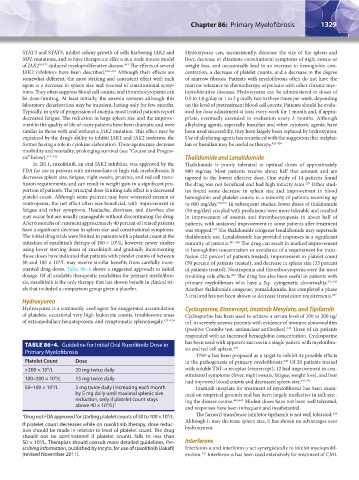
                  mented drug doses. Table 86–4 shows a suggested approach to initial   of patients treated). Neutropenia and thrombocytopenia were the most
                  dosage. Of all available therapeutic modalities for primary myelofibro-  troubling side effects.  The drug has also been useful in patients with
                                                                                        433
                  sis, ruxolitinib is the only therapy that has shown benefit in clinical tri-  primary myelofibrosis who have a 5q– cytogenetic abnormality. 435,436
                  als that included a comparison group given a placebo.  Another thalidomide congener, pomalidomide, has completed a phase
                                                                        3 trial and has not been shown to decrease transfusion requirements. 437
                  Hydroxyurea
                  Hydroxyurea is a commonly used agent for exaggerated accumulation   Cyclosporine, Etanercept, Imatinib Mesylate, and Tipifarnib
                  of platelets, occasional very high leukocyte counts, troublesome areas   Cyclosporine has been used to achieve a serum level of 100 to 200 ng/
                  of extramedullary hematopoiesis, and symptomatic splenomegaly. 424–426    mL in severely anemic patients with evidence of immune abnormalities
                                                                        (positive Coombs test, antinuclear antibodies).  Three of six patients
                                                                                                          438
                                                                        responded with an increased hemoglobin concentration. Cyclosporine
                   TABLE 86–4.  Guideline for Initial Oral Ruxolitinib Dose in   has been used with apparent success in a single patient with myelofibro-
                                                                                         439
                   Primary Myelofibrosis                                sis and red cell aplasia.
                                                                            TNF-α has been proposed as a target to inhibit its possible effects
                   Platelet Count   Dose                                in the pathogenesis of primary myelofibrosis.  Of 20 patients treated
                                                                                                         440
                   >200 × 10 /L     20 mg twice daily                   with soluble TNF-α receptor (etanercept), 12 had improvement in con-
                          9
                                                                        stitutional symptoms (fever, night sweats, fatigue, weight loss), and four
                             9
                   100–200 × 10 /L  15 mg twice daily
                                                                        had improved blood counts and decreased spleen size. 441,442
                   50–100 × 10 /L   5 mg twice daily (increasing each month   Imatinib mesylate for treatment of myelofibrosis has been exam-
                            9
                                    by 5 mg daily until maximal splenic size   ined on empirical grounds and has been largely ineffective in influenc-
                                    reduction, only if platelet count stays   ing the disease course. 442,443  Modest doses have not been well tolerated,
                                              9
                                    above 40 × 10 /L) *
                                                                        and responses have been infrequent and insubstantial.
                                                                                                                          444
                  * Drug not FDA approved for starting platelet counts of 50 to 100 × 10 /L.  The farnesyl transferase inhibitor tipifarnib is not well tolerated.
                                                                  9
                  If platelet count decreases while on ruxolitinib therapy, dose reduc-  Although it may decrease spleen size, it has shown no advantages over
                                                                        hydroxyurea.
                  tion should be made in relation to level of platelet count. The drug
                  should not be administered if platelet counts falls to less than
                        9
                  50 × 10 /L. Therapists should consult more detailed guidelines, Pre-  Interferons
                  scribing Information, published by Incyte, for use of ruxolitinib (Jakafi)   Interferon-α and interferon-γ act synergistically to inhibit myeloprolif-
                  (revised November 2011).                              eration.  Interferon-α has been used extensively for treatment of CML
                                                                              445
          Kaushansky_chapter 86_p1319-1340.indd   1329                                                                  9/18/15   10:24 AM

