


Page 1350 - Williams Hematology ( PDFDrive )
P. 1350
1324  Part X:  Malignant Myeloid Diseases                                Chapter 86:  Primary Myelofibrosis          1325


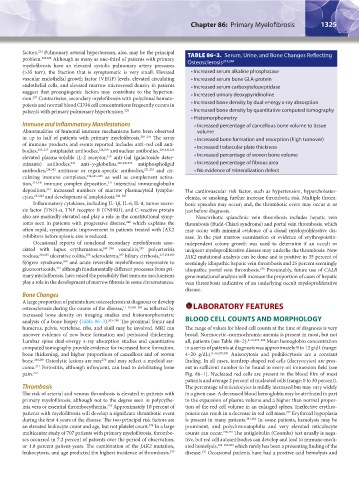
                  factors.  Pulmonary arterial hypertension, also, may be the principal   TABLE 86–3.  Serum, Urine, and Bone Changes Reflecting
                       224
                  problem. 225,226  Although as many as one-third of patients with primary   243,244
                  myelofibrosis have an elevated systolic pulmonary artery pressures    Osteosclerosis
                  (>35 torr), the fraction that is symptomatic is very small. Elevated   • Increased serum alkaline phosphatase
                  vascular endothelial growth factor (VEGF) levels, elevated circulating   • Increased serum bone GLA-protein
                  endothelial cells, and elevated marrow microvessel density in patients   • Increased serum carboxytelopeptidase
                  suggest that proangiogenic factors may contribute to the hyperten-  • Increased urinary deoxypyridinoline
                  sion.  Contrariwise, secondary myelofibrosis with polyclonal hemato-
                     227
                  poiesis and normal blood CD34 cell concentrations frequently occurs in   • Increased bone density by dual-energy x-ray absorption
                  patients with primary pulmonary hypertension. 228       • Increased bone density by quantitative computed tomography
                                                                          • Histomorphometry
                  Immune and Inflammatory Manifestations                   • Increased percentage of cancellous bone volume to tissue
                  Abnormalities of humoral immune mechanisms have been observed   volume
                  in up to half of patients with primary myelofibrosis. 229–234  The array   • Increased bone formation and resorption (high turnover)
                  of immune products and events reported includes anti–red cell anti-  • Increased trabecular plate thickness
                  bodies, 233–237  antiplatelet antibodies, 238,239  antinuclear antibodies, 229,230,234
                                              240
                  elevated plasma-soluble  IL-2  receptor,  anti-Gal  (galactoside  deter-  • Increased percentage of woven bone volume
                                  241
                  minants) antibodies,  anti–γ-globulins, 229,230,234  antiphospholipid   • Increased percentage of fibrous area
                  antibodies, 234,242   antitissue  or  organ-specific  antibodies, 231,233   and  cir-  • No evidence of mineralization defect
                  culating immune complexes, 234,243–245  as well as complement activa-
                  tion, 234,246  immune complex deposition,  interstitial immunoglobulin
                                              231
                          231
                  deposition,  increased numbers of marrow plasmacytoid lympho-  The cardiovascular risk factor, such as hypertension, hypercholester-
                  cytes, 231,243  and development of amyloidosis. 244–247  olemia, or smoking, further increase thrombotic risk. Multiple throm-
                     Inflammatory cytokines, including IL-1β, IL-6, IL-8, tumor necro-  botic episodes may occur; and, the thrombotic event may occur at or
                  sis factor (TNF)-α, TNF receptor II (TNFRII), and C-reactive protein   just before diagnosis.
                  also are markedly elevated and play a role in the constitutional symp-  Noncirrhotic splanchnic vein thrombosis includes hepatic vein
                                                     248
                  toms seen in patients with progressive disease,  which explains the   thrombosis (Budd-Chiari syndrome) and portal vein thrombosis, which
                  often rapid, symptomatic improvement in patients treated with JAK2   may occur with minimal evidence of a clonal myeloproliferative dis-
                  inhibitors before splenic size is reduced.            ease.  In  the past marrow  examination or  evidence of  erythropoietin-
                     Occasional reports of nonclonal secondary myelofibrosis asso-  independent colony growth was used to determine if an occult or
                                                         255
                  ciated with lupus  erythematosus, 249–254  vasculitis,  polyarteritis   incipient myeloproliferative disease may underlie the thrombosis. Now
                                                  257
                                       256
                  nodosa, 234,255  ulcerative colitis,  scleroderma,  biliary cirrhosis, 237,258,259    JAK2 mutational analysis can be done and is positive in 35 percent of
                  Sjögren syndrome,  and acute reversible myelofibrosis responsive to   seemingly idiopathic hepatic vein thrombosis and 25 percent seemingly
                               260
                  glucocorticoids,  although fundamentally different processes from pri-  idiopathic portal vein thrombosis.  Presumably, future use of CALR
                             261
                                                                                                  276
                  mary myelofibrosis, have raised the possibility that immune mechanisms   gene mutational analysis will increase the proportion of cases of hepatic
                  play a role in the development of marrow fibrosis in some circumstances.  vein thrombosis indicative of an underlying occult myeloproliferative
                                                                        disease.
                  Bone Changes
                  A large proportion of patients have osteosclerosis at diagnosis or develop
                  osteosclerosis during the course of the disease, 11–15,262–265  as reflected by   LABORATORY FEATURES
                  increased bone density on imaging studies and histomorphometric
                  analysis of a bone biopsy (Table 86–3). 263–268  The proximal femur and   BLOOD CELL COUNTS AND MORPHOLOGY
                  humerus, pelvis, vertebrae, ribs, and skull may be involved. MRI can   The range of values for blood cell counts at the time of diagnosis is very
                  uncover evidence of new bone formation and periosteal thickening.   broad. Normocytic–normochromic anemia is present in most, but not
                  Lumbar spine dual-energy x-ray absorption studies and quantitative   all, patients (see Table  86–2). 8–10,273–280  Mean hemoglobin concentration
                  computed tomography provide evidence for increased bone formation,   in a series of patients at diagnosis was approximately 9 to 12 g/dL (range:
                  bone thickening, and higher proportions of cancellous and of woven   4–20  g/dL). 8–16,279,280   Anisocytosis  and  poikilocytosis  are  a  constant
                                            270
                  bone. 268,269  Osteolytic lesions are rare  and may reflect a myeloid sar-  finding. In all cases, teardrop-shaped red cells (dacryocytes) are pres-
                  coma.  Periostitis, although infrequent, can lead to debilitating bone   ent in sufficient number to be found in every oil immersion field (see
                      271
                  pain. 272                                             Fig. 86–1). Nucleated red cells are present in the blood film of most
                                                                        patients and average 2 percent of nucleated cells (range: 0 to 30 percent).
                  Thrombosis                                            The percentage of reticulocytes is mildly increased but may vary widely
                  The risk of arterial and venous thrombosis is elevated in patients with   in a given case. A decreased blood hemoglobin may be attributed in part
                  primary myelofibrosis, although not to the degree seen in polycythe-  to the expansion of plasma volume and a higher than normal propor-
                                              273
                  mia vera or essential thrombocythemia.  Approximately 10 percent of   tion of the red cell volume in an enlarged spleen. Ineffective erythro-
                                                                                                          277
                  patients with myelofibrosis will develop a significant thrombotic event   poiesis can result in a decrease in red cell mass.  Erythroid hypoplasia
                  during the first 4 years of the disease. The two principal risk factors are   is present in many patients. 281,282  In some patients, hemolysis may be
                                                            274
                  an elevated leukocyte count and age, but not platelet count.  In a large   prominent, and polychromatophilia and very elevated reticulocyte
                  multicenter study of 707 patients with primary myelofibrosis, thrombo-  counts can occur. 278,279  The antiglobulin (Coombs) test usually is nega-
                  ses occurred in 7.2 percent of patients over the period of observation,   tive, but red cell autoantibodies can develop and lead to immune-medi-
                  or 1.8 percent patient-years. The combination of the JAK2 mutation,   ated hemolysis, 234–236,283  which rarely has been a presenting finding of the
                                                                   275
                                                                              236
                  leukocytosis, and age predicted the highest incidence of thrombosis.     disease.  Occasional patients have had a positive acid hemolysis and


          Kaushansky_chapter 86_p1319-1340.indd   1325                                                                  9/18/15   10:23 AM

