


Page 1381 - Williams Hematology ( PDFDrive )
P. 1381
1356           Part X:  Malignant Myeloid Diseases                                                                                                                               Chapter 87:  Myelodysplastic Syndromes          1357


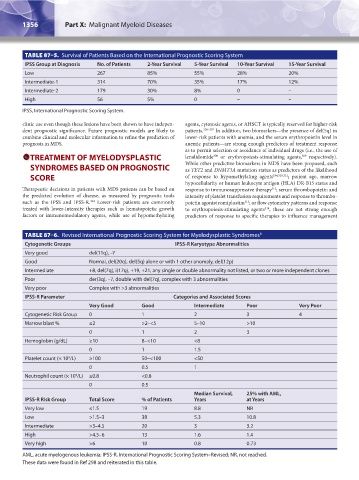
                TABLE 87–5.  Survival of Patients Based on the International Prognostic Scoring System
                IPSS Group at Diagnosis  No. of Patients  2-Year Survival  5-Year Survival  10-Year Survival  15-Year Survival
                Low                     267              85%             55%           28%               20%
                Intermediate-1          314              70%             35%           17%               12%
                Intermediate-2          179              30%             8%            0                 –
                High                    56               5%              0             –                 –

               IPSS, International Prognostic Scoring System.

               clinic use even though these lesions have been shown to have indepen-  agents, cytotoxic agents, or AHSCT is typically reserved for higher-risk
               dent prognostic significance. Future prognostic models are likely to   patients. 305–307  In addition, two biomarkers—the presence of del(5q) in
               combine clinical and molecular information to refine the prediction of   lower-risk patients with anemia, and the serum erythropoietin level in
               prognosis in MDS.                                      anemic patients—are strong enough predictors of treatment response
                                                                      as to permit selection or avoidance of individual drugs (i.e., the use of
                    TREATMENT OF MYELODYSPLASTIC                      lenalidomide  or erythropoiesis-stimulating agents,  respectively).
                                                                               308
                                                                                                             309
                  SYNDROMES BASED ON PROGNOSTIC                       While other predictive biomarkers in MDS have been proposed, such
                                                                      as TET2 and DNMT3A mutation status as predictors of the likelihood
                  SCORE                                               of response to hypomethylating agents 194,310,311 ; patient age, marrow
                                                                      hypocellularity or human leukocyte antigen (HLA) DR-B15 status and
               Therapeutic decisions in patients with MDS patients can be based on   response to immunosuppressive therapy ; serum thrombopoietin and
                                                                                                   312
               the predicted evolution of disease, as measured by prognostic tools   intensity of platelet transfusion requirements and response to thrombo-
                                      304
               such  as  the  IPSS  and  IPSS-R.   Lower-risk  patients  are  commonly   poietin agonist romiplostim ; or flow cytometry patterns and response
                                                                                          313
               treated with  lower-intensity  therapies  such  as hematopoietic  growth   to erythropoiesis-stimulating agents , these  are not strong  enough
                                                                                                 314
               factors or immunomodulatory agents, while use of hypomethylating   predictors of response to specific therapies to influence management
                TABLE 87–6.  Revised International Prognostic Scoring System for Myelodysplastic Syndromes 8
                Cytogenetic Groups                                 IPSS-R Karyotype Abnormalities
                Very good             del(11q), –Y
                Good                  Normal, del(20q), del(5q) alone or with 1 other anomaly, del(12p)
                Intermediate          +8, del(7q), i(17q), +19, +21, any single or double abnormality not listed, or two or more independent clones
                Poor                  der(3q), –7, double with del(7q), complex with 3 abnormalities
                Very poor             Complex with >3 abnormalities
                IPSS-R Parameter                                  Categories and Associated Scores
                                      Very Good        Good              Intermediate      Poor             Very Poor
                Cytogenetic Risk Group  0              1                 2                 3                4
                Marrow blast %        ≤2               >2–<5             5–10              >10
                                      0                1                 2                 3
                Hemoglobin (g/dL)     ≥10              8–<10             <8
                                      0                1                 1.5
                Platelet count (× 10 /L)  ≥100         50–<100           <50
                               9
                                      0                0.5               1
                Neutrophil count (× 10 /L)  ≥0.8       <0.8
                                 9
                                      0                0.5
                                                                         Median Survival,   25% with AML,
                IPSS-R Risk Group     Total Score      % of Patients     Years             at Years
                Very low              ≤1.5             19                8.8               NR
                Low                   >1.5–3           38                5.3               10.8
                Intermediate          >3–4.5           20                3                 3.2
                High                  >4.5–6           13                1.6               1.4
                Very high             >6               10                0.8               0.73

               AML, acute myelogenous leukemia; IPSS-R, International Prognostic Scoring System–Revised; NR, not reached.
               These data were found in Ref 298 and reiterated in this table.


          Kaushansky_chapter 87_p1341-1372.indd   1356                                                                  9/21/15   11:06 AM

