


Page 1380 - Williams Hematology ( PDFDrive )
P. 1380
1354  Part X:  Malignant Myeloid Diseases                           Chapter 87:  Myelodysplastic Syndromes           1355


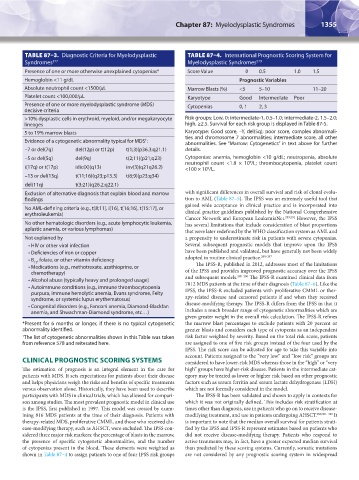
                   TABLE 87–3.  Diagnostic Criteria for Myelodysplastic   TABLE 87–4.  International Prognostic Scoring System for
                   Syndromes 577                                         Myelodysplastic Syndromes 579
                   Presence of one or more otherwise unexplained cytopenias*  Score Value    0   0.5         1.0   1.5
                  Hemoglobin <11 g/dL                                                      Prognostic Variables
                  Absolute neutrophil count <1500/μL                     Marrow Blasts (%)  <5   5–10              11–20
                  Platelet count <100,000/μL                             Karyotype         Good  Intermediate  Poor
                  Presence of one or more myelodysplastic syndrome (MDS)    Cytopenias     0, 1  2, 3
                  decisive criteria
                  >10% dysplastic cells in erythroid, myeloid, and/or megakaryocyte   Risk groups: Low, 0; intermediate-1, 0.5–1.0; intermediate-2, 1.5–2.0;
                  lineages                                              high, ≥2.5. Survival for each risk group is displayed in Table 87-5.
                  5 to 19% marrow blasts                                Karyotype: Good score, –Y, del(5q); poor score, complex abnormali-
                  Evidence of a cytogenetic abnormality typical for MDS : †  ties and chromosome 7 abnormalities; intermediate score, all other
                                                                        abnormalities. See “Marrow: Cytogenetics” in text above for further
                   –7 or del(7q)    del(12p) or t(12p)  t(1;3)(p36.3;q21.1)  details.
                   –5 or del(5q)    del(9q)          t(2;11)(p21;q23)   Cytopenias: anemia, hemoglobin <10 g/dL; neutropenia, absolute
                                                                        neutrophil count <1.8 × 10 /L; thrombocytopenia, platelet count
                                                                                              9
                   i(17q) or t(17p)  idic(X)(q13)    inv(3)(q21q26.2)   <100 × 10 /L.
                                                                                9
                   –13 or del(13q)  t(11;16)(q23;p13.3)  t(6;9)(p23;q34)
                   del(11q)         t(3;21)(q26.2;q22.1)
                   Exclusion of alternative diagnosis that explain blood and marrow   with significant differences in overall survival and risk of clonal evolu-
                   findings                                             tion to AML (Table 87–5). The IPSS was an extremely useful tool that
                                                                        gained wide acceptance in clinical practice and is incorporated into
                   No AML-defining criteria (e.g., t[8;11], i[16], t[16;16], t[15:17], or
                   erythroleukemia)                                     clinical practice guidelines published by the National Comprehensive
                                                                        Cancer Network and European LeukemiaNet. 293,294  However, the IPSS
                   No other hematologic disorders (e.g., acute lymphocytic leukemia,   has several limitations that include consideration of blast proportions
                   aplastic anemia, or various lymphomas)               that were later redefined by the WHO classification system as AML and
                   Not explained by                                     a propensity to underestimate risk in patients with severe cytopenias.
                    • HIV or other viral infection                      Several subsequent prognostic models that improve upon the IPSS
                    • Deficiencies of iron or copper                    have been published and validated, but have generally not been widely
                    • B , folate, or other vitamin deficiency           adopted in routine clinical practice. 295–297
                      12                                                    The IPSS-R, published in 2012, addresses most of the limitations
                    • Medications (e.g., methotrexate, azathioprine, or
                     chemotherapy)                                      of the IPSS and provides improved prognostic accuracy over the IPSS
                    • Alcohol abuse (typically heavy and prolonged usage)  and subsequent models. 298–300  The IPSS-R examined clinical data from
                                                                        7012 MDS patients at the time of their diagnosis (Table 87–6). Like the
                    • Autoimmune conditions (e.g., immune thrombocytopenia   IPSS, the IPSS-R excluded patients with proliferative CMML or ther-
                     purpura, immune hemolytic anemia, Evans syndrome, Felty
                     syndrome, or systemic lupus erythematosus)         apy-related disease and censored patients if and when they received
                    • Congenital disorders (e.g., Fanconi anemia, Diamond-Blackfan   disease-modifying therapy. The IPSS-R differs from the IPSS in that it
                     anemia, and Shwachman-Diamond syndrome, etc…)      includes a much broader range of cytogenetic abnormalities which are
                                                                        given greater weight in the overall risk calculation. The IPSS-R refines
                  *Present for 6 months or longer, if there is no typical cytogenetic   the marrow blast percentages to exclude patients with 20 percent or
                  abnormality identified.                               greater blasts and considers each type of cytopenia as an independent
                  † The list of cytogenetic abnormalities shown in this Table was taken   risk factor weighted by severity. Based on the total risk score, patients
                  from reference 578 and reiterated here.               are assigned to one of five risk groups instead of the four used by the
                                                                        IPSS. The risk score can be adjusted for age to take this variable into
                                                                        account. Patients assigned to the “very low” and “low risk” groups are
                  CLINICAL PROGNOSTIC SCORING SYSTEMS                   considered to have lower-risk MDS whereas those in the “high” or “very
                  The estimation of prognosis is an integral element in the care for   high” groups have higher-risk disease. Patients in the intermediate cat-
                  patients with MDS. It sets expectations for patients about their disease   egory may be treated as lower or higher risk based on other prognostic
                  and helps physicians weigh the risks and benefits of specific treatments   factors such as serum ferritin and serum lactate dehydrogenase (LDH)
                  versus observation alone. Historically, they have been used to describe   which are not formally considered in the model.
                  participants with MDS in clinical trials, which has allowed for compari-  The IPSS-R has been validated and shown to apply in contexts for
                  son among studies. The most prevalent prognostic model in clinical use   which it was not originally defined. This includes risk stratification at
                  is the IPSS, first published in 1997. This model was created by exam-  times other than diagnosis, use in patients who go on to receive disease-
                  ining 816 MDS patients at the time of their diagnosis. Patients with   modifying treatment, and use in patients undergoing AHSCT. 299,301–303  It
                  therapy-related MDS, proliferative CMML, and those who received dis-  is important to note that the median overall survival for patients strati-
                  ease-modifying therapy, such as AHSCT, were excluded. The IPSS con-  fied by the IPSS and IPSS-R represent estimates based on patients who
                  sidered three major risk markers: the percentage of blasts in the marrow,   did not receive disease-modifying therapy. Patients who respond to
                  the presence of specific cytogenetic abnormalities, and the number   active treatments may, in fact, have a greater expected median survival
                  of cytopenias present in the blood. These elements were weighted as   than predicted by these scoring systems. Currently, somatic mutations
                  shown in Table 87–4 to assign patients to one of four IPSS risk groups   are not considered by any prognostic scoring system in widespread


          Kaushansky_chapter 87_p1341-1372.indd   1355                                                                  9/21/15   11:06 AM

