


Page 1427 - Williams Hematology ( PDFDrive )
P. 1427
1402           Part X:  Malignant Myeloid Diseases                                                                                                                           Chapter 88:  Acute Myelogenous Leukemia             1403


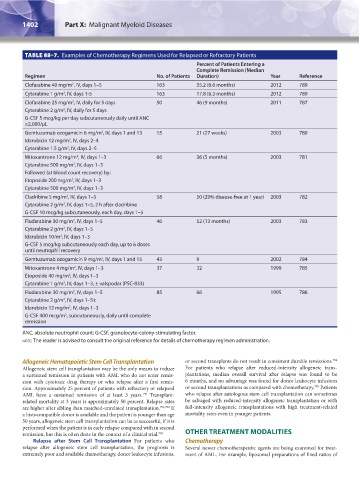
                TABLE 88–7.  Examples of Chemotherapy Regimens Used for Relapsed or Refractory Patients
                                                                          Percent of Patients Entering a
                                                                          Complete Remission (Median
                Regimen                                     No. of Patients  Duration)             Year     Reference
                Clofarabine 40 mg/m , IV, days 1–5          163           35.2 (6.6 months)        2012     789
                                2
                Cytarabine 1 g/m , IV, days 1-5             163           17.8 (6.3 months)        2012     789
                             2
                Clofarabine 25 mg/m , IV, daily for 5 days  50            46 (9 months)            2011     787
                                2
                Cytarabine 2 g/m , IV, daily for 5 days
                             2
                G-CSF 5 mcg/kg per day subcutaneously daily until ANC
                ≥2,000/μL
                Gemtuzumab ozogamicin 6 mg/m , IV, days 1 and 13  15      21 (27 weeks)            2003     780
                                          2
                Idarubicin 12 mg/m , IV, days 2–4
                               2
                              2
                Cytarabine 1.5 g/m , IV, days 2–5
                Mitoxantrone 12 mg/m , IV, days 1–3         66            36 (5 months)            2003     781
                                  2
                Cytarabine 500 mg/m , IV, days 1–3
                                2
                Followed (at blood count recovery) by:
                Etoposide 200 mg/m , IV, days 1–3
                                2
                Cytarabine 500 mg/m , IV, days 1–3
                                2
                Cladribine 5 mg/m , IV, days 1–5            58            50 (29% disease-free at 1 year)  2003  782
                              2
                Cytarabine 2 g/m , IV, days 1–5, 2 h after cladribine
                             2
                G-CSF 10 mcg/kg subcutaneously, each day, days 1–5
                Fludarabine 30 mg/m , IV, days 1–5          46            52 (13 months)           2003     783
                                2
                Cytarabine 2 g/m , IV, days 1–5
                             2
                Idarubicin 10/m , IV, days 1–3
                            2
                G-CSF 5 mcg/kg subcutaneously each day, up to 6 doses
                until neutrophil recovery
                                          2
                Gemtuzumab ozogamicin 9 mg/m , IV, days 1 and 15  43      9                        2002     784
                Mitoxantrone 4 mg/m , IV, days 1–3          37            32                       1999     785
                                 2
                Etoposide 40 mg/m , IV, days 1–3
                               2
                Cytarabine 1 g/m , IV, days 1–3, ± valspodar (PSC-833)
                             2
                Fludarabine 30 mg/m , IV, days 1–5          85            66                       1995     786
                                2
                Cytarabine 2 g/m , IV, days 1–5±
                             2
                Idarubicin 12 mg/m , IV, days 1–3
                               2
                G-CSF 400 mcg/m , subcutaneously, daily until complete
                              2
                remission
               ANC, absolute neutrophil count; G-CSF, granulocyte-colony-stimulating factor.
               note: The reader is advised to consult the original reference for details of chemotherapy regimen administration.
                                                                                                                       794
               Allogeneic Hematopoietic Stem Cell Transplantation     or second transplants do not result in consistent durable remissions.
               Allogeneic stem cell transplantation may be the only means to induce   For patients who relapse after reduced-intensity allogeneic trans-
               a sustained remission in patients with AML who do not enter remis-  plantations, median overall survival after relapse was found to be
               sion with cytotoxic drug therapy or who relapse after a first remis-  6 months, and no advantage was found for donor leukocyte infusions
                                                                                                                 795
               sion. Approximately 25 percent of patients with refractory or relapsed   or second transplantations as compared with chemotherapy.  Patients
               AML have a sustained remission of at least 3 years.  Transplant-   who relapse after autologous stem cell transplantation can sometimes
                                                        790
               related mortality at 3 years is approximately 50 percent. Relapse rates   be salvaged with reduced-intensity allogeneic transplantation or with
               are higher after sibling than matched-unrelated transplantation. 791,792  If   full-intensity allogeneic transplantations with high treatment-related
               a histocompatible donor is available and the patient is younger than age     mortality rates even in younger patients.
               50 years, allogeneic stem cell transplantation can be as successful, if it is
               performed when the patient is in early relapse compared with in second
               remission, but this is often done in the context of a clinical trial. 793  OTHER TREATMENT MODALITIES
                   Relapse after Stem Cell  Transplantation  For patients who   Chemotherapy
               relapse  after  allogeneic  stem  cell  transplantation,  the  prognosis  is   Several newer chemotherapeutic agents are being examined for treat-
               extremely poor and available chemotherapy, donor leukocyte infusions,   ment of AML. For example, liposomal preparations of fixed ratios of


          Kaushansky_chapter 88_p1373-1436.indd   1402                                                                  9/21/15   11:02 AM

