


Page 1487 - Williams Hematology ( PDFDrive )
P. 1487
1462           Part X:  Malignant Myeloid Diseases                                                                                                   Chapter 89:  Chronic Myelogenous Leukemia and Related Disorders             1463


               the drugs be used? Should they only be started in cases of molecular   TABLE 89–7.  Chronic Myelogenous Leukemia: 5-Year
               relapse? How can they be best combined with DLI in cases of relapse?
                                                                       Period Relative Survival Rates (2004–2012) by Age at
                                                                       Diagnosis
               IMMUNOTHERAPY: ADOPTIVE CELL THERAPY
               FOR POSTTRANSPLANTATION RELAPSE                         Age (years)                   Percent of Patients*
                                                                                                     86
                                                                       <45
               Substantial evidence indicates that the effectiveness of allografting in
               CML does not result solely from the eradication of the leukemic clone   45–54         82
               with high-dose chemoradiotherapy conditioning regimens, but also   55–64              70
               from adoptive immunotherapy provided by lymphocytes in the allog-  65–74              51
               raft, the graft-versus-leukemia effect (see “Myeloablative Allogeneic
                              707
               Transplants” above).  This phenomenon has been recreated to produce   <75             27
               a therapeutic response by infusing the lymphocytes from the stem cell   *Percent rounded to nearest whole number.
               donor after a relapse following allogeneic stem cell transplantation. 708,709
               The overall response rate to DLI is approximately 75 percent. The   Data from Surveillance, Epidemiology, End Results Cancer Statistics:
                                                                      5-Year Survival Rates, Table 13.6, All Races and Sexes. National Cancer
               response rate is higher when this approach is used early after detecting   Institute, Washington, DC. Available at http://www.seer.cancer.gov.
                            710
               a relapse by PCR,  compared to use after a hematologic or cytogenetic
               relapse. Patients with a short interval between transplantation and DLI
               have a higher probability of response than patients with longer inter-
                                                                 711
               vals. Responses are the same with related versus unrelated donors.    molecular response, progression-free, and overall survival to those who
                                                                                                   724
               Some patients show a very rapid decline of BCR-ABL1 transcript levels     achieve  a cytogenetic remission sooner.  In  patients  with failure  to
               (<6 months after DLI), whereas other patients demonstrate PCR nega-  respond or intolerance to imatinib the estimated 3-year survival rate
               tivity only over a longer period.  The responses to DLI can be durable.    was approximately 70 percent for patients in chronic phase. Survival
                                                                 713
                                     712
               Molecular responses can occur in up to two-thirds of patients. 714  in chronic phase was better when subsequent therapy was nilotinib or
                   The main toxicities of DLI have been the induction of GVHD   dasatinib as compared to allogeneic hematopoietic stem cell transplan-
               and myelosuppression. Chronic GVHD can occur in up to 60 percent   tation or to others agents. This result was at a median followup of 2
                                                                          725
                     715
               of cases.  Attempts to diminish these toxicities have included use of   years.  Older patients have lower response rates when treated in late
               CD8-depleted DLIs and infusion of smaller numbers of T cells. 716,717    chronic phase, but if they attain a CCyR, no difference was found in the
                                                                                          724
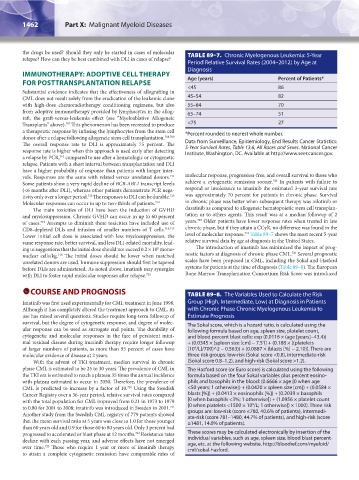
               Lower  initial  cell  dose  is  associated  with less  myelosuppression,  the   level of molecular response.  Table 89–7 shows the most recent 5-year
               same response rate, better survival, and less DLI-related mortality, lead-  relative survival data by age at diagnosis in the United States.
                                                             8
               ing to suggestions that the initial dose should not exceed 0.2 × 10  mono-  The introduction of imatinib has minimized the impact of prog-
                                                                                                          726
                           718
               nuclear cells/kg.  The initial doses should be lower when matched   nostic factors at diagnosis of chronic phase CML.  Several prognostic
               unrelated donors are used. Immune suppression should first be tapered   scales have been proposed in CML, including the Sokal and Hasford
               before DLIs are administered. As noted above, imatinib may synergize   systems for patients at the time of diagnosis (Table 89–8). The European
               with DLI to foster rapid molecular responses after relapse. 719  Bone Marrow Transplantation Consortium Risk Score was introduced
                  COURSE AND PROGNOSIS                                 TABLE 89–8.  The Variables Used to Calculate the Risk
               Imatinib was first used experimentally for CML treatment in June 1998.   Group (High, Intermediate, Low) at Diagnosis in Patients
               Although it has completely altered the treatment approach to CML, its   with Chronic Phase Chronic Myelogenous Leukemia to
               use has raised several questions. Studies require long-term followup of   Estimate Prognosis
               survival, but the degree of cytogenetic response, and degree of molec-  The Sokal score, which is a hazard ratio, is calculated using the
               ular response can be used as surrogate end points. The durability of   following formula based on age, spleen size, platelet count,
               cytogenetic  and molecular  responses  in  the  face  of  persistent  mini-  and blood percent blast cells: exp (0.0116 × (age [years]−43.4))
               mal residual disease during imatinib therapy require longer followup   + (0.0345 × (spleen size [cm] − 7.51) + (0.188 × ((platelets
                                                                         9
               of larger numbers of patients, as more than 95 percent of cases have   [10 /L]/700)^2 − 0.563)) + (0.0887 × (blasts [%] − 2.10)). There are
               molecular evidence of disease at 2 years.               three risk groups: low-risk (Sokal score <0.8), intermediate-risk
                   With the advent of TKI treatment, median survival in chronic   (Sokal score 0.8–1.2), and high-risk (Sokal score >1.2).
               phase CML is estimated to be 25 to 30 years. The prevalence of CML in   The Hasford score (or Euro score) is calculated using the following
               the TKI era is estimated to reach a plateau 35 times the annual incidence   formula based on the four Sokal variables plus percent eosino-
               with plateau estimated to occur in 2050. Therefore, the prevalence of   phils and basophils in the blood: (0.6666 × age [0 when age
               CML is predicted to increase by a factor of 10.  Using the Swedish   <50 years; 1 otherwise]) + (0.0420 × spleen size [cm]) + (0.0584 ×
                                                   720
               Cancer Registry over a 36-year period, relative survival rates compared   blasts [%]) + (0.0413 × eosinophils [%]) + (0.2039 × basophils
               with the total population for CML improved from 0.21 in 1973 to 1979   [0 when basophils <3%; 1 otherwise]) + (1.0956 × platelet count
                                                                                            9
               to 0.80 for 2001 to 2008; imatinib was introduced in Sweden in 2001.    [0 when platelets <1500 × 10 /L; 1 otherwise]) × 1000). Three risk
                                                                 721
               Another study from the Swedish CML registry of 779 patients showed   groups are: low-risk (score ≤780, 40.6% of patients), intermedi-
                                                                       ate-risk (score 781–1480, 44.7% of patients), and high-risk (score
               that the mean survival ratio at 5 years was close to 1.0 for those younger   ≥1481, 14.6% of patients).
               than 60 years old and 0.9 for those 60 to 80 years old. Only 3 percent had
                                                     722
               progressed to accelerated or blast phase at 12 months.  Resistance rates   These scores may be calculated electronically by insertion of the
               decline with each passing year, and adverse effects have not emerged   individual variables, such as age, spleen size, blood blast percent-
                                                                       age, etc. at the following website. http://bloodref.com/myeloid/
                       723
               over time.  Those who require 1 year or more of imatinib therapy   cml/sokal-hasford.
               to attain a complete cytogenetic remission have comparable rates of


          Kaushansky_chapter 89_p1437-1490.indd   1462                                                                  9/18/15   3:42 PM

