


Page 1482 - Williams Hematology ( PDFDrive )
P. 1482
1456  Part X:  Malignant Myeloid Diseases  Chapter 89:  Chronic Myelogenous Leukemia and Related Disorders           1457


                                                                                                                  554
                                        538
                                                                                                                          555
                                                                                  553
                  have a proliferative advantage.  Some of these mutations may lie out-  proliferation.  These include heat shock protein (hsp) 70,  survivin,
                                                                                 556
                  side the kinase domain, and more than 40 such mutations have been   LYN kinase,  SRC,  and GRB2, among others. 558
                                                                                       557
                  described. Screening early phase CML patients for mutations before   Dose escalation, combination therapy, and treatment interruption
                  the start of imatinib therapy is not cost-effective because of their low   have been proposed as means to overcome drug resistance.  Combina-
                                                                                                                  559
                  incidence, but in patients with evidence of an increase in CML cells   tion therapy from the outset  also has been proposed to prevent devel-
                                                                                             560
                  while on imatinib, mutation searches are indicated.  BCR-ABL1 kinase   opment of resistance. Treatment interruption to stop clonal selection
                                                      539
                                                                                                  557
                  domain point mutations are rare in those who have had good cytoge-  of resistant cells has been proposed.  Gene-expression profiles may be
                  netic responses to imatinib, and when detected in that setting, their   useful to predict the clinical effectiveness of imatinib for CML treatment,
                                                                                                                  560
                  presence does not always predict relapse.  Mutations in the ABL1 por-  thereby allowing individualized therapy from the outset.  In patients
                                               540
                  tion of the BCR-ABL1 oncogene are present in approximately 40 per-  with relapse or resistance, alternative approaches include increasing the
                                                                                                                  561
                  cent of patients who do not achieve a CHR or CCyR to imatinib. ABL1   dose of imatinib or switching to dasatinib or nilotinib.  Allogeneic
                  mutations were found in those patients with both primary and acquired   hematopoietic stem cell transplantation is not recommended unless
                  resistance. Amino acid substitutions in seven residues accounted for   patients have inadequate response or intolerance to multiple TKIs or
                  85 percent of all mutations associated with resistance.  The mutations   have the T315I mutation. Mutational analysis is not recommended at
                                                        541
                  most associated with resistance are Thr315ILe, Gly250Glu, Glu255Lys,   diagnosis but is of help in selecting TKI therapy for patients with an
                  and Thr253His substitutions. Few of the described mutations directly   inadequate initial response or loss of response to TKI therapy. Mutation
                  affect imatinib binding.  Mutations in the ABL1–ATP phosphate-bind-  type may dictate choice of the next TKI. 562
                                  542
                                                                   543
                  ing loop (P-loop) are most closely associated with a poor prognosis,    Management of Resistance
                  and these P-loop mutations predict for disease progression. Overall sur-  Dose Escalation  If the patient is on imatinib, 400 mg/day, dose escala-
                  vival is worse for P-loop and for T315I mutations, but not significantly   tion to 800 mg/day can be tried. This may be most efficacious in patients
                  different when other mutations are present. 544       with cytogenetic relapse who had achieved a cytogenetic response with
                     Ultra-deep sequencing approaches have shown that routine Sanger   the initial dose of imatinib, but is not likely to benefit those who have
                  sequencing underestimates BCR-ABL1 mutation in 55 percent of sam-  not had a cytogenetic response with imatinib at 400 mg/day.
                                                        545
                  ples where the missed mutations had low abundance.  Mass spectrom-  Second-Generation  Tyrosine  Kinase  Inhibitor  Therapy  Several
                                                                546
                  etry can detect a 0.05 to 0.5 percent level of mutations, as well.  For   TKIs are approved for use in the case of imatinib resistance or intol-
                  many mutations, the concentration that inhibits 50 percent (IC ) of   erance. In general, outcome with each is comparable, so the choice of
                                                                 50
                  various TKIs and response have not been documented. 547  agent often depends on its side-effect profile or in some cases on muta-
                     Second-generation BCR-ABL1 inhibitors (see “Dasatinib and   tion type (see Tables  89–2 and 89–6). 562
                  Nilotinib” below) are able to overcome imatinib-resistant mutants, with   The 3-month molecular response after initiation of a second TKI
                  the exception of the T315I mutations (Table 89–6). Mutations F317L   is also a predictor of overall and event-free survival for those patients in
                  and V299L are resistant to dasatinib and mutations Y253H, E255K, and   chronic phase when switched from imatinib to another TKI.  A BCR-
                                                                                                                    505
                  F359I are resistant to nilotinib. Ponatinib was active against T315I and   ABL1 level of 10 percent or less at 3 months is desirable. In patients
                  against other BCR-ABL1 mutations resistant to dasatinib or nilotinib.    treated with nilotinib after imatinib resistance or intolerance, the 4-year
                                                                   548
                  Ponatinib may be effective against individual ABL1 point mutations but   progression-free and overall survival was 85 and 95 percent, respec-
                  may not overcome some compound mutations, which are two or more   tively, if BCR-ABL1 transcripts were 10 percent or less as compared to
                  mutations in the same BCR/ABL1 molecule. Some mutations may be   42 and 71 percent for those with BCR-ABL1 transcripts greater than
                  polyclonal as well.  The T315I mutation results in steric hindrance,   10 percent at 3 months. 563
                               549
                  which precludes access of some TKIs to the ATP-binding pocket of the   Either dasatinib or nilotinib can be used in cases of imatinib resis-
                  ABL1 kinase domain.  In a series of 27 patients with T315I mutation,   tance or intolerance. Dasatinib is 325-fold more potent than imatinib;
                                 550
                  survival was dependent on stage of disease, with many of the chronic   and, as a dual inhibitor of SRC and ABL1 kinases, dasatinib is able to
                                                         551
                  phase patients described as having an indolent course.  In addition to   bind to BCR-ABL1 with less-stringent conformational requirements.
                                                                                                                          564
                  ponatinib, agents such as IFN-α and homoharringtonine have also been   In patients resistant to imatinib, dasatinib, 140 mg/day (70 mg q12h),
                  proposed as therapy for those with the T315I mutation. 552  resulted in a higher proportion of MCyR, CCyR, and MMR than did
                     In some cases of resistance associated with imatinib, other signal   800 mg/day (400 mg q12h) of imatinib. Treatment failure was decreased
                                                                                                                    565
                  pathways independent of BCR-ABL1 may become important in cell   and progression-free survival was improved with dasatinib.  Unlike
                                                                        imatinib, dasatinib penetrates the blood–brain barrier.  In long-term
                                                                                                                566
                                                                        followup of 670 patients with imatinib-resistant or intolerant CML,
                                                                        treated with various doses of dasatinib, 28 percent of patients remained
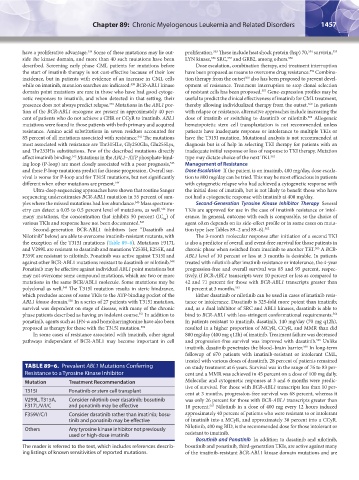
                   TABLE 89–6.  Prevalent ABL1 Mutations Conferring     on study treatment at 6 years. Survival was in the range of 76 to 83 per-
                   Resistance to a Tyrosine Kinase Inhibitor            cent and a MMR was achieved in 45 percent on a dose of 100 mg daily.
                   Mutation      Treatment Recommendation               Molecular and cytogenetic responses at 3 and 6 months were predic-
                                                                        tive of survival. For those with BCR-ABL1 transcripts less than 10 per-
                   T315I         Ponatinib or stem cell transplant
                                                                        cent at 3 months, progression-free survival was 68 percent, whereas it
                   V299L, T315A,   Consider nilotinib over dasatinib; bosutinib   was only 26 percent for those with BCR-ABL1 transcripts greater than
                   F317L/V/I/C   and ponatinib may be effective         10 percent.  Nilotinib in a dose of 400 mg every 12 hours induced
                                                                                 567
                   F359V/C/I     Consider dasatinib rather than imatinib; bosu-  approximately 40 percent of patients who were resistant to or intolerant
                                 tinib and ponatinib may be effective   of imatinib into a MCyR, and approximately 30 percent into a CCyR.
                                                                        Nilotinib, 400 mg BID, is the recommended dose for those intolerant or
                   Others        Any tyrosine kinase inhibitor not previously
                                 used or high-dose imatinib             resistant to imatinib.
                                                                            Bosutinib and Ponatinib  In addition to dasatinib and nilotinib,
                  The reader is referred to the text, which includes references describ-  bosutinib and ponatinib, third-generation TKIs, are active against many
                  ing listings of known sensitivities of reported mutations.  of the imatinib-resistant BCR-ABL1 kinase domain mutations and are
          Kaushansky_chapter 89_p1437-1490.indd   1457                                                                  9/18/15   3:42 PM

