


Page 1869 - Williams Hematology ( PDFDrive )
P. 1869
1844           Part XII:  Hemostasis and Thrombosis                                                                                                      Chapter 112:  Platelet Morphology, Biochemistry, and Function           1845


               A                                                                             E


               B                                                                             F


               C          D                                                                  G
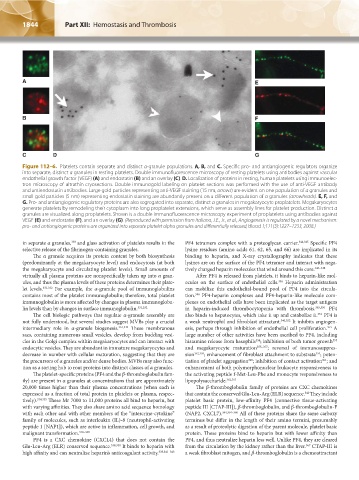
               Figure 112–6.  Platelets contain separate and distinct α-granule populations. A, B, and C. Specific pro- and antiangiogenic regulators organize
               into separate, distinct α granules in resting platelets. Double immunofluorescence microscopy of resting platelets using antibodies against vascular
               endothelial growth factor (VEGF) (A) and endostatin (B) and an overlay (C). D. Localization of proteins in resting, human platelets using immunoelec-
               tron microscopy of ultrathin cryosections. Double immunogold labeling on platelet sections was performed with the use of anti-VEGF antibody
               and antiendostatin antibodies. Large gold particles representing anti-VEGF staining (15 nm, arrows) are evident on one population of α granules and
               small gold particles (5 nm) representing endostatin staining are abundantly present on a different population of α granules (arrowheads). E, F, and
               G. Pro- and antiangiogenic regulatory proteins are also segregated into separate, distinct α granules in megakaryocyte proplatelets. Megakaryocytes
               generate platelets by remodeling their cytoplasm into long proplatelet extensions, which serve as assembly lines for platelet production. Distinct α
               granules are visualized along proplatelets. Shown is a double immunofluorescence microscopy experiment of proplatelets using antibodies against
               VEGF (E) and endostatin (F), and an overlay (G). (Reproduced with permission from Italiano, J.E., Jr., et al., Angiogenesis is regulated by a novel mechanism:
               pro- and antiangiogenic proteins are organized into separate platelet alpha granules and differentially released, Blood 1;111(3):1227–1233, 2008.)

               in separate α granules,  and glass activation of platelets results in the   PF4 tetramers complex with a proteoglycan carrier. 344,345  Specific PF4
                                330
               selective release of the fibrinogen-containing granules.  lysine residues (amino acids 61, 62, 65, and 66) are implicated in its
                   The  α granule acquires its protein content by both biosynthesis   binding to heparin, and X-ray crystallography indicates that these
               (predominantly at the megakaryocyte level) and endocytosis (at both   lysines are on the surface of the PF4 tetramer and interact with nega-
               the megakaryocyte and circulating platelet levels). Small amounts of   tively charged heparin molecules that wind around this core. 346–348
               virtually all plasma proteins are nonspecifically taken up into α gran-  After PF4 is released from platelets, it binds to heparin-like mol-
               ules, and thus the plasma levels of these proteins determines their plate-  ecules on the surface of endothelial cells.  Heparin administration
                                                                                                     346
               let levels. 331,332  For example, the  α-granule pool of immunoglobulins   can mobilize this endothelial-bound pool of PF4 into the circula-
               contains most of the platelet immunoglobulin; therefore, total platelet   tion.  PF4-heparin complexes and PF4-heparin-like molecule com-
                                                                         346
               immunoglobulin is more affected by changes in plasma immunoglobu-  plexes on endothelial cells have been implicated as the target antigens
               lin levels than by changes in surface immunoglobulin. 331,332  in heparin-induced thrombocytopenia with thrombosis. 349,350  PF4
                   The cell biologic pathways that regulate  α-granule assembly are   also binds to hepatocytes, which take it up and catabolize it.  PF4 is
                                                                                                                  351
               not fully understood, but several studies suggest MVBs play a crucial   a weak neutrophil and fibroblast attractant. 340,352  It inhibits angiogen-
               intermediary role in  α-granule biogenesis. 316,333  These membranous   esis, perhaps through inhibition of endothelial cell proliferation.  A
                                                                                                                      353
               sacs, containing numerous small vesicles, develop from budding vesi-  large number of other activities have been ascribed to PF4, including
               cles in the Golgi complex within megakaryocytes and can interact with   histamine release from basophils ; inhibition of both tumor growth
                                                                                                                       353
                                                                                              354
               endocytic vesicles. They are abundant in immature megakaryocytes and   and megakaryocyte maturation 355–357 ; reversal of immunosuppres-
               decrease in number with cellular maturation, suggesting that they are   sion 352,358 ; enhancement of fibroblast attachment to substrata ; poten-
                                                                                                                  359
               the precursors of α granules and/or dense bodies. MVBs may also func-  tiation of platelet aggregation ; inhibition of contact activation ; and
                                                                                           360
                                                                                                                    361
               tion as a sorting hub to rout proteins into distinct classes of α granules.  enhancement of both polymorphonuclear leukocyte responsiveness to
                   The platelet-specific proteins (PF4 and the β-thromboglobulin fam-  the activating peptide f-Met-Leu-Phe and monocyte responsiveness to
               ily) are present in α granules at concentrations that are approximately   lipopolysaccharide. 362,363
               20,000 times higher than their plasma concentrations (when each is   The β-thromboglobulin family of proteins are CXC chemokines
               expressed as a fraction of total protein in platelets or plasma, respec-  that contain the conserved Glu-Leu-Arg (ELR) sequence.  They include
                                                                                                              340
               tively). 334,335  These Mr 7000 to 11,000 proteins all bind to heparin, but   platelet  basic  protein,  low-affinity  PF4  (connective  tissue-activating
               with varying affinities. They also share amino acid sequence homology   peptide III [CTAP-III]), β-thromboglobulin, and β-thromboglobulin-F
               with each other and with other members of the “intercrine-cytokine”   (NAP2, CXCL7). 334,364–366  All of these proteins share the same carboxy
               family of molecules, such as interleukin (IL)-8 (neutrophil-activating   terminus but differ in the length of their amino termini, presumably
               peptide 1 [NAP1]), which are active in inflammation, cell growth, and   as a result of proteolytic digestion of the parent molecule, platelet basic
               malignant transformation. 336–338                      protein. These proteins bind to heparin but with lower affinity than
                   PF4 is a CXC chemokine (CXCL4) that does not contain the     PF4, and thus neutralize heparin less well. Unlike PF4, they are cleared
               Glu-Leu-Arg (ELR) conserved sequence. 339,340  It binds to heparin with   from the circulation by the kidney rather than the liver.  CTAP-III is
                                                                                                               367
               high affinity and can neutralize heparin’s anticoagulant activity. 335,341–343    a weak fibroblast mitogen, and β-thromboglobulin is a chemoattractant


          Kaushansky_chapter 112_p1829-1914.indd   1844                                                                 17/09/15   3:26 pm

