


Page 1864 - Williams Hematology ( PDFDrive )
P. 1864
1838  Part XII:  Hemostasis and Thrombosis   Chapter 112:  Platelet Morphology, Biochemistry, and Function           1839


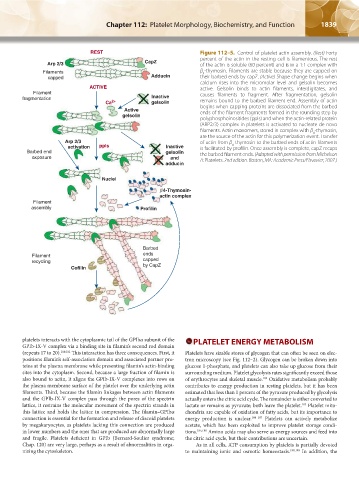
                                                                             Figure 112–5.  Control of platelet actin assembly. (Rest) Forty
                                                                             percent of the actin in the resting cell is filamentous. The rest
                                                                             of the actin is soluble (60 percent) and is in a 1:1 complex with
                                                                             β -thymosin. Filaments are stable because they are capped on
                                                                              4
                                                                             their barbed ends by capZ. (Active) Shape change begins when
                                                                             calcium rises  into the micromolar level  and gelsolin becomes
                                                                             active. Gelsolin binds to actin filaments, interdigitates, and
                                                                             causes filaments to fragment. After fragmentation, gelsolin
                                                                             remains bound to the barbed filament end. Assembly of actin
                                                                             begins when capping proteins are dissociated from the barbed
                                                                             ends of the filament fragments formed in the rounding step by
                                                                             polyphosphoinositides (ppIs) and when the actin-related protein
                                                                             (ARP2/3) complex in platelets is activated to nucleate de novo
                                                                             filaments. Actin monomers, stored in complex with β -thymosin,
                                                                                                                   4
                                                                             are the source of the actin for this polymerization event. Transfer
                                                                             of actin from β -thymosin to the barbed ends of actin filaments
                                                                                        4
                                                                             is facilitated by profilin. Once assembly is complete, capZ recaps
                                                                             the barbed filament ends. (Adapted with permission from Michelson
                                                                             A: Platelets. 2nd edition. Boston, MA: Academic Press/Elsvevier; 2007.)


                  platelets interacts with the cytoplasmic tail of the GPIbα subunit of the   PLATELET ENERGY METABOLISM
                  GPIb-IX-V complex via a binding site in filamin’s second rod domain
                  (repeats 17 to 20). 180,181  This interaction has three consequences. First, it   Platelets have sizable stores of glycogen that can often be seen on elec-
                  positions filamin’s self-association domain and associated partner pro-  tron microscopy (see Fig. 112–2). Glycogen can be broken down into
                  teins at the plasma membrane while presenting filamin’s actin-binding   glucose 1-phosphate, and platelets can also take up glucose from their
                  sites into the cytoplasm. Second, because a large fraction of filamin is   surrounding medium. Platelet glycolysis rates significantly exceed those
                  also bound to actin, it aligns the GPIb-IX-V complexes into rows on   of erythrocytes and skeletal muscle.  Oxidative metabolism probably
                                                                                                  182
                  the plasma membrane surface of the platelet over the underlying actin   contributes to energy production in resting platelets, but it has been
                  filaments. Third, because the filamin linkages between actin filaments   estimated that less than 1 percent of the pyruvate produced by glycolysis
                  and the GPIb-IX-V complex pass through the pores of the spectrin   actually enters the citric acid cycle. The remainder is either converted to
                  lattice, it restrains the molecular movement of the spectrin strands in   lactate or remains as pyruvate; both leave the platelet.  Platelet mito-
                                                                                                                183
                  this  lattice and  holds  the  lattice  in  compression. The  filamin–GPIbα   chondria are capable of oxidation of fatty acids, but its importance to
                  connection is essential for the formation and release of discoid platelets   energy production  is  unclear. 184–187   Platelets  can actively  metabolize
                  by megakaryocytes, as platelets lacking this connection are produced   acetate, which has been exploited to improve platelet storage condi-
                  in lower numbers and the ones that are produced are abnormally large   tions. 185,188  Amino acids may also serve as energy sources and feed into
                  and fragile. Platelets deficient in GPIb (Bernard-Soulier syndrome;    the citric acid cycle, but their contributions are uncertain.
                  Chap. 120) are very large, perhaps as a result of abnormalities in orga-  As in all cells, ATP consumption by platelets is partially devoted
                  nizing the cytoskeleton.                              to  maintaining  ionic  and  osmotic  homeostasis. 189,190   In  addition,  the


          Kaushansky_chapter 112_p1829-1914.indd   1839                                                                 17/09/15   3:26 pm

