


Page 1984 - Williams Hematology ( PDFDrive )
P. 1984
1958  Part XII:  Hemostasis and Thrombosis                   Chapter 114:  Control of Coagulation Reactions          1959


                  product and regenerates the active site Ser residue of the protease.   one of which (Asn135) is variably glycosylated, giving rise to a  β-i-
                  However, serpins have an ability to undergo major conformational   soform that has higher affinity for heparin. 317,318  Heparin binding to
                  changes following cleavage at the reactive site residue that can distort   antithrombin is mediated by a number of positively charged Arg and
                  that protease’s active site region and lock the enzyme into the protease–   Lys residues in the N-terminal region of the molecule, including Lys11,
                  serpin complex in which both the serpin and the protease are essentially    Arg13, Arg47, Lys114, Lys125, and Arg129, whereas the reactive center
                  deformed. 304–307,309–312  The dominant structural feature of native serpins   loop containing the scissile peptide bond at Arg393-Ser394 is near the
                  is a large five-stranded β-sheet that defines the structure of an ellipsoidal   C-terminus. 311
                  protein. Following cleavage at the reactive residue in the reactive center
                  loop by a protease, this extended loop is able to partially or completely   ANTITHROMBIN GENE
                  insert  itself into the five-stranded  β-sheet,  forming a  very stable six  The antithrombin gene comprising seven exons and six introns spans
                  -stranded β-sheet. If this insertion reaction proceeds before deacylation   13.4 kb and is located on chromosome 1q23–25 (see Table  114–1). 319,320
                  occurs, then the protease remains covalently attached to the reactive
                  center P1 residue through the protease’s active site Ser residue, and a sta-  ANTITHROMBIN MUTATIONS
                  ble covalent protease–inhibitor complex with each protein in an altered
                  conformation is formed. 307,308                       Hereditary deficiencies of antithrombin are risk factors for venous
                     Heparin enhancement of the rate of reaction between antithrombin   thrombosis (Chap. 130). More than 100 different antithrombin muta-
                  and thrombin or other clotting factors is caused by two distinct effects   tions are associated with thrombosis. An extensive database of muta-
                                                                                      321
                  of heparin, one involving conformational effects on antithrombin and   tions  is  published   and  is  available  at  http://www1.imperial.ac.uk/
                  the other involving “approximation” effects on both antithrombin and   departmentofmedicine/divisions/experimentalmedicine/haematology/
                  thrombin. 300,307,308,311–315  For the first effect, a particular pentasaccharide   coag/antithrombin/.
                  sequence within heparin binds antithrombin and potently causes a con-  Mutations that cause antithrombin deficiency are scattered through-
                  formational change that converts antithrombin from its native state of   out the gene. Molecular defects can be classified as type I, characterized
                  moderate reactivity to a conformation with relatively high reactivity. This   by parallel decreases in antigen and activity, or type II, characterized
                  pentasaccharide contains a specific sulfated sequence of glucosamine   by circulating dysfunctional molecules such that plasma has decreased
                  and iduronic acid residues, 300,307,308,311–315  and when it is present in a   functional activity but normal or near-normal antigen levels. Type II
                  large heparin molecule, in low-molecular-weight heparin, or in a syn-  defects are further classified based on whether the dysfunction involves
                  thetic pentasaccharide, it alters antithrombin conformation and greatly   only reactive center defects that can be tested in the absence of hepa-
                  accelerates the reaction of antithrombin, especially with factor Xa. Syn-  rin, only heparin-binding defects that can be tested only in the presence
                  thetic pentasaccharides, such as fondaparinux, which are analogues of   of heparin, or both of these defects (pleiotropic effects). Reactive center
                  the naturally occurring sequence, are often termed to be indirect factor   defects carry the largest risk of thrombosis, whereas heparin-binding
                  Xa inhibitors and have significant clinical utility. For the second mech-  defects are associated with less risk of venous thrombosis (Chap. 130).
                  anistic effect, namely the approximation effect, unfractionated heparin
                  or low-molecular-weight heparins simultaneously bind to antithrombin   TISSUE FACTOR PATHWAY INHIBITOR
                  and the target protease to promote frequent and geometrically produc-
                  tive encounters between protease and inhibitor, thus increasing the reac-  TFPI, also known as lipoprotein-associated coagulation inhibitor or extrinsic
                  tion rate. Heparan sulfates to some extent can also act in this manner.  pathway inhibitor, has a predicted mature protein sequence of 276 residues
                     The mature antithrombin polypeptide chain contains 432-amino-  and a Mr of 34,000. However, TFPI is a complex protein and has at least
                  acid residues after cleavage of a propeptide from a 464-amino-acid-resi-  three isoforms in blood vessels. 277,301–303,322–327  There are two alternatively
                            316
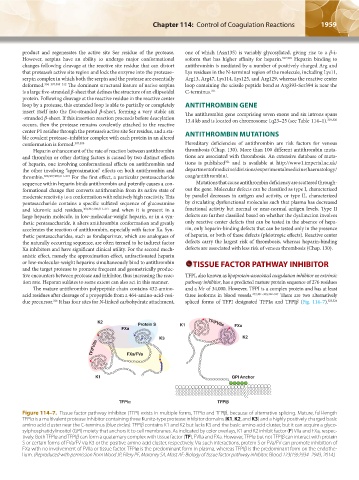
                  due precursor.  It has four sites for N-linked carbohydrate attachment,   spliced forms of TFPI designated TFPIα and TFPIβ (Fig. 114–7). 323,324

                                           K2            Protein S     K1       TF/FVIIa
                                                   FXa                                   FXa
                                                                K3                          K2
                                         TF/FVIIa    FXa/FVa


                                          K1                                            GPI Anchor


                                                  TFPI`                            TFPIa
                  Figure 114–7.  Tissue factor pathway inhibitor (TFPI) exists in multiple forms, TFPIα and TFPIβ, because of alternative splicing. Mature, full-length
                  TFPIα is a multivalent protease inhibitor containing three Kunitz-type protease inhibitor domains (K1, K2, and K3) and a highly positively charged basic
                  amino acid cluster near the C-terminus (blue circles). TFPIβ contains K1 and K2 but lacks K3 and the basic amino acid cluster, but it can acquire a glyco-
                  sylphosphatidylinositol (GPI) moiety that anchors it to cell membranes. As indicated by color overlays, K1 and K2 inhibit factor (F) VIIa and FXa, respec-
                  tively. Both TFPIα and TFPIβ can form a quaternary complex with tissue factor (TF), FVIIa and FXa. However, TFPIα but not TFPIβ can interact with protein
                  S or certain forms of FVa/FV via K3 or the positive amino acid cluster, respectively. Via such interactions, protein S or FVa/FV can promote inhibition of
                  FXa with no involvement of FVIIa or tissue factor. TFPIα is the predominant form in plasma, whereas TFPIβ is the predominant form on the endothe-
                  lium. (Reproduced with permission from Wood JP, Ellery PE, Maroney SA, Mast AE: Biology of tissue factor pathway inhibitor. Blood 123(19):2934–2943, 2014.)


          Kaushansky_chapter 114_p1949-1966.indd   1959                                                                 9/18/15   10:06 AM

