


Page 2035 - Williams Hematology ( PDFDrive )
P. 2035
2010           Part XII:  Hemostasis and Thrombosis                                                                                                                                    Chapter 117:  Thrombocytopenia            2011


               was much more likely to increase platelet  counts  in patients with     GESTATIONAL THROMBOCYTOPENIA
               H. pylori infection than in uninfected patients,  strengthening the case   Gestational thrombocytopenia is detected in 5 to 7 percent of otherwise
                                                 315
               for a causal relationship between infection and thrombocytopenia. On   healthy pregnant women, accounting for 64 to 80 percent of patients
               the other hand, eradication was shown to be less effective in patients   with thrombocytopenia at term. 319–321  Gestational thrombocytopenia is
                                      309
               with severe thrombocytopenia.  The recent ASH ITP guideline sug-  a benign disorder and is not associated with an increased risk of bleed-
               gests that ITP patients be screened for  H. pylori and for eradication   ing. Platelet counts are greater than 70 × 10 /L 316,317,319,320  and return to
                                                                                                      9
               therapy to be used if testing is positive. 148
                                                                      normal after delivery.
                                                                          The pathogenesis of gestational thrombocytopenia is unknown.
                                                                      Several mechanisms have been proposed, including hemodilution, a
                    THROMBOCYTOPENIA DURING                           compensated state of subclinical coagulopathy, endothelial cell injury,
                  PREGNANCY                                           and immune destruction. Some authors have proposed platelet con-
                                                                      sumption by the placenta and hormonal depression of megakaryo-
               Thrombocytopenia is the second most common hematologic prob-  poiesis as causes of gestational thrombocytopenia, as suggested by the
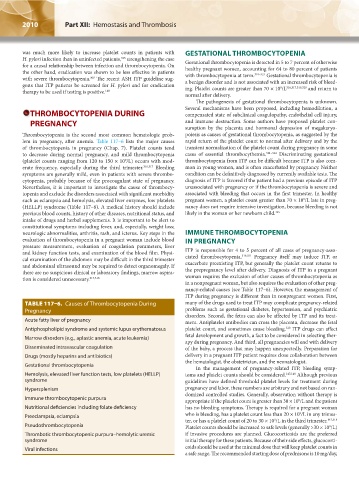
               lem in pregnancy, after anemia.  Table 117–6 lists the major causes   rapid return of the platelet count to normal after delivery and by the
               of thrombocytopenia in pregnancy (Chap. 7). Platelet counts tend   transient normalization of the platelet count during pregnancy in some
               to decrease during normal pregnancy, and mild thrombocytopenia   cases of essential thrombocythemia. 321–324  Discriminating gestational
                                                  9
               (platelet counts ranging from 120 to 150 × 10 /L) occurs with mod-  thrombocytopenia from ITP can be difficult because ITP is also com-
               erate frequency, especially during the third trimester. 316,317  Bleeding   mon in young women, and is often exacerbated by pregnancy. Neither
               symptoms are generally mild, even in patients with severe thrombo-  condition can be definitively diagnosed by currently available tests. The
               cytopenia, probably because of the procoagulant state of pregnancy.   diagnosis of ITP is favored if the patient had a previous episode of ITP
               Nevertheless, it is important to investigate the cause of thrombocy-  unassociated with pregnancy or if the thrombocytopenia is severe and
               topenia and exclude the disorders associated with significant morbidity   associated with bleeding that occurs in the first trimester. In healthy
               such as eclampsia and hemolysis, elevated liver enzymes, low platelets   pregnant women, a platelet count greater than 70 × 10 /L late in preg-
                                                                                                              9
               (HELLP) syndrome (Table  117–6). A medical history should include   nancy does not require intensive investigation, because bleeding is not
               previous blood counts, history of other diseases, nutritional status, and   likely in the woman or her newborn child. 325
               intake of drugs and herbal supplements. It is important to be alert to
               constitutional symptoms including fever, and, especially, weight loss;
               neurologic abnormalities, arthritis, rash, and icterus. Key steps in the   IMMUNE THROMBOCYTOPENIA
               evaluation of thrombocytopenia in a pregnant woman include blood   IN PREGNANCY
               pressure measurement, evaluation of coagulation parameters, liver
               and kidney function tests, and examination of the blood film. Physi-  ITP is responsible for 4 to 5 percent of all cases of pregnancy-asso-
                                                                                         319,321
               cal examination of the abdomen may be difficult in the third trimester   ciated thrombocytopenia.   Pregnancy itself may induce ITP, or
               and abdominal ultrasound may be required to detect organomegaly. If   exacerbate preexisting ITP, but generally the platelet count returns to
               there are no suspicious clinical or laboratory findings, marrow aspira-  the prepregnancy level after delivery. Diagnosis of ITP in a pregnant
               tion is considered unnecessary. 317,318                woman requires the exclusion of other causes of thrombocytopenia as
                                                                      in a nonpregnant woman, but also requires the evaluation of other preg-
                                                                      nancy-related causes (see Table  117–6). However, the management of
                                                                      ITP during pregnancy is different than in nonpregnant women. First,
                TABLE 117–6.  Causes of Thrombocytopenia During       many of the drugs used to treat ITP may complicate pregnancy-related
                Pregnancy                                             problems such as gestational diabetes, hypertension, and psychiatric
                                                                      disorders. Second, the fetus can also be affected by ITP and its treat-
                Acute fatty liver of pregnancy                        ment. Antiplatelet antibodies can cross the placenta, decrease the fetal
                                                                                                        320
                Antiphospholipid syndrome and systemic lupus erythematosus  platelet count, and sometimes cause bleeding.  ITP drugs can affect
                                                                      fetal development and growth, a fact to be considered in selecting ther-
                Marrow disorders (e.g., aplastic anemia, acute leukemia)
                                                                      apy during pregnancy. And third, all pregnancies will end with delivery
                Disseminated intravascular coagulation                of the baby, a process that may happen unexpectedly. Preparation for
                Drugs (mostly heparins and antibiotics)               delivery in a pregnant ITP patient requires close collaboration between
                                                                      the hematologist, the obstetrician, and the neonatologist.
                Gestational thrombocytopenia
                                                                          In the management of pregnancy-related ITP, bleeding symp-
                Hemolysis, elevated liver function tests, low platelets (HELLP)   toms and platelet counts should be considered. 147,148  Although previous
                syndrome                                              guidelines have defined threshold platelet levels for treatment during
                Hypersplenism                                         pregnancy and labor, these numbers are arbitrary and not based on ran-
                                                                      domized controlled studies. Generally, observation without therapy is
                Immune thrombocytopenic purpura
                                                                      appropriate if the platelet count is greater than 30 × 10 /L and the patient
                                                                                                            9
                Nutritional deficiencies including folate deficiency  has no bleeding symptoms. Therapy is required for a pregnant woman
                                                                                                            9
                Preeclampsia, eclampsia                               who is bleeding, has a platelet count less than 20 × 10 /L in any trimes-
                                                                      ter, or has a platelet count of 20 to 30 × 10 /L in the third trimester. 147,318
                                                                                                    9
                Pseudothrombocytopenia                                Platelet counts should be increased to safe levels (generally >30 × 10 /L)
                                                                                                                      9
                Thrombotic thrombocytopenic purpura–hemolytic uremic   if invasive procedures are planned. Glucocorticoids are the preferred
                syndrome                                              initial therapy for these patients. Because of their side effects, glucocorti-
                Viral infections                                      coids should be used at the minimal dose that will keep platelet counts in
                                                                      a safe range. The recommended starting dose of prednisone is 10 mg/day,


          Kaushansky_chapter 117_p1993-2024.indd   2010                                                                 9/21/15   2:32 PM

