


Page 2032 - Williams Hematology ( PDFDrive )
P. 2032
2006  Part XII:  Hemostasis and Thrombosis                                Chapter 117:  Thrombocytopenia             2007


                  immunosuppressive drugs, major adverse effects are marrow suppres-  Other Therapies  ITP patients with H. pylori infection should receive
                  sion and possible increased risk of secondary malignancy. 177,234  eradication therapy.  Many other therapies, including interferon-α,
                                                                                                                          243
                                                                                       148
                                                                        immunoadsorption with staphylococcal protein A,  ascorbic acid,
                                                                                                                          245
                                                                                                              244
                  Cyclophosphamide  This alkylating drug can be used orally (50 to 200   colchicine,  and plasmapheresis,  have been studied for refractory
                                                                                246
                                                                                                 247
                  mg/day) or parenterally (1.0 to 1.5 g/m  IV every 4 weeks) in patients   ITP cases, but none has been clearly demonstrated to be effective.
                                              2
                  with refractory ITP. 235,236  It increases platelet counts in 60 to 80 percent
                  of patients with ITP, and 20 to 40 percent of those patients will remain   Accessory Therapies  Adjunctive therapies include agents designed
                  in remission for 2 to 3 years  after receiving 2 to 3 months of ther-  to reduce bleeding without necessarily affecting the platelet count.
                                       177
                  apy. Its beneficial action is linked to its immunosuppression. The major   Aminocaproic acid or tranexamic acid, both of which inhibit fibrinoly-
                  complications of cyclophosphamide therapy are marrow suppression,   sis, can be used for excessive mucosal bleeding. Local bleeding can be
                  hemorrhagic cystitis, infertility, alopecia, and secondary malignancy.  controlled by compression and use of gelatin sponges, fibrin sealants,
                                                                        or antifibrinolytic-embedded gauze. Avoiding the use of antiplatelet
                  Cyclosporine  Cyclosporine is an immunosuppressive drug inhibiting   drugs, contact sports, and activities that increase bleeding risk, and
                  T-cell function, and is primarily used to prevent rejection in patients   educating patients about maintaining dental hygiene are very impor-
                  with organ transplantation. Although cyclosporine may induce a   tant. Menorrhagia is a common problem in patients with chronic ITP;
                  durable remission in patients with ITP when used at relatively low   gynecologic  evaluation  of  uterine  problems  is  crucial.  Oral  contra-
                  doses (2.5 to 3.0 mg/kg/day),  experience with cyclosporine in ITP   ceptives and hormonal intrauterine devices together with antifibrino-
                                        237
                  patients is usually based on small case series. Cyclosporine has several   lytic drugs may help to reduce excessive menstrual bleeding in these
                  side effects, some potentially serious, including fever, increased risk of   patients.
                  opportunistic infections, gingival hyperplasia, diarrhea, peptic ulcer,
                  pancreatitis, renal dysfunction, elevated liver enzymes, hypertension,
                  peripheral neuropathy, convulsions, hirsutism, and increased risk of   SECONDARY IMMUNE THROMBOCYTOPENIA
                  secondary malignancy.
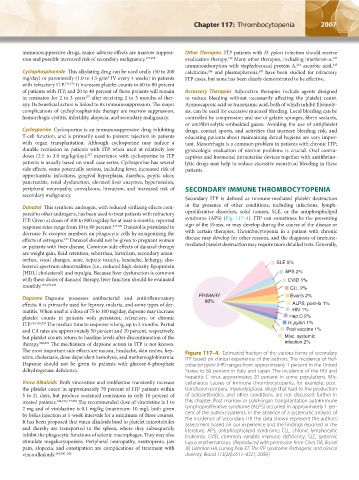
                                                                        Secondary ITP  is defined as  immune-mediated  platelet  destruction
                  Danazol  This synthetic androgen, with reduced virilizing effects com-  in the presence of other conditions, including infections, lymph-
                  pared to other androgens, has been used to treat patients with refractory   oproliferative disorders, solid tumors, SLE, or the antiphospholipid
                  ITP. Given at doses of 400 to 800 mg/day for at least 6 months, reported     syndrome (APS) (Fig. 117–4). ITP can sometimes be the presenting
                  response rates range from 10 to 80 percent. 177,234  Danazol is postulated to   sign of the illness, or may develop during the course of the disease or
                  decrease Fc receptor numbers on phagocytic cells by antagonizing the   with certain therapies. Thrombocytopenia in a patient with chronic
                  effects of estrogens.  Danazol should not be given to pregnant women   disease may develop for other reasons, and the diagnosis of immune-
                                153
                  or patients with liver disease. Common side effects of danazol therapy   mediated platelet destruction may require more detailed tests. Generally,
                  are weight gain, fluid retention, seborrhea, hirsutism, secondary amen-
                  orrhea, vocal changes, acne, hepatic toxicity, headache, lethargy, cho-
                  lesterol spectrum abnormalities (i.e., reduced high-density lipoprotein              SLE 5%
                  [HDL] cholesterol) and myalgia. Because liver dysfunction is common                     APS 2%
                  with these doses of danazol therapy, liver function should be evaluated                  CVID 1%
                  monthly. 153,177,234                                                                      CLL 2%

                  Dapsone  Dapsone possesses antibacterial and antiinflammatory   PRIMARY                   Evan’s 2%
                  effects; it is primarily used for leprosy, malaria, and some types of der-  80%           ALPS, post-tx 1%
                  matitis. When used at a dose of 75 to 100 mg/day, dapsone may increase                    HIV 1%
                  platelet counts in patients with persistent, refractory, or chronic                      Hep C 2%
                  ITP. 147,238,239  The median time to response is long, up to 2 months. Partial           H. pylori 1%
                  and CR rates are approximately 50 percent and 20 percent, respectively,                 Post vaccine 1%
                  but platelet counts return to baseline levels after discontinuation of the              Misc. systemic
                  therapy. 238,239  The mechanism of dapsone action in ITP is not known.                  infection 2%
                  The most important side effects are nausea, headache, skin rashes, hep-  Figure 117–4.  Estimated fraction of the various forms of secondary
                  atitis, cholestasis, dose-dependent hemolysis, and methemoglobinemia.   ITP based on clinical experience of the authors. The incidence of Heli-
                  Dapsone should not be given to patients with glucose-6-phosphate   cobacter pylori (HP) ranges from approximately 1 percent in the United
                  dehydrogenase deficiency.                             States to 60 percent in Italy and Japan. The incidence of the HIV and
                                                                        hepatitis C virus approximates 20 percent in some populations. Mis-
                  Vinca Alkaloids  Both vincristine and vinblastine transiently increase   cellaneous  causes  of immune  thrombocytopenia,  for  example, post-
                  the platelet count in approximately 70 percent of ITP patients within   transfusion purpura, myelodysplasia, drugs that lead to the production
                  5 to 21 days, but produce sustained remissions in only 10 percent of   of autoantibodies, and other conditions, are not discussed further in
                  treated patients. 108,153,177,234  The recommended dose of vincristine is 1 to   this chapter. Post marrow or solid-organ transplantation autoimmune
                  2 mg and of vinblastine is 0.1 mg/kg (maximum: 10 mg), both given   lymphoproliferative syndrome (ALPS) occurred in approximately 1 per-
                  by bolus injection at 1-week intervals for a minimum of three courses.   cent of the authors’ patients. In the absence of a systematic analysis of
                  It has been proposed that vinca alkaloids bind to platelet microtubules   the incidence of secondary ITP, the data shown represent the authors’
                                                                        assessment based on our experience and the findings reported in the
                  and thereby are transported to the spleen, where they subsequently   literature. APS, antiphospholipid syndrome; CLL, chronic lymphocytic
                  inhibit the phagocytic functions of splenic macrophages. They may also   leukemia, CVID, common  variable  immune  deficiency;  SLE,  systemic
                  stimulate megakaryopoiesis. Peripheral neuropathy, neutropenia, jaw   lupus erythematosus. (Reproduced with permission from Cines DB, Bussel
                  pain, alopecia, and constipation are complications of treatment with   JB, Liebman HA, Luning Prak ET. The ITP syndrome: Pathogenic and clinical
                  vinca alkaloids. 234,240–242                          diversity. Blood 113(26):6511–6521, 2009.)


          Kaushansky_chapter 117_p1993-2024.indd   2007                                                                 9/21/15   2:32 PM

