


Page 2042 - Williams Hematology ( PDFDrive )
P. 2042
2016  Part XII:  Hemostasis and Thrombosis                                Chapter 117:  Thrombocytopenia             2017


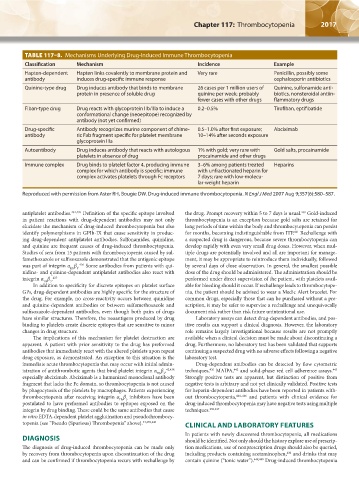
                   TABLE 117–8.  Mechanisms Underlying Drug-Induced Immune Thrombocytopenia
                   Classification   Mechanism                                Incidence                Example
                   Hapten-dependent   Hapten links covalently to membrane protein and   Very rare     Penicillin, possibly some
                   antibody         induces drug-specific immune response                             cephalosporin antibiotics
                   Quinine-type drug  Drug induces antibody that binds to membrane   26 cases per 1 million users of   Quinine, sulfonamide anti-
                                    protein in presence of soluble drug      quinine per week; probably   biotics, nonsteroidal antiin-
                                                                             fewer cases with other drugs  flammatory drugs
                   Fiban-type drug  Drug reacts with glycoprotein IIb/IIIa to induce a   0.2–0.5%     Tirofiban, eptifibatide
                                    conformational change (neoepitope) recognized by
                                    antibody (not yet confirmed)
                   Drug-specific    Antibody recognizes murine component of chime-  0.5–1.0% after first exposure;   Abciximab
                   antibody         ric Fab fragment specific for platelet membrane   10–14% after seconds exposure
                                    glycoprotein IIIa
                   Autoantibody     Drug induces antibody that reacts with autologous   1% with gold; very rare with   Gold salts, procainamide
                                    platelets in absence of drug             procainamide and other drugs
                   Immune complex   Drug binds to platelet factor 4, producing immune   3–6% among patients treated   Heparins
                                    complex for which antibody is specific; immune   with unfractionated heparin for
                                    complex activates platelets through Fc receptors  7 days; rare with low-molecu-
                                                                             lar-weight heparin
                  Reproduced with permission from Aster RH, Bougie DW. Drug-induced immune thrombocytopenia. N Engl J Med 2007 Aug 9;357(6):580–587.


                  antiplatelet antibodies. 434,435  Definition of the specific epitope involved   the drug. Prompt recovery within 5 to 7 days is usual.  Gold-induced
                                                                                                               430
                  in patient reactions with drug-dependent antibodies may not only   thrombocytopenia is an exception because gold salts are retained for
                  elucidate the mechanism of drug-induced thrombocytopenia but also   long periods of time within the body and thrombocytopenia can persist
                  identify polymorphisms in GPIb-IX that cause sensitivity in produc-  for months, becoming indistinguishable from ITP.  Rechallenge with
                                                                                                             441
                  ing drug-dependent antiplatelet antibodies. Sulfonamides, quinidine,   a suspected drug is dangerous, because severe thrombocytopenia can
                  and quinine are frequent causes of drug-induced thrombocytopenia.   develop rapidly with even very small drug doses. However, when mul-
                  Studies of sera from 15 patients with thrombocytopenia caused by sul-  tiple drugs are potentially involved and all are important for manage-
                  famethoxazole or sulfisoxazole demonstrated that the antigenic epitope   ment, it may be appropriate to reintroduce them individually, followed
                  was part of integrin α β .  Some antibodies from patients with qui-  by several days of close observation. In general, the smallest possible
                                     436
                                  IIb 3
                  nidine- and quinine-dependent antiplatelet antibodies also react with   dose of the drug should be administered. The administration should be
                  integrin α β . 437                                    performed under direct supervision of the patient, with platelets avail-
                         IIb 3
                     In addition to specificity for discrete epitopes on platelet surface   able for bleeding should it occur. If rechallenge leads to thrombocytope-
                  GPs, drug-dependent antibodies are highly specific for the structure of   nia, the patient should be advised to wear a Medic Alert bracelet. For
                  the drug. For example, no cross-reactivity occurs between quinidine   common drugs, especially those that can be purchased without a pre-
                  and quinine-dependent antibodies or between sulfamethoxazole and   scription, it may be safer to supervise a rechallenge and unequivocally
                  sulfisoxazole-dependent antibodies, even though both pairs of drugs   document risk rather than risk future unintentional use.
                  have similar structures. Therefore, the neoantigens produced by drug   Laboratory assays can detect drug-dependent antibodies, and pos-
                  binding to platelets create discrete epitopes that are sensitive to minor   itive results can support a clinical diagnosis. However, the laboratory
                  changes in drug structure.                            role remains largely investigational because results are not promptly
                     The implications of this mechanism for platelet destruction are   available when a clinical decision must be made about discontinuing a
                  apparent. A patient with prior sensitivity to the drug has preformed   drug. Furthermore, no laboratory test has been validated that supports
                  antibodies that immediately react with the altered platelets upon repeat   continuing a suspected drug with no adverse effects following a negative
                  drug exposure, as demonstrated. An exception to this situation is the   laboratory test.
                  immediate acute thrombocytopenia that may occur with initial admin-  Drug-dependent antibodies can be detected by flow cytometric
                  istration of antithrombotic agents that bind platelet integrin α β , 42,438    techniques,  MAIPA,  and solid-phase red cell adherence assays.
                                                                                                                          443
                                                                                 436
                                                                                         442
                                                               IIb 3
                  especially abciximab. Abciximab is a humanized monoclonal antibody   Strongly  positive tests  are  apparent, but  distinction  of  positive  from
                  fragment that lacks the Fc domain, so thrombocytopenia is not caused   negative tests is arbitrary and not yet clinically validated. Positive tests
                  by phagocytosis of the platelets by macrophages. Patients experiencing   for heparin-dependent antibodies have been reported in patients with-
                  thrombocytopenia after receiving integrin α β  inhibitors have been   out thrombocytopenia, 444–446  and patients with clinical evidence for
                                                  IIb 3
                  postulated to have preformed antibodies to epitopes exposed on the   drug-induced thrombocytopenia may have negative tests using multiple
                  integrin by drug binding. These could be the same antibodies that cause   techniques. 436,447
                  in vitro EDTA-dependent platelet agglutination and pseudothrombocy-
                  topenia (see “Pseudo (Spurious) Thrombopenia” above). 33,439,440  CLINICAL AND LABORATORY FEATURES
                                                                        In patients with newly discovered thrombocytopenia, all medications
                  DIAGNOSIS                                             should be identified. Not only should the history explore use of prescrip-
                  The diagnosis of drug-induced thrombocytopenia can be made only   tion medications, use of nonprescription drugs should also be queried,
                  by recovery from thrombocytopenia upon discontinuation of the drug   including products containing acetaminophen,  and drinks that may
                                                                                                          430
                  and can be confirmed if thrombocytopenia recurs with rechallenge by   contain quinine (“tonic water”). 448,449  Drug-induced thrombocytopenia


          Kaushansky_chapter 117_p1993-2024.indd   2017                                                                 9/21/15   2:33 PM

