


Page 2279 - Williams Hematology ( PDFDrive )
P. 2279
2254           Part XII:  Hemostasis and Thrombosis                                                                                                                        Chapter 132:  Thrombotic Microangiopathies            2255


               the  ADAMTS13  locus  was  identified  by linkage  analysis  in  families   consistently. The demographics of TTP are similar to those of systemic
               affected by congenital TTP and causative ADAMTS13 mutations were   lupus erythematosus (SLE). TTP is relatively uncommon before age 20
               characterized. 19                                      years, with a peak incidence between ages 30 and 50 years. 24,25  Across
                                                                      many reports the female-to-male ratio averages approximately 2:1, but
                                                                      female preponderance is more pronounced below age 50 years and the
               ETIOLOGY AND PATHOGENESIS                              ratio approaches equality above age 60 years. 24,25  Other risk factors for TTP
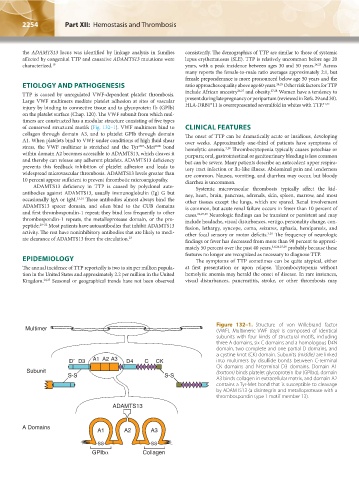
               TTP is caused by unregulated VWF-dependent platelet thrombosis.   include African ancestry 26,27  and obesity. 27,28  Women have a tendency to
               Large VWF multimers mediate platelet adhesion at sites of vascular   present during late pregnancy or peripartum (reviewed in Refs. 29 and 30).
               injury by binding to connective tissue and to glycoprotein Ib (GPIb)   HLA-DRB1*11 is overrepresented severalfold in whites with TTP. 31,32
               on the platelet surface (Chap. 120). The VWF subunit from which mul-
               timers are constructed has a modular structure consisting of five types
               of conserved structural motifs (Fig. 132–1). VWF multimers bind to   CLINICAL FEATURES
               collagen through domain A3, and to platelet GPIb through domain   The onset of TTP can be dramatically acute or insidious, developing
               A1. When platelets bind to VWF under conditions of high fluid shear   over  weeks.  Approximately  one-third  of  patients  have  symptoms  of
               stress, the VWF multimer is stretched and the Tyr 1605 -Met 1606  bond   hemolytic anemia.  Thrombocytopenia typically causes petechiae or
                                                                                   3,29
               within domain A2 becomes accessible to ADAMTS13, which cleaves it   purpura; oral, gastrointestinal or genitourinary bleeding is less common
               and thereby can release any adherent platelets. ADAMTS13 deficiency   but can be severe. Many patients describe an antecedent upper respira-
               prevents this feedback inhibition of platelet adhesion and leads to   tory tract infection or flu-like illness. Abdominal pain and tenderness
               widespread microvascular thrombosis. ADAMTS13 levels greater than     are common. Nausea, vomiting, and diarrhea may occur, but bloody
               10 percent appear sufficient to prevent thrombotic microangiopathy.  diarrhea is uncommon.
                   ADAMTS13 deficiency in TTP is caused by polyclonal auto-  Systemic microvascular thrombosis typically affect the kid-
               antibodies against ADAMTS13, usually immunoglobulin (Ig) G but   ney, heart, brain, pancreas, adrenals, skin, spleen, marrow, and most
               occasionally IgA or IgM. 13,14  These antibodies almost always bind the   other tissues except the lungs, which are spared. Renal involvement
               ADAMTS13 spacer domain, and often bind to the CUB domains   is common, but acute renal failure occurs in fewer than 10 percent of
               and first thrombospondin-1 repeat; they bind less frequently to other   cases. 26,27,29  Neurologic findings can be transient or persistent and may
               thrombospondin-1 repeats, the metalloprotease domain, or the pro-  include headache, visual disturbances, vertigo, personality change, con-
               peptide. 20–22  Most patients have autoantibodies that inhibit ADAMTS13   fusion, lethargy, syncope, coma, seizures, aphasia, hemiparesis, and
               activity. The rest have noninhibitory antibodies that are likely to medi-  other focal sensory or motor deficits.  The frequency of neurologic
                                                                                                  3,29
               ate clearance of ADAMTS13 from the circulation. 23     findings or fever has decreased from more than 90 percent to approxi-
                                                                      mately 50 percent over the past 40 years, 3,8,26,27,29  probably because these
                                                                      features no longer are recognized as necessary to diagnose TTP.
               EPIDEMIOLOGY                                               The symptoms of TTP sometimes can be quite atypical, either
               The annual incidence of TTP reportedly is two to six per million popula-  at  first presentation  or upon relapse. Thrombocytopenia  without
               tion in the United States and approximately 2.2 per million in the United   hemolytic anemia may herald the onset of disease. In rare instances,
               Kingdom. 24,25  Seasonal or geographical trends have not been observed   visual disturbances, pancreatitis, stroke, or other thrombosis may


                                                                                Figure 132–1.  Structure of von  Willebrand factor
                                                                                (VWF).  Multimeric VWF  (top) is composed of identical
                                                                                subunits with four kinds of structural motifs, including
                                                                                three A domains, six C domains and a homologous D4N
                                                                                domain, two complete and one partial D domains, and
                                                                                a cystine knot (CK) domain. Subunits (middle) are linked
                                ′                                               into multimers by disulfide bonds between C-terminal
                                                                                CK domains and N-terminal D3 domains. Domain A1
                                                                                (bottom) binds platelet glycoprotein Ibα (GPIbα), domain
                                                                                A3 binds collagen in extracellular matrix, and domain A2
                                                                                contains a Tyr-Met bond that is susceptible to cleavage
                                                                                by ADAMTS13 (a disintegrin and metalloprotease with a
                                                                                thrombospondin type 1 motif member 13).


          Kaushansky_chapter 132_p2253-2266.indd   2254                                                                 17/09/15   3:47 pm

