


Page 2280 - Williams Hematology ( PDFDrive )
P. 2280
2254  Part XII:  Hemostasis and Thrombosis                     Chapter 132:  Thrombotic Microangiopathies            2255


                  precede  overt thrombotic  microangiopathy  by  days to  months. 33–36     fibrin and few inflammatory cells. They often include focal endothelial
                  Macrovascular venous or arterial thrombosis occurs in up to one-half   cell proliferation. 46,47
                  of patients. 37
                     Cardiac involvement may cause chest pain, myocardial infarction,   DIFFERENTIAL DIAGNOSIS
                  congestive heart failure or arrhythmias. 29,38,39  Direct pulmonary involve-
                  ment is uncommon but severe acute respiratory distress syndrome may   The diagnosis of TTP should be entertained for any patient with
                                                  29
                  occur, possibly secondary to cardiac failure.  Gastrointestinal symp-  microangiopathic hemolytic anemia and thrombocytopenia, without
                  toms are common and can include abdominal pain, nausea, vomiting,   evidence for disseminated intravascular coagulation, and without fea-
                           3,29
                  and diarrhea.  Physical examination may suggest acute pancreatitis or   tures associated with Shiga toxin–producing Escherichia coli (STEC)-
                  mesenteric ischemia. Infrequent findings include Raynaud phenome-  HUS such as a prodromal diarrheal illness and acute oliguric or anuric
                  non, arthralgia, myalgia, and retinal hemorrhage or detachment. 3,29  renal failure. These criteria can only be approximate, however, because
                                                                        many diseases associated with secondary thrombotic microangiopathy
                                                                        can produce overlapping clinical and laboratory findings. As a conse-
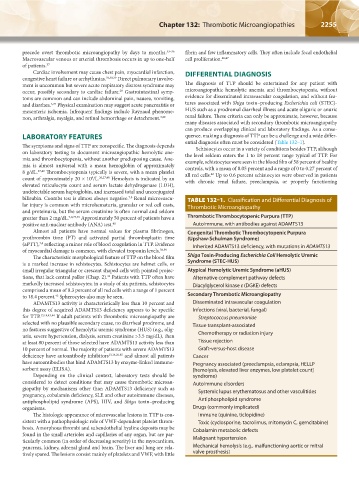
                  LABORATORY FEATURES                                   quence, making a diagnosis of TTP can be a challenge and a wide differ-
                  The symptoms and signs of TTP are nonspecific. The diagnosis depends   ential diagnosis often must be considered (Table 132–1).
                                                                            Schistocytes occur in a variety of conditions besides TTP, although
                  on  laboratory  testing to document  microangiopathic  hemolytic  ane-  the level seldom enters the 1 to 18 percent range typical of TTP. For
                  mia and thrombocytopenia, without another predisposing cause. Ane-  example, schistocytes were seen in the blood film of 58 percent of healthy
                  mia is almost universal with a mean hemoglobin of approximately    controls, with a mean of 0.05 percent and a range of 0 to 0.27 percent of
                  8 g/dL. 27,40  Thrombocytopenia typically is severe, with a mean platelet   all red cells.  Up to 0.6 percent schistocytes were observed in patients
                                                                                 42
                  count of approximately 20 × 10 /L. 26,27,40  Hemolysis is indicated by an   with chronic renal failure, preeclampsia, or properly functioning
                                         9
                  elevated reticulocyte count and serum lactate dehydrogenase (LDH),
                  undetectable serum haptoglobin, and increased total and unconjugated
                  bilirubin. Coombs test is almost always negative.  Renal microvascu-  TABLE 132–1.  Classification and Differential Diagnosis of
                                                     7,8
                  lar injury is common with microhematuria, granular or red cell casts,   Thrombotic Microangiopathy
                  and proteinuria, but the serum creatinine is often normal and seldom
                  greater than 2 mg/dL. 7,8,27,40  Approximately 50 percent of patients have a   Thrombotic Thrombocytopenic Purpura (TTP)
                  positive anti-nuclear antibody (ANA) test. 40            Autoimmune, with antibodies against ADAMTS13
                     Almost all patients have normal values for plasma fibrinogen,   Congenital Thrombotic Thrombocytopenic Purpura
                  prothrombin time (PT) and activated partial thromboplastin time   (Upshaw-Schulman Syndrome)
                  (aPTT),  reflecting a minor role of blood coagulation in TTP. Evidence     Inherited ADAMTS13 deficiency, with mutations in ADAMTS13
                        7,8
                  of myocardial damage is common, with elevated troponin levels. 38,39
                     The characteristic morphological feature of TTP on the blood film   Shiga Toxin-Producing Escherichia Coli Hemolytic Uremic
                  is a marked increase in schistocytes. Schistocytes are helmet cells, or     Syndrome (STEC-HUS)
                  small irregular triangular or crescent shaped cells with pointed projec-  Atypical Hemolytic Uremic Syndrome (aHUS)
                  tions, that lack central pallor (Chap. 2).  Patients with TTP often have     Alternative complement pathway defects
                                              41
                  markedly increased schistocytes; in a study of six patients, schistocytes     Diacylglycerol kinase ε (DGKE) defects
                  comprised a mean of 8.3 percent of all red cells with a range of 1 percent
                  to 18.4 percent.  Spherocytes also may be seen.        Secondary Thrombotic Microangiopathy
                             42
                     ADAMTS13 activity is characteristically less than 10 percent and     Disseminated intravascular coagulation
                  this degree of acquired ADAMTS13 deficiency appears to be specific     Infections (viral, bacterial, fungal)
                  for TTP. 13,14,43,44  If adult patients with thrombotic microangiopathy are      Streptococcus pneumoniae
                  selected with no plausible secondary cause, no diarrheal prodrome, and     Tissue transplant-associated
                  no features suggestive of hemolytic uremic syndrome (HUS) (e.g., olig-
                  uria, severe hypertension, dialysis, serum creatinine >3.5 mg/dL), then       Chemotherapy or radiation injury
                  at least 80 percent of those selected have ADAMTS13 activity less than       Tissue rejection
                  10 percent of normal. The majority of patients with severe ADAMTS13      Graft-versus-host disease
                  deficiency have autoantibody inhibitors 13,14,26,45  and almost all patients     Cancer
                  have autoantibodies that bind ADAMTS13 by enzyme-linked immuno-     Pregnancy associated (preeclampsia, eclampsia, HELLP
                  sorbent assay (ELISA).                                     [hemolysis, elevated liver enzymes, low platelet count]
                     Depending on the clinical  context, laboratory tests should be   syndrome)
                  considered to detect conditions that may cause thrombotic microan-    Autoimmune disorders
                  giopathy by mechanisms other than ADAMTS13 deficiency such as       Systemic lupus erythematosus and other vasculitides
                  pregnancy, cobalamin deficiency, SLE and other autoimmune diseases,
                  antiphospholipid syndrome (APS), HIV, and  Shiga toxin–producing      Antiphospholipid syndrome
                  organisms.                                               Drugs (commonly implicated)
                     The histologic appearance of microvascular lesions in TTP is con-      Immune (quinine, ticlopidine)
                  sistent with a pathophysiologic role of VWF-dependent platelet throm-      Toxic (cyclosporine, tacrolimus, mitomycin C, gemcitabine)
                  bosis. Amorphous thrombi and subendothelial hyaline deposits may be     Cobalamin metabolic defects
                  found in the small arterioles and capillaries of any organ, but are par-
                  ticularly common (in order of decreasing severity) in the myocardium,     Malignant hypertension
                  pancreas, kidney, adrenal gland and brain. The liver and lung are rela-     Mechanical hemolysis (e.g., malfunctioning aortic or mitral
                  tively spared. The lesions consist mainly of platelets and VWF, with little   valve prosthesis)


          Kaushansky_chapter 132_p2253-2266.indd   2255                                                                 17/09/15   3:47 pm

