


Page 2285 - Williams Hematology ( PDFDrive )
P. 2285
2260           Part XII:  Hemostasis and Thrombosis                                                                                                                        Chapter 132:  Thrombotic Microangiopathies            2261


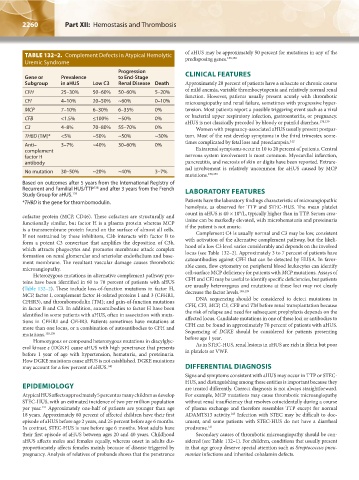
                TABLE 132–2.  Complement Defects in Atypical Hemolytic   of aHUS may be approximately 50 percent for mutations in any of the
                                                                      predisposing genes.
                                                                                    138,139
                Uremic Syndrome
                                                Progression           CLINICAL FEATURES
                Gene or     Prevalence          to End-Stage
                Subgroup    in aHUS    Low C3   Renal Disease Death   Approximately 20 percent of patients have a subacute or chronic course
                CFH         25–30%     50–60%   50–60%      5–20%     of mild anemia, variable thrombocytopenia and relatively normal renal
                                                                      function. However, patients usually present acutely with thrombotic
                CFI         4–10%      20–50%   ~60%        0–10%     microangiopathy and renal failure, sometimes with progressive hyper-
                MCP         7–10%      6–30%    6–35%       0%        tension. Most patients report a possible triggering event such as a viral
                                                                      or bacterial upper respiratory infection, gastroenteritis, or pregnancy.
                CFB         <1.5%      ≤100%    ~50%        0%
                                                                      aHUS is not classically preceded by bloody or painful diarrhea. 138,139
                C3          4–8%       70–80%   55–70%      0%            Women with pregnancy-associated aHUS usually present postpar-
                THBD (TM)*  <5%        ~50%     ~50%        ~30%      tum. Most of the rest develop symptoms in the third trimester, some-
                                                                      times complicated by fetal loss and preeclampsia. 142
                Anti–       3–7%       ~40%     30–60%      0%
                complement                                                Extrarenal symptoms occur in 10 to 20 percent of patients. Central
                factor H                                              nervous system involvement is most common. Myocardial infarction,
                antibody                                              pancreatitis, and necrosis of skin or digits have been reported. Extrare-
                                                                      nal involvement is relatively uncommon for aHUS caused by MCP
                No mutation  30–50%    ~20%     ~40%        3–7%
                                                                      mutations. 138,139
               Based on outcomes after 5 years from the International Registry of
               Recurrent and Familial HUS/TTP  and after 3 years from the French   LABORATORY FEATURES
                                       138
               Study Group for aHUS. 139
               *THBD is the gene for thrombomodulin.                  Patients have the laboratory findings characteristic of microangiopathic
                                                                      hemolysis, as observed for TTP and STEC-HUS. The mean platelet
                                                                      count in aHUS is 40 × 10 /L, typically higher than in TTP. Serum crea-
                                                                                        9
               cofactor protein (MCP, CD46). These cofactors are structurally and
               functionally similar, but factor H is a plasma protein whereas MCP   tinine can be markedly elevated, with microhematuria and proteinuria
               is a transmembrane protein found on the surface of almost all cells.   if the patient is not anuric.
               If not restrained by these inhibitors, C3b interacts with factor B to   Complement C4 is usually normal and C3 may be low, consistent
               form a potent C3 convertase that amplifies the deposition of C3b,   with activation of the alternative complement pathway, but the likeli-
               which attracts phagocytes and promotes membrane attack complex   hood of a low C3 level varies considerably and depends on the involved
               formation on renal glomerular and arteriolar endothelium and base-  locus (see Table  132–2). Approximately 3 to 7 percent of patients have
               ment membrane. The resultant vascular damage causes thrombotic   autoantibodies against CFH that can be detected by ELISA. In favor-
               microangiopathy.                                       able cases, flow cytometry on peripheral blood leukocytes can identify
                   Heterozygous mutations in alternative complement pathway pro-  cell-surface MCP deficiency for patients with MCP mutations. Assays of
               teins have been identified in 60 to 70 percent of patients with aHUS   CFH and CFI may be useful to identify specific deficiencies, but patients
               (Table 132–2). These include loss-of-function mutations in factor H,   are usually heterozygous and mutations at these loci may not clearly
                                                                                        138,139
               MCP, factor I, complement factor H-related proteins 1 and 3 (CFHR1,   decrease the factor levels.
               CFHR3), and thrombomodulin (TM); and gain-of-function mutations   DNA sequencing should  be considered to detect mutations in
               in factor B and C3. In addition, autoantibodies to factor H have been   CFH, CFI, MCP, C3, CFB and TM before renal transplantation because
               identified in some patients with aHUS, often in association with muta-  the risk of relapse and need for subsequent prophylaxis depends on the
               tions in CFHR1 and CFHR3. Patients sometimes have mutations at   affected locus. Candidate mutations in one of these loci or antibodies to
               more than one locus, or a combination of autoantibodies to CFH and   CFH can be found in approximately 70 percent of patients with aHUS.
               mutations. 138,139                                     Sequencing of  DGKE should be considered for patients presenting
                   Homozygous or compound heterozygous mutations in diacylglyc-  before age 1 year.
               erol kinase ε (DGKE) cause aHUS with high penetrance that presents   As in STEC-HUS, renal lesions in aHUS are rich in fibrin but poor
               before 1 year of age with hypertension, hematuria, and proteinuria.   in platelets or VWF.
               How DGKE mutations cause aHUS is not established. DGKE mutations
               may account for a few percent of aHUS. 140             DIFFERENTIAL DIAGNOSIS
                                                                      Signs and symptoms consistent with aHUS may occur in TTP or STEC-
                                                                      HUS, and distinguishing among these entities is important because they
               EPIDEMIOLOGY                                           are treated differently. Correct diagnosis is not always straightforward.
               Atypical HUS affects approximately 5 percent as many children as develop   For example, MCP mutations may cause thrombotic microangiopathy
               STEC-HUS, with an estimated incidence of two per million population   without renal insufficiency that resolves coincidentally during a course
               per  year.  Approximately one-half  of patients are  younger than age    of plasma exchange and therefore resembles TTP except for normal
                      141
               18 years. Approximately 60 percent of affected children have their first   ADAMTS13 activity.  Infection with STEC may be difficult to doc-
                                                                                     143
               episode of aHUS before age 2 years, and 25 percent before age 6 months.   ument, and some patients with STEC-HUS do not have a diarrheal
               In contrast, STEC-HUS is rare before age 6 months. Most adults have   prodrome. 121
               their first episode of aHUS between ages 20 and 40 years. Childhood   Secondary causes of thrombotic microangiopathy should be con-
               aHUS affects males and females equally, whereas onset in adults dis-  sidered (see Table  132–1). For children, conditions that usually present
               proportionately affects females mainly because of disease triggered by   in that age group deserve special attention such as Streptococcus pneu-
               pregnancy. Analysis of relatives of probands shows that the penetrance   moniae infections and inherited cobalamin defects.


          Kaushansky_chapter 132_p2253-2266.indd   2260                                                                 17/09/15   3:48 pm

