


Page 276 - Williams Hematology ( PDFDrive )
P. 276
250  Part IV:  Molecular and Cellular Hematology                 Chapter 17:  Signal Transduction Pathways            251


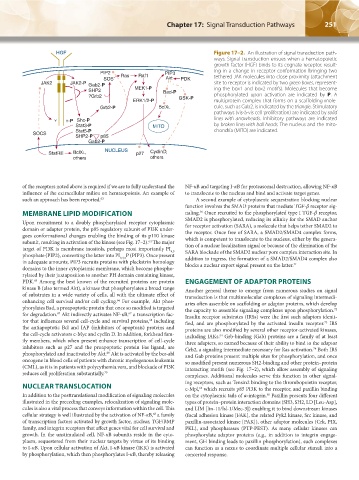
                             HGF                                                  Figure 17–2.  An illustration of signal transduction path-
                                                                                  ways. Signal transduction ensues when a hematopoietic
                                                                                  growth factor (HGF) binds to its cognate receptor, result-
                                            PIP2   Ras   Raf1     PIP3            ing in a change in receptor conformation bringing two
                                             SOS                  Akt  PDK        tethered JAK molecules into close proximity (attachment
                        JAK2      JAK2-P  Gab2-P                                  site to receptor is indicated by two green boxes, represent-
                                        SHP2           MEK1-P    Bad-P            ing the box1 and box2 motifs). Molecules that become
                                        ?Grb2                         GSK-P       phosphorylated upon activation are indicated by  P. A
                                                       ERK1/2-P                   multiprotein complex that forms on a scaffolding mole-
                                            Grb2-P             BclXL              cule, such as Gab2, is indicated by the triangle. Stimulatory
                                                                                  pathways (vis-à-vis cell proliferation) are indicated by solid
                             Y  Y-P  Shc-P                                        lines with arrowheads.  Inhibitory  pathways  are  indicated
                                    Stat3-P                   MITO                by broken lines with ball heads. The nucleus and the mito-
                                    Stat5-P                                       chondria (MITO) are indicated.
                     SOCS
                                    SHP2-P  p85
                                        Gab2-P
                           StatRE  BclXL,     NUCLEUS   p27  CyclinD,
                                   others                    others


                  of the receptors noted above is required if we are to fully understand the   NF-κB and targeting I-κB for proteasomal destruction, allowing NF-κB
                  influence of the extracellular milieu on hematopoiesis. An example of   to translocate to the nucleus and bind and activate target genes.
                  such an approach has been reported. 63                    A second example of cytoplasmic sequestration blocking nuclear
                                                                        function involves the SMAD proteins that mediate TGF-β receptor sig-
                  MEMBRANE LIPID MODIFICATION                           naling.  Once recruited to the phosphorylated type I TGF-β receptor,
                                                                             36
                  Upon recruitment to a doubly phosphorylated receptor cytoplasmic   SMAD2 is phosphorylated, reducing its affinity for the SMAD anchor
                                                                        for receptor activation (SARA), a molecule that helps tether SMAD2 to
                  domain or adapter protein, the p85 regulatory subunit of PI3K under-  the receptor. Once free of SARA, a SMAD2/SMAD4 complex forms,
                  goes conformational changes enabling the binding of its p110 kinase   which is competent to translocate to the nucleus, either by the genera-
                  subunit, resulting in activation of the kinase (see Fig. 17–2).  The major   tion of a nuclear localization signal or because of the elimination of the
                                                            64
                  target of PI3K is membrane inositols, perhaps most importantly PI    SARA blockade of the SMAD2 nuclear pore complex interaction site. In
                                                                    4,5
                  phosphate (PIP2), converting the latter into PI 3,4,5 P (PIP3). Once present   addition to ingress, the formation of a SMAD2/SMAD4 complex also
                  in adequate amounts, PIP3 recruits proteins with pleckstrin homology   blocks a nuclear export signal present on the latter. 71
                  domains to the inner cytoplasmic membrane, which become phospho-
                  rylated by their juxtaposition to another PH domain containing kinase,
                  PDK.  Among the best known of the recruited proteins are protein   ENGAGEMENT OF ADAPTOR PROTEINS
                      65
                  kinase B (also termed Akt), a kinase that phosphorylates a broad range   Another general theme to emerge from numerous studies on signal
                  of substrates in a wide variety of cells, all with the ultimate effect of   transduction is that multimolecular complexes of signaling intermedi-
                  enhancing cell survival and/or cell cycling.  For example, Akt phos-  aries often assemble on scaffolding or adaptor proteins, which develop
                                                  66
                  phorylates Bad, a proapoptotic protein that once so modified is targeted   the capacity to assemble signaling complexes upon phosphorylation.
                                                                                                                          72
                  for degradation.  Akt indirectly activates NF-κB,  a transcription fac-  Insulin receptor substrates (IRSs) were the first such adaptors identi-
                                                     67
                             67
                  tor that influences several cell-cycle and survival proteins,  including   fied, and are phosphorylated by the activated insulin receptor.  IRS
                                                            68
                                                                                                                       73
                  the antiapoptotic Bcl and IAP (inhibitors of apoptosis) proteins and   proteins are also modified by several other receptor-activated kinases,
                  the cell-cycle activators c-Myc and cyclin D. In addition, forkhead fam-  including JAKs.  Grb-binding (Gab) proteins are a family of at least
                                                                                    54
                  ily members, which when present enhance transcription of cell-cycle   three adapters, so named because of their ability to bind to the adaptor
                  inhibitors such as p27 and the proapoptotic protein Fas ligand, are   Grb2, a signaling intermediate necessary for Ras activation.  Both IRS
                                                                                                                   74
                  phosphorylated and inactivated by Akt.  Akt is activated by the bcr-abl   and Gab proteins present multiple sites for phosphorylation, and once
                                              69
                  oncogene in blood cells of patients with chronic myelogenous leukemia   so modified present numerous SH2-binding and other protein–protein
                  (CML), as it is in patients with polycythemia vera, and blockade of PI3K   interacting motifs (see Fig. 17–2), which allow assembly of signaling
                  reduces cell proliferation substantially. 70          complexes. Additional molecules serve this function in other signal-
                  NUCLEAR TRANSLOCATION                                 ing receptors, such as Tensin2 binding to the thrombopoietin receptor,
                                                                        c-Mpl,  which recruits p85 PI3K to the receptor, and paxillin binding
                                                                             63
                  In addition to the posttranslational modification of signaling molecules   on the cytoplasmic tails of α-integrin.  Paxillin presents four different
                                                                                                    48
                  illustrated in the preceding examples, relocalization of signaling mole-  types of protein–protein interaction domains (SH3, SH2, LD [Leu-Asp],
                  cules is also a vital process that conveys information within the cell. This   and LIM [lin-11/Isl-1/Mec-3]) enabling it to bind downstream kinases
                  cellular strategy is well illustrated by the activation of NF-κB,  a family   (focal adhesion kinase [FAK], the related Pyk2 kinase, Src kinase, and
                                                              68
                  of transcription factors activated by growth factor, nuclear, TGF/BMP   paxillin-associated kinase [PAK]), other adaptor molecules (Crk, PIX,
                  family, and integrin receptors that affect genes vital for cell survival and   PKL), and phosphatases (PTP-PEST). As many cellular kinases can
                  growth. In the unstimulated cell, NF-κB subunits reside in the cyto-  phosphorylate adaptor proteins (e.g., in addition to integrin engage-
                  plasm, sequestered from their nuclear targets by virtue of its binding   ment, GH binding leads to paxillin phosphorylation), such complexes
                  to I-κB. Upon cellular activation of Akt, I-κB kinase (IKK) is activated   can function as a nexus to coordinate multiple cellular stimuli into a
                  by phosphorylation, which then phosphorylates I-κB, thereby releasing   concerted response.


          Kaushansky_chapter 17_p0247-0256.indd   251                                                                   9/17/15   5:45 PM

