


Page 283 - Williams Hematology ( PDFDrive )
P. 283
258            Part IV:  Molecular and Cellular Hematology                                                                                            Chapter 18:  Hematopoietic Stem Cells, Progenitors, and Cytokines            259


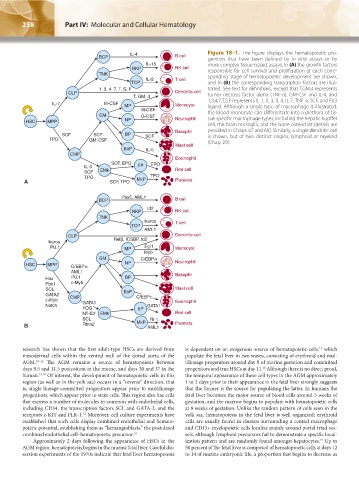
                                                                              Figure 18–1.  The figure displays the hematopoietic pro-
                                                                              genitors  that  have  been  defined  by  in  vitro  assays  or  by
                                                                              more complex tissue-based assays. In (A) the growth factors
                                                                              responsible for cell survival and proliferation at each corre-
                                                                              sponding stage of hematopoietic development are shown,
                                                                              and in (B) the corresponding transcription factors are illus-
                                                                              trated. See text for definitions, except that T,GM,4 represents
                                                                              tumor necrosis factor alpha (TNF-α), GM-CSF and IL-4, and
                                                                              1,3,4,7,T,S,F represents IL-1, IL-3, IL-4, IL-7, TNF-α, SCF, and Flt3
                                                                              ligand. Although a single type of macrophage is illustrated,
                                                                              the blood monocyte can differentiate into a plethora of tis-
                                                                              sue specific macrophage types, including the hepatic Kupffer
                                                                              cell, the brain microglia, and the bone osteoclast (details are
                                                                              provided in Chaps. 67 and 69). Similarly, a single dendritic cell
                                                                              is shown, but of two distinct origins, lymphoid or myeloid
                                                                              (Chap. 20).


               research has shown that the first adult-type HSCs are derived from   is dependent on an exogenous source of hematopoietic cells,  which
                                                                                                                   17
               mesodermal cells within the ventral wall of the dorsal aorta of the   populate the fetal liver in two waves, consisting of erythroid and mul-
               AGM. 10–12  The AGM remains a source of hematopoiesis between   tilineage progenitors around day 9 of murine gestation and committed
               days 9.5 and 11.5 postcoitum in the mouse, and days 30 and 37 in the   progenitors and true HSCs at day 11.  Although there is no direct proof,
                                                                                                18
               human. 13,14  Of interest, the development of hematopoietic cells in this   the temporal appearance of these cell types in the AGM approximately
               region (as well as in the yolk sac) occurs in a “reverse” direction, that   1 to 2 days prior to their appearance in the fetal liver strongly suggests
               is, single lineage-committed progenitors appear prior to multilineage   that the former is the source for populating the latter. In humans the
               progenitors, which appear prior to stem cells. This region also has cells   fetal liver becomes the major source of blood cells around 5 weeks of
               that express a number of molecules in common with endothelial cells,   gestation, and the marrow begins to populate with hematopoietic cells
               including CD34, the transcription factors SCL and GATA-2, and the   at 8 weeks of gestation. Unlike the random pattern of cells seen in the
               receptors c-KIT and FLK-1.  Moreover, cell culture experiments have   yolk sac, hematopoiesis in the fetal liver is well organized; erythroid
                                    15
               established that such cells display combined endothelial and hemato-  cells are usually found in clusters surrounding a central macrophage
               poietic potential, establishing them as “hemangioblasts,” the postulated   and CD15+ myelopoietic cells localize mainly around portal triad ves-
               combined endothelial cell–hematopoietic precursor. 16  sels, although lymphoid precursors fail to demonstrate a specific local-
                   Approximately 2 days following the appearance of HSCs in the   ization pattern and are randomly found amongst hepatocytes.  Up to
                                                                                                                   19
               AGM region, hematopoiesis begins in the murine fetal liver. Careful dis-  50 percent of the fetal liver is composed of hematopoietic cells at days 12
               section experiments of the 1970s indicate that fetal liver hematopoiesis   to 14 of murine embryonic life, a proportion that begins to decrease as


          Kaushansky_chapter 18_p0257-0278.indd   258                                                                   9/19/15   12:05 AM

