


Page 288 - Williams Hematology ( PDFDrive )
P. 288
262  Part IV:  Molecular and Cellular Hematology  Chapter 18:  Hematopoietic Stem Cells, Progenitors, and Cytokines   263


                  Several investigators have shown that the 5′ flanking region of the c-mpl                Perivascular
                  gene contains a functionally important GATA site and that GATA1              Mø          Stromal cells
                  transactivates the gene in hematopoietic cell lines.  Because GATA1                      CAR cells
                                                       134
                  does not appear in hematopoietic cells until they have lost their repop-                 Nestin-GFP +
                  ulating capacity, it is possible that GATA2 fulfills this role in HSCs,                  LeptinR +
                  although there is no evidence yet available establishing that this protein               Prx1 +
                  can transactivate the c-mpl GATA site. 135

                  STEM CELL AGING                                              Mø                 HSC      `SM
                  While blood cell counts do not change substantially in elderly mam-                          CXCL 12
                  mals, a number of alterations are demonstrable in HSCs derived from   OM
                  older individuals. In aged mice, the HSC compartment expands,          HSC    OM             KitL
                                                         136
                  although each HSC has reduced capacity to expand.  Upon trans-
                  plantation, aged marrow HSCs display a myeloid skewing, generating           Ob              Oc
                  reduced numbers of T- and B-lymphoid precursors, that along with
                  thymic involution helps to explain the immune depletion seen in older     BONE
                  adults. Similar findings were reported when aged human stem cells were
                                                    137
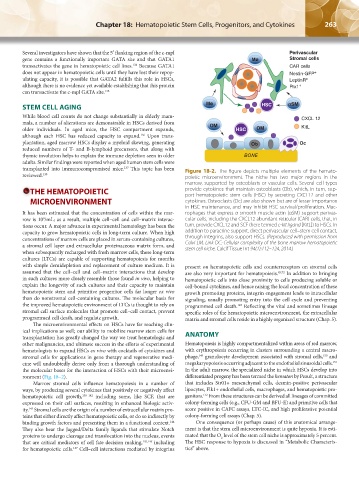
                  transplanted  into  immunocompromised  mice.   This  topic  has  been   Figure 18-2.  The  figure  depicts  multiple  elements  of  the  hemato-
                  reviewed. 138                                         poietic microenvironment.  The niche has two major regions in the
                                                                        marrow, supported by osteoblasts or vascular cells. Several cell types
                      THE HEMATOPOIETIC                                 provide cytokines that maintain osteoblasts (Ob), which, in turn, sup-
                                                                        port hematopoietic stem cells (HSC) by secreting CXCL12 and other
                    MICROENVIRONMENT                                    cytokines. Osteoclasts (Oc) are also shown but are of lesser importance
                                                                        in HSC maintenance, and may inhibit HSC survival/proliferation. Mac-
                  It has been estimated that the concentration of cells within the mar-  rophages that express α smooth muscle actin (αSM) support perivas-
                  row is 10 /mL; as a result, multiple cell–cell and cell–matrix interac-  cular cells, including the CXCL12 abundant reticular (CAR) cells, that, in
                         9
                  tions occur. A major advance in experimental hematology has been the   turn, provide CXCL12 and SCF (here termed c-kit ligand [KitL]) to HSCs. In
                  capacity to grow hematopoietic cells in long-term culture. When high   addition to paracrine support, direct perivascular cell–stem cell contact,
                  concentrations of marrow cells are placed in serum-containing cultures,   through integrins, also support HSCs. (Reproduced with permission from
                  a stromal cell layer and extracellular proteinaceous matrix form, and   Calvi LM, Link DC: Cellular complexity of the bone marrow hematopoietic
                  when subsequently recharged with fresh marrow cells, these long-term   stem cell niche. Calcif Tissue Int 94(1):112–124, 2014.)
                  cultures (LTCs) are capable of supporting hematopoiesis for months
                  with simple demidepletion and replacement of culture medium. It is   present on hematopoietic cells and counterreceptors on stromal cells
                  assumed that the cell–cell and cell–matrix interactions that develop   are also very important for hematopoiesis. 65,72  In addition to bringing
                  in such cultures more closely resemble those found in vivo, helping to   hematopoietic cells into close proximity to cells producing soluble or
                  explain the longevity of such cultures and their capacity to maintain   cell-bound cytokines, and hence raising the local concentration of these
                  hematopoietic stem and primitive progenitor cells far longer ex vivo   growth promoting proteins, integrin engagement leads to intracellular
                  than do nonstromal cell-containing cultures. The molecular basis for   signaling, usually promoting entry into the cell cycle and preventing
                  the improved hematopoietic environment of LTCs is thought to rely on   programmed cell death.  Reflecting the vital and sometimes lineage
                                                                                          148
                  stromal cell surface molecules that promote cell–cell contact, prevent   specific roles of the hematopoietic microenvironment, the extracellular
                  programmed cell death, and regulate growth.           matrix and stromal cells reside in a highly organized structure (Chap. 5).
                     The microenvironmental effects on HSCs have far reaching clin-
                  ical implications as well; our ability to mobilize marrow stem cells for
                  transplantation has greatly changed the way we treat hematologic and   ANATOMY
                  other malignancies, and ultimate success in the efforts of experimental   Hematopoiesis is highly compartmentalized within areas of red marrow,
                  hematologists to expand HSCs ex vivo with cocktails of cytokines and   with erythropoiesis occurring in clusters surrounding a central macro-
                                                                                                                       150
                                                                             149
                  stromal cells for applications in gene therapy and regenerative medi-  phage,  granulocyte development associated with stromal cells,  and
                                                                                                                          151
                  cine will undoubtedly derive only from a thorough understanding of   megakaryopoiesis occurring adjacent to the endothelial sinusoidal cells.
                  the molecular bases for the interaction of HSCs with their microenvi-  In the adult marrow, the specialized niche in which HSCs develop into
                  ronment (Fig. 18–2).                                  differentiated progeny has been termed the hematon by Peault, a structure
                     Marrow stromal cells influence hematopoiesis in a number of   that includes Str01+ mesenchymal cells, desmin-positive perivascular
                  ways, by producing several cytokines that positively or negatively affect   lipocytes, Flk1+ endothelial cells, macrophages, and hematopoietic pro-
                                                                              152
                  hematopoietic cell growth, 139–142  including some, like SCF, that are   genitors.  From these structures can be derived all lineages of committed
                  expressed on their cell surfaces, resulting in enhanced biologic activ-  colony-forming cells (e.g., CFU-GM and BFU-E) and primitive cells that
                    143
                  ity.  Stromal cells are the origin of a number of extracellular matrix pro-  score positive in CAFC assays, LTC-IC, and high proliferative potential
                  teins that either directly affect hematopoietic cells, or do so indirectly by   colony-forming cell assays (Chap. 5).
                  binding growth factors and presenting them in a functional context.    One consequence (or perhaps cause) of this anatomical arrange-
                                                                   144
                  They also bear the Jagged/Delta family ligands that stimulate Notch   ment is that the stem cell microenvironment is quite hypoxia. It is esti-
                  proteins to undergo cleavage and translocation into the nucleus, events   mated that the O  level of the stem cell niche is approximately 5 percent.
                                                                                    2
                  that are critical mediators of cell fate decision making, 145,146  including   The HSC response to hypoxia is discussed in “Metabolic Characteris-
                  for hematopoietic cells.  Cell–cell interactions mediated by integrins   tics” above.
                                   147


          Kaushansky_chapter 18_p0257-0278.indd   263                                                                   9/19/15   12:05 AM

