


Page 289 - Williams Hematology ( PDFDrive )
P. 289
264            Part IV:  Molecular and Cellular Hematology                                                                                            Chapter 18:  Hematopoietic Stem Cells, Progenitors, and Cytokines            265


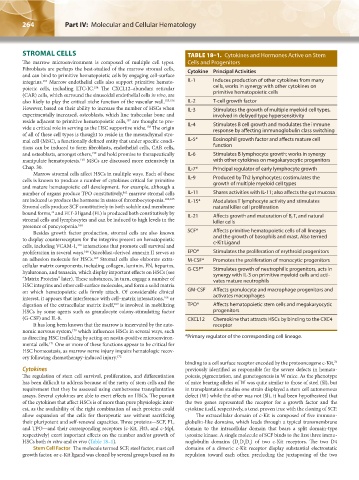
               STROMAL CELLS                                           TABLE 18–1.  Cytokines and Hormones Active on Stem
               The marrow microenvironment is composed of multiple cell types.   Cells and Progenitors
               Fibroblasts are perhaps the best-studied of the marrow stromal cells,   Cytokine Principal Activities
               and can bind to primitive hematopoietic cells by engaging cell-surface
               integrins.  Marrow endothelial cells also support primitive hemato-  IL-1  Induces production of other cytokines from many
                      153
               poietic cells, including LTC-IC.  The CXCL12–abundant reticular   cells, works in synergy with other cytokines on
                                       154
               (CAR) cells, which surround the sinusoidal endothelial cells in vivo, are   primitive hematopoietic cells
               also likely to play the critical niche function of the vascular wall. 155,156    IL-2  T-cell growth factor
               However, based on their ability to increase the number of HSCs when   IL-3  Stimulates the growth of multiple myeloid cell types,
               experimentally increased, osteoblasts, which line trabecular bone and   involved in delayed type hypersensitivity
               reside adjacent to primitive hematopoietic cells,  are thought to pro-
                                                  157
               vide a critical role in serving as the HSC supportive niche.  The origin   IL-4  Stimulates B cell growth and modulates the immune
                                                         158
                                                                               response by affecting immunoglobulin class switching
               of all of these cell types is thought to reside in the mesenchymal stro-
               mal cell (MSC), a functionally defined entity that under specific condi-  IL-5*  Eosinophil growth factor and affects mature cell
               tions can be induced to form fibroblasts, endothelial cells, CAR cells,   function
               and osteoblasts, amongst others,  and hold promise to therapeutically   IL-6  Stimulates B lymphocyte growth; works in synergy
                                       159
               manipulate hematopoiesis.  MSCs are discussed more extensively in   with other cytokines on megakaryocytic progenitors
                                   160
               Chap. 30.                                               IL-7*   Principal regulator of early lymphocyte growth
                   Marrow stromal cells affect HSCs in multiple ways. Each of these
               cells is known to produce a number of cytokines critical for primitive   IL-9  Produced by Th2 lymphocytes; costimulates the
               and mature hematopoietic cell development. For example, although a   growth of multiple myeloid cell types
               number of organs produce TPO constitutively,  marrow stromal cells   IL-11  Shares activities with IL-11; also affects the gut mucosa
                                                 161
               are induced to produce the hormone in states of thrombocytopenia. 162,163    IL-15*  Modulates T lymphocyte activity and stimulates
               Stromal cells produce SCF constitutively in both soluble and membrane   natural killer cell proliferation
               bound forms,  and FLT-3 ligand (FL) is produced both constitutively by   IL-21  Affects growth and maturation of B, T, and natural
                         76
               stromal cells and lymphocytes and can be induced to high levels in the   killer cells
               presence of pancytopenia. 164
                   Besides  growth factor production,  stromal cells  are  also known   SCF*  Affects primitive hematopoietic cells of all lineages
               to display counterreceptors for the integrins present on hematopoietic   and the growth of basophils and mast. Also termed
               cells, including VCAM-1,  interactions that promote cell survival and   c-Kit Ligand
                                  165
               proliferation in several ways.  Osteoblast-derived annexin II serves as   EPO*  Stimulates the proliferation of erythroid progenitors
                                    166
               an adhesion molecule for HSCs.  Stromal cells also elaborate extra-  M-CSF*  Promotes the proliferation of monocytic progenitors
                                       167
               cellular matrix components, including collagen, laminin, FN, heparins,
               hyaluronan, and tenascin, which display important effects on HSCs (see   G-CSF*  Stimulates growth of neutrophilic progenitors, acts in
                                                                               synergy with IL-3 on primitive myeloid cells and acti-
               “Matrix Proteins” later). These substances, in turn, engage a number of   vates mature neutrophils
               HSC integrins and other cell-surface molecules, and form a solid matrix
               on which hematopoietic cells firmly attach. Of considerable clinical   GM-CSF  Affects granulocyte and macrophage progenitors and
               interest, it appears that interference with cell–matrix interactions,  or   activates macrophages
                                                               168
               digestion of the extracellular matrix itself,  is involved in mobilizing   TPO*  Affects hematopoietic stem cells and megakaryocytic
                                              169
               HSCs by some agents such as granulocyte colony-stimulating factor   progenitors
               (G-CSF) and IL-8.                                       CXCL12  Chemokine that attracts HSCs by binding to the CXC4
                   It has long been known that the marrow is innervated by the auto-  receptor
               nomic nervous system,  which influences HSCs in several ways, such
                                170
               as directing HSC trafficking by acting on nestin-positive microenviron-  *Primary regulator of the corresponding cell lineage.
               mental cells.  One or more of these functions appear to be critical for
                        171
               HSC homeostasis, as marrow nerve injury impairs hematologic recov-
               ery following chemotherapy-induced injury. 172
                                                                      binding to a cell surface receptor encoded by the protooncogene c-Kit,
                                                                                                                        76
               Cytokines                                              previously identified as responsible for the severe defects in hemato-
               The regulation of stem cell survival, proliferation, and differentiation   poiesis, pigmentation, and gametogenesis in W mice. As the phenotype
               has been difficult to address because of the rarity of stem cells and the   of mice bearing alleles of W was quite similar to those of steel (Sl), but
               requirement that they be assessed using cumbersome transplantation   in transplantation studies one strain displayed a stem cell autonomous
               assays. Several cytokines are able to exert effects on HSCs. The pursuit   defect (W) while the other was not (Sl), it had been hypothesized that
               of the cytokines that affect HSCs is of more than pure physiologic inter-  the two genes represented the receptor for a growth factor and the
               est, as the availability of the right combination of such proteins could   cytokine itself, respectively, a tenet proven true with the cloning of SCF.
               allow expansion of the cells for therapeutic use without sacrificing   The extracellular domain of c-Kit is composed of five immuno-
               their pluripotent and self-renewal capacities. Three proteins—SCF, FL,   globulin-like domains, which leads through a typical transmembrane
               and TPO—and their corresponding receptors (c-Kit, Flt3, and c-Mpl,   domain to the intracellular domain that bears a split domain-type
               respectively) exert important effects on the number and/or growth of   tyrosine kinase. A single molecule of SCF binds to the first three immu-
               HSCs both in vitro and in vivo (Table 18–1).           noglobulin  domains (D D D ) of  two c-Kit  receptors.  The two D4
                                                                                          2
                                                                                           3
                                                                                        1
                   Stem Cell Factor  The molecule termed SCF, steel factor, mast cell   domains  of  a  dimeric  c-Kit  receptor  display  substantial  electrostatic
               growth factor, or c-Kit ligand was cloned by several groups based on its   repulsion toward each other, precluding the juxtaposing of the two


          Kaushansky_chapter 18_p0257-0278.indd   264                                                                   9/19/15   12:05 AM

