


Page 419 - Williams Hematology ( PDFDrive )
P. 419
394            Part V:  Therapeutic Principles                                                                                                                                     Chapter 25:  Antithrombotic Therapy             395


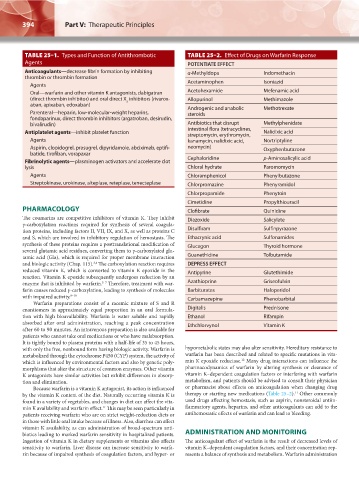
                TABLE 25–1.  Types and Function of Antithrombotic      TABLE 25–2.  Effect of Drugs on Warfarin Response
                Agents                                                 POTENTIATE EFFECT
                Anticoagulants—decrease fibrin formation by inhibiting   α-Methyldopa           Indomethacin
                thrombin or thrombin formation
                  Agents                                               Acetaminophen            Isoniazid
                   Oral—warfarin and other vitamin K antagonists, dabigatran   Acetohexamide    Mefenamic acid
                  (direct thrombin inhibitor) and oral direct X  inhibitors (rivarox-  Allopurinol  Methimazole
                                                  a
                  aban, apixaban, edoxaban)                            Androgenic and anabolic   Methotrexate
                   Parenteral—heparin, low-molecular-weight heparins,   steroids
                  fondaparinux, direct thrombin inhibitors (argatroban, desirudin,
                  bivalirudin)                                         Antibiotics that disrupt   Methylphenidate
                Antiplatelet agents—inhibit platelet function          intestinal flora (tetracyclines,   Nalidixic acid
                                                                       streptomycin, erythromycin,
                  Agents                                               kanamycin, nalidixic acid,   Nortriptyline
                   Aspirin, clopidogrel, prasugrel, dipyridamole, abciximab, eptifi-  neomycin)  Oxyphenbutazone
                  batide, tirofiban, vorapaxar
                Fibrinolytic agents—plasminogen activators and accelerate clot   Cephaloridine  p-Aminosalicylic acid
                lysis                                                  Chloral hydrate          Paromomycin
                  Agents                                               Chloramphenicol          Phenylbutazone
                  Streptokinase, urokinase, alteplase, reteplase, tenecteplase  Chlorpromazine  Phenyramidol
                                                                       Chlorpropamide           Phenytoin
                                                                       Cimetidine               Propylthiouracil
               PHARMACOLOGY                                            Clofibrate               Quinidine
               The coumarins are competitive inhibitors of vitamin K. They inhibit   Diazoxide  Salicylate
               γ-carboxylation reactions required for synthesis of several coagula-
               tion proteins, including factors II, VII, IX, and X, as well as proteins C   Disulfiram  Sulfinpyrazone
               and S, which are involved in inhibitory regulation of hemostasis. The   Ethacrynic acid  Sulfonamides
               synthesis of these proteins requires a posttranslational modification of   Glucagon  Thyroid hormone
               several glutamic acid residues, converting them to γ-carboxylated glu-
               tamic acid (Gla), which is required for proper membrane interaction   Guanethidine  Tolbutamide
               and biologic activity (Chap. 115).  The carboxylation reaction requires   DEPRESS EFFECT
                                       3,4
               reduced vitamin K, which is converted to vitamin K epoxide  in the   Antipyrine  Glutethimide
               reaction. Vitamin K epoxide subsequently undergoes reduction by an
               enzyme that is inhibited by warfarin.  Therefore, treatment with war-  Azathioprine  Griseofulvin
                                          5–7
               farin causes reduced γ-carboxylation, leading to synthesis of molecules   Barbiturates  Haloperidol
               with impaired activity. 8–10                            Carbamazepine            Phenobarbital
                   Warfarin preparations consist of a racemic mixture of S and R
               enantiomers in approximately equal  proportion  in an oral formula-  Digitalis   Prednisone
               tion  with  high  bioavailability.  Warfarin  is  water  soluble  and  rapidly   Ethanol  Rifampin
               absorbed after oral administration, reaching a peak concentration   Ethchlorvynol  Vitamin K
               after 60 to 90 minutes. An intravenous preparation is also available for
               patients who cannot take oral medications or who have malabsorption.
               It is tightly bound to plasma proteins with a half-life of 35 to 45 hours,
               with only the free, nonbound form having biologic activity. Warfarin is   hypometabolic states may also alter sensitivity. Hereditary resistance to
               metabolized through the cytochrome P450 (CYP) system, the activity of   warfarin has been described and related to specific mutations in vita-
                                                                                         12
               which is influenced by environmental factors and also by genetic poly-  min K epoxide reductase.  Many drug interactions can influence the
               morphisms that alter the structure of common enzymes. Other vitamin   pharmacodynamics of warfarin by altering synthesis or clearance of
               K antagonists have similar activities but exhibit differences in absorp-  vitamin K–dependent coagulation factors or interfering with warfarin
               tion and elimination.                                  metabolism, and patients should be advised to consult their physician
                   Because warfarin is a vitamin K antagonist, its action is influenced   or pharmacist  about effects on anticoagulation  when changing  drug
                                                                                                           11
               by the vitamin K content of the diet. Naturally occurring vitamin K is   therapy or starting new medications (Table 25–2).  Other commonly
               found in a variety of vegetables, and changes in diet can affect the vita-  used drugs affecting hemostasis, such as aspirin, nonsteroidal antiin-
               min K availability and warfarin effect.  This may be seen particularly in   flammatory agents, heparins, and other anticoagulants can add to the
                                          11
               patients receiving warfarin who are on strict weight-reduction diets or   antihemostatic effects of warfarin and can lead to bleeding.
               in those with little oral intake because of illness. Also, diarrhea can affect
               vitamin K availability, as can administration of broad-spectrum anti-
               biotics leading to marked warfarin sensitivity in hospitalized patients.   ADMINISTRATION AND MONITORING
               Ingestion of vitamin K in dietary supplements or vitamins also affects   The anticoagulant effect of warfarin is the result of decreased levels of
               sensitivity to warfarin. Liver disease can increase sensitivity to warfa-  vitamin K–dependent coagulation factors, and their concentration rep-
               rin because of impaired synthesis of coagulation factors, and hyper- or   resents a balance of synthesis and metabolism. Warfarin administration


          Kaushansky_chapter 25_p0393-0408.indd   394                                                                   9/19/15   12:19 AM

