


Page 421 - Williams Hematology ( PDFDrive )
P. 421
396            Part V:  Therapeutic Principles                                                                                                                                     Chapter 25:  Antithrombotic Therapy             397


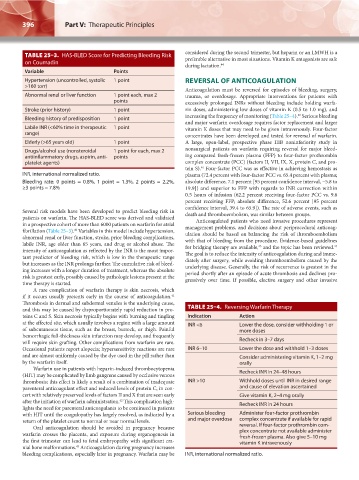
                TABLE 25–3.  HAS-BLED Score for Predicting Bleeding Risk   considered during the second trimester, but heparin or an LMWH is a
                                                                      preferable alternative in most situations. Vitamin K antagonists are safe
                on Coumadin
                                                                      during lactation. 44
                Variable                      Points
                Hypertension (uncontrolled, systolic   1 point        REVERSAL OF ANTICOAGULATION
                >160 torr)
                                                                      Anticoagulation must be reversed for episodes of bleeding, surgery,
                Abnormal renal or liver function  1 point each, max 2   trauma, or overdosage. Appropriate interventions for patients with
                                              points                  excessively prolonged INRs without bleeding include holding warfa-
                Stroke (prior history)        1 point                 rin doses, administering low doses of vitamin K (0.5 to 1.0 mg), and
                                                                      increasing the frequency of monitoring (Table 25–4).  Serious bleeding
                                                                                                            45
                Bleeding history of predisposition  1 point
                                                                      and major warfarin overdosage requires factor replacement and larger
                Labile INR (<60% time in therapeutic   1 point        vitamin K doses that may need to be given intravenously. Four-factor
                range)                                                concentrates have been developed and tested for reversal of warfarin.
                Elderly (>65 years old)       1 point                 A large, open-label, prospective phase IIIB noninferiority study in
                Drugs/alcohol use (nonsteroidal   1 point for each, max 2   nonsurgical patients on warfarin requiring reversal for major bleed-
                antiinflammatory drugs, aspirin, anti-  points        ing compared fresh-frozen plasma (FFP) to four-factor prothrombin
                platelet agents)                                      complex concentrate (PCC) (factors II, VII, IX, X, protein C, and pro-
                                                                      tein S).  Four-factor PCC was as effective in achieving hemostasis as
                                                                           46
               INR, international normalized ratio.                   plasma (72.4 percent with four-factor PCC vs. 65.4 percent with plasma;
               Bleeding rate: 0 points = 0.8%, 1 point = 1.3%, 2 points = 2.2%,     absolute difference, 7.1 percent [95 percent confidence interval, −5.8 to
               ≥3 points = 7.8%                                       19.9]) and superior to FFP with regards to INR correction within
                                                                      0.5 hours of infusion (62.2 percent receiving four-factor PCC vs. 9.6
                                                                      percent receiving FFP; absolute difference, 52.6 percent [95 percent
                                                                      confidence interval, 39.4 to 65.9]). The rate of adverse events, such as
               Several risk models have been developed to predict bleeding risk in   death and thromboembolism, was similar between groups.
               patients on warfarin. The HAS-BLED score was derived and validated   Anticoagulated patients who need invasive procedures represent
               in a prospective cohort of more than 6000 patients on warfarin for atrial   management problems, and decisions about periprocedural anticoag-
               fibrillation (Table 25–3).  Variables in this model include hypertension,   ulation should be based on balancing the risk of thromboembolism
                                 40
               abnormal renal or liver function, stroke, prior bleeding complications,   with that of bleeding from the procedure. Evidence-based guidelines
               labile INR, age older than 65 years, and drug or alcohol abuse. The   for bridging therapy are available,  and the topic has been reviewed.
                                                                                               45
                                                                                                                        47
               intensity of anticoagulation as reflected by the INR is the most impor-  The goal is to reduce the intensity of anticoagulation during and imme-
               tant predictor of bleeding risk, which is low in the therapeutic range   diately after surgery, while avoiding thromboembolism caused by the
               but increases as the INR prolongs further. The cumulative risk of bleed-  underlying disease. Generally, the risk of recurrence is greatest in the
               ing increases with a longer duration of treatment, whereas the absolute   period shortly after an episode of acute thrombosis and declines pro-
               risk is greatest early, possibly caused by pathologic lesions present at the   gressively over time. If possible, elective surgery and other invasive
               time therapy is started.
                   A rare complication of warfarin therapy is skin necrosis, which
               if it occurs usually presents early in the course of anticoagulation.
                                                                 41
               Thrombosis in dermal and subdermal venules is the underlying cause,
               and this may be caused by disproportionately rapid reduction in pro-  TABLE 25–4.  Reversing Warfarin Therapy
               teins C and S. Skin necrosis typically begins with burning and tingling   Indication  Action
               at the affected site, which usually involves a region with a large amount   INR <6  Lower the dose, consider withholding 1 or
               of subcutaneous tissue, such as the breast, buttock, or thigh. Painful   more doses
               hemorrhagic full-thickness skin infarction may develop, and frequently
               will require skin grafting. Other complications from warfarin are rare.   Recheck in 3–7 days
               Occasional patients report alopecia; hypersensitivity reactions are rare   INR 6–10  Lower the dose and withhold 1–3 doses
               and are almost uniformly caused by the dye used in the pill rather than   Consider administering vitamin K, 1–2 mg
               by the warfarin itself.                                                  orally
                   Warfarin use in patients with heparin-induced thrombocytopenia       Recheck INR in 24–48 hours
               (HIT) may be complicated by limb gangrene caused by occlusive venous
               thrombosis; this effect is likely a result of a combination of inadequate   INR >10  Withhold doses until INR in desired range
               parenteral anticoagulant effect and reduced levels of protein C, in con-  and cause of elevation ascertained
               cert with relatively preserved levels of factors II and X that are seen early   Give vitamin K, 2–4 mg orally
               after the initiation of warfarin administration.  This complication high-  Recheck INR in 24 hours
                                                42
               lights the need for parenteral anticoagulants to be continued in patients
               with HIT until the coagulopathy has largely resolved, as indicated by a   Serious bleeding   Administer four-factor prothrombin
               return of the platelet count to normal or near normal levels.  and major overdose  complex concentrate if available for rapid
                   Oral anticoagulation should be avoided in pregnancy because          reversal. If four-factor prothrombin com-
                                                                                        plex concentrate not available administer
               warfarin crosses the placenta, and exposure during organogenesis in      fresh-frozen plasma. Also give 5–10 mg
               the first trimester can lead to fetal embryopathy with significant cra-  vitamin K intravenously
               nial bone malformations.  Anticoagulation during pregnancy increases
                                 43
               bleeding complications, especially later in pregnancy. Warfarin may be   INR, international normalized ratio.


          Kaushansky_chapter 25_p0393-0408.indd   396                                                                   9/19/15   12:19 AM

