


Page 707 - Williams Hematology ( PDFDrive )
P. 707
682            Part VI:  The Erythrocyte                                                                                                                                  Chapter 46:  Erythrocyte Membrane Disorders              683


               Other Neuroacanthocytosis Syndromes                    clinical phenotypes and also resemble Huntington disease, which ren-
               The HDL2 disorder is caused by expanded CGT/CAG trinucleotide   ders the clinical diagnosis difficult. Identification of the underlying gene
               repeat mutations in the junctophilin-3 gene, which encodes a protein   defects and the availability of molecular tests have markedly improved
               involved in junctional membrane structures and calcium regulation.    the diagnostic accuracy. This also provides insight into the underlying
                                                                 167
               The disease is autosomal dominant and presents with late-onset cho-  pathogenesis and suggests that the affected proteins, which are all linked
               rea, parkinsonism, and progressive cognitive defects. Acanthocytes are   to membrane structure, may participate in a common pathway that ulti-
               present in some patients. In one unusual kindred autosomal dominant   mately causes degeneration of the basal ganglia.
               inheritance of chorea-acanthocytosis with polyglutamine neuronal
               inclusions was described in association with HDL2. Proteolysis of
               band 3 was also noted, which could contribute to the altered red cell   HEREDITARY STOMATOCYTOSIS SYNDROMES
               morphology. 170,173                                    The intracellular concentration of the monovalent cations, Na  and K ,
                                                                                                                        +
                                                                                                                   +
                   Acanthocytes have been noted in some patients with PKAN (for-  contribute to erythrocyte volume homeostasis. A net increase in these
               merly known as Hallervorden-Spatz syndrome) with features of dys-  cations causes water to enter the cells resulting in overhydrated cells or
               tonia, dysarthria, and rigidity in childhood, and in HARP syndrome   stomatocytes, whereas a net loss dehydrates the cells and forms xero-
               (hypobetalipoproteinemia,  acanthocytosis,  retinitis  pigmentosa  and   cytes. Disorders of red cell cation permeability are very rare conditions
               pallidal degeneration). Both conditions are caused by mutations in pan-  that are inherited in an autosomal dominant fashion with marked clini-
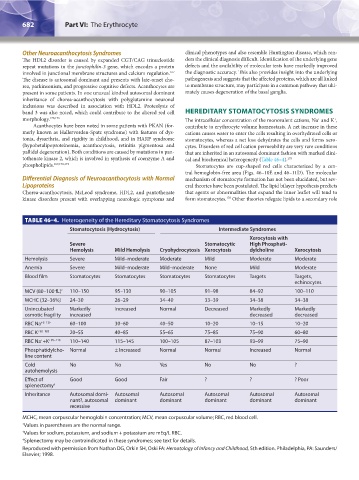
               tothenate kinase 2, which is involved in synthesis of coenzyme A and   cal and biochemical heterogeneity (Table 46–4). 175
               phospholipids. 167,170,174                                 Stomatocytes are cup-shaped red cells characterized by a cen-
                                                                      tral hemoglobin-free area (Figs. 46–10E and 46–11D). The molecular
               Differential Diagnosis of Neuroacanthocytosis with Normal   mechanism of stomatocyte formation has not been elucidated, but sev-
               Lipoproteins                                           eral theories have been postulated. The lipid bilayer hypothesis predicts
               Chorea-acanthocytosis, McLeod syndrome, HDL2, and pantothenate   that agents or abnormalities that expand the inner leaflet will tend to
               kinase disorders present with overlapping neurologic symptoms and   form stomatocytes.  Other theories relegate lipids to a secondary role
                                                                                    176


                TABLE 46–4.  Heterogeneity of the Hereditary Stomatocytosis Syndromes
                               Stomatocytosis (Hydrocytosis)                     Intermediate Syndromes
                                                                                            Xerocytosis with
                               Severe                                        Stomatocytic   High Phosphati-
                               Hemolysis      Mild Hemolysis  Cryohydrocytosis Xerocytosis  dylcholine     Xerocytosis
                Hemolysis      Severe         Mild–moderate  Moderate        Mild           Moderate       Moderate
                Anemia         Severe         Mild–moderate  Mild–moderate   None           Mild           Moderate
                Blood film     Stomatocytes   Stomatocytes   Stomatocytes    Stomatocytes   Targets        Targets,
                                                                                                           echinocytes
                MCV (80–100 fL) *  110–150    95–130         90–105          91–98          84–92          100–110
                MCHC (32–36%)  24–30          26–29          34–40           33–39          34–38          34–38
                Unincubated    Markedly       Increased      Normal          Decreased      Markedly       Markedly
                osmotic fragility  increased                                                decreased      decreased
                RBC Na +5–12†  60–100         30–60          40–50           10–20          10–15          10–20
                RBC K +90–103  20–55          40–85          55–65           75–85          75–90          60–80
                RBC Na +K +95–110  110–140    115–145        100–105         87–103         93–99          75–90
                      +
                Phosphatidylcho-  Normal      ± Increased    Normal          Normal         Increased      Normal
                line content
                Cold           No             No             Yes             No             No             ?
                autohemolysis
                Effect of      Good           Good           Fair            ?              ?              ? Poor
                splenectomy ‡
                Inheritance    Autosomal domi-  Autosomal    Autosomal       Autosomal      Autosomal      Autosomal
                               nant?, autosomal   dominant   dominant        dominant       dominant       dominant
                               recessive
               MCHC, mean corpuscular hemoglobin concentration; MCV, mean corpuscular volume; RBC, red blood cell.
               * Values in parentheses are the normal range.
               † Values for sodium, potassium, and sodium + potassium are mEq/L RBC.
               ‡ Splenectomy may be contraindicated in these syndromes; see text for details.
               Reproduced with permission from Nathan DG, Orkin SH, Oski FA: Hematology of Infancy and Childhood, 5th edition. Philadelphia, PA: Saunders/
               Elsevier; 1998.


          Kaushansky_chapter 46_p0661-0688.indd   682                                                                   9/17/15   6:42 PM

