


Page 828 - Williams Hematology ( PDFDrive )
P. 828
802  Part VI:  The Erythrocyte                               Chapter 51:  Fragmentation Hemolytic Anemia              803


                  used peripartum. It can also be tried postpartum in the 5 percent of   EPIDEMIOLOGY
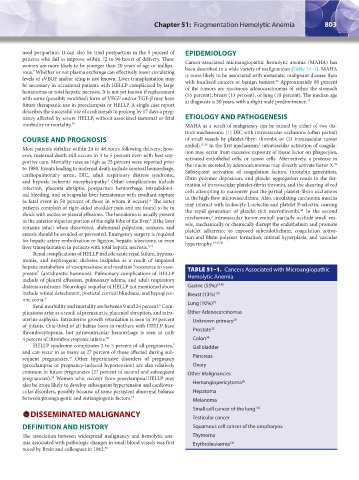
                  patients who fail to improve within 72 to 96 hours of delivery. These   Cancer-associated microangiopathic hemolytic anemia (MAHA) has
                  women are more likely to be younger than 20 years of age or nullipa-  been described in a wide variety of malignancies (Table 51–1). MAHA
                  rous.  Whether or not plasma exchange can effectively lower circulating   is more likely to be associated with metastatic malignant disease than
                     7
                  levels of sVEGF and/or sEng is not known. Liver transplantation may   with localized cancers or benign tumors.  Approximately 80 percent
                                                                                                       36
                  be necessary in occasional patients with HELLP complicated by large   of the tumors are mucinous adenocarcinomas of either the stomach
                  hematomas or total hepatic necrosis. It is not yet known if replacement   (55 percent), breast (13 percent), or lung (10 percent). The median age
                  with some (possibly modified) form of VEGF and/or TGF-β may have   at diagnosis is 50 years, with a slight male predominance. 37
                  future therapeutic use in preeclampsia or HELLP. A single case report
                  describes the successful use of eculizumab to prolong by 17 days a preg-
                  nancy affected by severe HELLP, without associated maternal or fetal   ETIOLOGY AND PATHOGENESIS
                  morbidity or mortality. 30                            MAHA as a result of malignancy can be caused by either of two dis-
                                                                        tinct mechanisms: (1) DIC with intravascular occlusions (often partial)
                  COURSE AND PROGNOSIS                                  of small vessels by platelet-fibrin thrombi; or (2) intravascular tumor
                                                                                                 1
                  Most patients stabilize within 24 to 48 hours following delivery; how-  emboli. 35,38  In the first mechanism,  intravascular activation of coagula-
                  ever, maternal death still occurs in 3 to 5 percent even with best sup-  tion may occur from excessive exposure of tissue factor on phagocytes,
                  portive care. Mortality rates as high as 25 percent were reported prior   activated endothelial cells, or tumor cells. Alternatively, a protease in
                                                                                                                          39
                  to 1980. Events leading to maternal death include cerebral hemorrhage,   the mucin secreted by adenocarcinomas may directly activate factor X.
                  cardiopulmonary arrest, DIC, adult respiratory distress syndrome,   Subsequent activation of coagulation factors, thrombin generation,
                  and hypoxic ischemic encephalopathy.  Other complications include   fibrin polymer deposition, and platelet aggregation result in the for-
                                              5
                  infection, placenta abruptio, postpartum hemorrhage, intraabdomi-  mation of intravascular platelet-fibrin thrombi, and the shearing of red
                  nal bleeding, and subcapsular liver hematomas with resultant rupture     cells attempting to maneuver past the partial platelet-fibrin occlusions
                  (a fatal event in 50 percent  of those in whom it occurs).  The latter   in the high-flow microvasculature. Also, circulating carcinoma mucins
                                                             6
                  patients complain of right-sided shoulder pain and are found to be in   may interact with leukocyte L-selectin and platelet P-selectin, causing
                                                                                                               40
                  shock with ascites or pleural effusions. The hematoma is usually present   the rapid generation of platelet-rich microthrombi.  In the second
                                                                                 2
                  in the anterior superior portion of the right lobe of the liver.  If the liver   mechanism,  intravascular tumor emboli partially occlude small ves-
                                                             5
                  remains intact when discovered, abdominal palpation, seizures, and   sels, mechanically or chemically disrupt the endothelium and promote
                  emesis should be avoided or prevented. Emergency surgery is required   platelet adherence to exposed subendothelium, coagulation activa-
                  for hepatic artery embolization or ligation, hepatic lobectomy, or even   tion and fibrin polymer formation, intimal hyperplasia, and vascular
                                                                                  35,37,38
                  liver transplantation in patients with total hepatic necrosis. 5,19  hypertrophy.
                     Renal complications of HELLP include acute renal failure, hypona-
                  tremia, and nephrogenic diabetes insipidus as a result of impaired
                  hepatic metabolism of vasopressinase and resultant “resistance to vaso-  TABLE 51–1.  Cancers Associated with Microangiopathic
                  pressin” (antidiuretic hormone). Pulmonary complications of HELLP
                  include of pleural effusions, pulmonary edema, and adult respiratory   Hemolytic Anemia
                  distress syndrome. Neurologic sequelae of HELLP not mentioned above   Gastric (55%) 37,40
                  include retinal detachment, postictal cortical blindness, and hypoglyce-  Breast (13%) 129
                  mic coma. 31                                                    35
                     Fetal morbidity and mortality are between 9 and 24 percent.  Com-  Lung (10%)
                                                                6
                  plications arise as a result of prematurity, placental abruption, and intra-  Other Adenocarcinomas
                  uterine asphyxia. Intrauterine growth retardation is seen in 39 percent     Unknown primary 38
                  of infants. One-third of all babies born to mothers with HELLP have   35
                  thrombocytopenia,  but  intraventricular  hemorrhage  is  seen  in  only      Prostate
                  4 percent of thrombocytopenic infants. 32                Colon 38
                     HELLP syndrome complicates 2 to 5 percent of all pregnancies,      Gallbladder
                                                                    5
                  and can recur in as many as 27 percent of those affected during sub-
                  sequent pregnancies.  Other hypertensive disorders of pregnancy     Pancreas
                                 33
                  (preeclampsia or pregnancy-induced hypertension) are also relatively     Ovary
                  common in future pregnancies (27 percent of second and subsequent   Other Malignancies
                  pregnancies).  Women who recover from preeclampsia/HELLP may
                           34
                  also be more likely to develop subsequent hypertension and cardiovas-    Hemangiopericytoma 36
                  cular disorders, possibly because of some persistent abnormal balance     Hepatoma
                  between proangiogenic and antiangiogenic factors. 17     Melanoma
                                                                           Small cell cancer of the lung 130
                     DISSEMINATED MALIGNANCY                               Testicular cancer

                  DEFINITION AND HISTORY                                   Squamous cell cancer of the oropharynx
                  The association between widespread malignancy and hemolytic ane-    Thymoma
                  mia associated with pathologic changes in small blood vessels was first     Erythroleukemia 131
                  noted by Brain and colleagues in 1962. 35


          Kaushansky_chapter 51_p0801-0008.indd   803                                                                   9/17/15   2:42 PM

