


Page 830 - Williams Hematology ( PDFDrive )
P. 830
804  Part VI:  The Erythrocyte                               Chapter 51:  Fragmentation Hemolytic Anemia              805


                                A                                      B
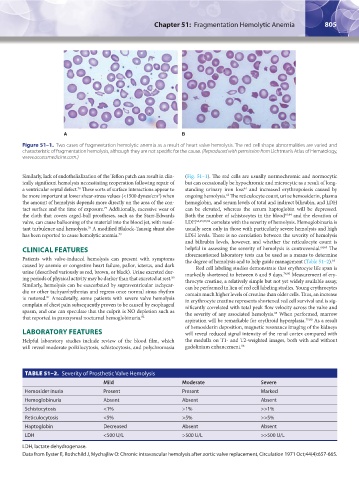
                  Figure 51–1.  Two cases of fragmentation hemolytic anemia as a result of heart valve hemolysis. The red cell shape abnormalities are varied and
                  characteristic of fragmentation hemolysis, although they are not specific for the cause. (Reproduced with permission from Lichtman’s Atlas of Hematology,
                  www.accessmedicine.com.)


                  Similarly, lack of endothelialization of the Teflon patch can result in clin-  (Fig. 51–1). The red cells are usually normochromic and normocytic
                  ically significant hemolysis necessitating reoperation following repair of   but can occasionally be hypochromic and microcytic as a result of long-
                  a ventricular septal defect.  These sorts of surface interactions appear to   standing urinary iron loss  and increased erythropoiesis caused by
                                                                                            61
                                    76
                  be more important at lower shear-stress values (<1500 dynes/cm ) when   ongoing hemolysis.  The reticulocyte count, urine hemosiderin, plasma
                                                               2
                                                                                      62
                  the amount of hemolysis depends more directly on the area of the con-  hemoglobin, and serum levels of total and indirect bilirubin, and LDH
                  tact surface and the time of exposure.  Additionally, excessive wear of   can be elevated, whereas the serum haptoglobin will be depressed.
                                             77
                  the cloth that covers caged-ball prostheses, such as the Starr-Edwards   Both the number of schistocytes in the blood 61,64  and the elevation of
                  valve, can cause ballooning of the material into the blood jet, with resul-  LDH 64,65,83,84  correlate with the severity of hemolysis. Hemoglobinuria is
                  tant turbulence and hemolysis.  A modified Blalock-Taussig shunt also   usually seen only in those with particularly severe hemolysis and high
                                        78
                  has been reported to cause hemolytic anemia. 79       LDH levels. There is no correlation between the severity of hemolysis
                                                                        and  bilirubin  levels,  however,  and whether  the  reticulocyte  count  is
                  CLINICAL FEATURES                                     helpful in assessing the severity of hemolysis is controversial. 64,65  The
                  Patients  with valve-induced  hemolysis  can  present with  symptoms   aforementioned laboratory tests can be used as a means to determine
                                                                        the degree of hemolysis and to help guide management (Table 51–2).
                                                                                                                          64
                  caused by anemia or congestive heart failure, pallor, icterus, and dark   Red cell labeling studies demonstrate that erythrocyte life span is
                  urine (described variously as red, brown, or black). Urine excreted dur-  markedly shortened to between 6 and 9 days. 76,80  Measurement of ery-
                                                                    80
                  ing periods of physical activity may be darker than that excreted at rest.    throcyte creatine, a relatively simple but not yet widely available assay,
                  Similarly, hemolysis can be exacerbated by supraventricular tachycar-  can be performed in lieu of red cell labeling studies. Young erythrocytes
                  dia or other tachyarrhythmias and regress once normal sinus rhythm   contain much higher levels of creatine than older cells. Thus, an increase
                  is restored.  Anecdotally, some patients with severe valve hemolysis   in erythrocyte creatine represents shortened red cell survival and is sig-
                          81
                  complain of chest pain subsequently proven to be caused by esophageal   nificantly correlated with total peak flow velocity across the valve and
                  spasm, and one can speculate that the culprit is NO depletion such as   the severity of any associated hemolysis.  When performed, marrow
                                                                                                      85
                  that reported in paroxysmal nocturnal hemoglobinuria. 82  aspiration will be remarkable for erythroid hyperplasia. 75,80  As a result
                                                                        of hemosiderin deposition, magnetic resonance imaging of the kidneys
                  LABORATORY FEATURES                                   will reveal reduced signal intensity of the renal cortex compared with
                  Helpful laboratory studies include review of the blood film, which   the medulla on T1- and T2-weighted images, both with and without
                  will reveal moderate poikilocytosis, schistocytosis, and polychromasia       gadolinium enhancement. 86


                   TABLE 51–2.  Severity of Prosthetic Valve Hemolysis
                                             Mild                      Moderate                   Severe
                   Hemosider inuria          Present                   Present                    Marked
                   Hemoglobinuria            Absent                    Absent                     Absent
                   Schistocytosis            <1%                       >1%                        >>1%
                   Reticulocytosis           <5%                       >5%                        >>5%
                   Haptoglobin               Decreased                 Absent                     Absent
                   LDH                       <500 U/L                  >500 U/L                   >>500 U/L
                  LDH, lactate dehydrogenase.
                  Data from Eyster E, Rothchild J, Mychajliw O: Chronic intravascular hemolysis after aortic valve replacement, Circulation 1971 Oct;44(4):657-665.


          Kaushansky_chapter 51_p0801-0008.indd   805                                                                   9/17/15   2:42 PM

