


Page 941 - Williams Hematology ( PDFDrive )
P. 941
916            Part VI:  The Erythrocyte                                                                                                                   Chapter 59:  Polyclonal and Hereditary Sideroblastic Anemias            917


                TABLE 59–1.  Classification of Sideroblastic Anemias  given the present state of knowledge, to discuss both forms together.
                                                                      The pathogenesis of the disorder may be viewed from two standpoints:
                 I.  Acquired                                         the underlying biochemical lesions and the mechanism(s) of the anemia
                  A.   Primary sideroblastic anemia (myelodysplastic syndromes)   itself.
                     (Chap. 88)
                     1.  Subunit 1 of the mitochondrial cytochrome oxidase 54,55  Biochemical Lesions and Genetics
                  B.  Sideroblastic anemia secondary to:              In the search for the biochemical lesions responsible for the develop-
                     1.  Isoniazid 21,22                              ment of sideroblastic anemia, attention has been focused upon an intra-
                                                                      mitochondrial defect in heme synthesis and on possible disturbances in
                     2.  Pyrazinamide 21,22                           pyridoxine metabolism.
                     3.  Cycloserine 149
                     4.  Chloramphenicol 149                          Defects in Heme Synthesis
                     5.  Ethanol 118                                  The role of defects in heme biosynthesis have occupied central stage
                                                                                                         35
                     6.  Lead 24                                      since the early studies of Garby and colleagues,  who postulated that
                     7.  Chronic neoplastic disease (Chap. 8)         such a defect might exist; they demonstrated that the level of free ery-
                                                                      throcyte protoporphyrin was decreased. Subsequently, a variety of
                     8.  Zinc-induced copper deficiency 124,125       abnormalities of the levels of precursors and of their rate of incorpora-
                II.  Hereditary                                       tion into heme was documented (Chap. 58). 36–41  However, the findings
                  A.  X chromosome linked                             have not all been consistent, as levels of free erythrocyte protoporphyrin
                  B.  Autosomal                                       have often been increased, 42,43  not diminished. The role of mitochondria
                     1.   Defects in the erythroid specific mitochondrial carrier   in the etiology of sideroblastic anemia gained further credence when
                       family protein SLC25A38 47                     mutations of the mitochondrial genome were found in patients with
                                                                                    15–19
                     2.   Mitochondrial myopathy and sideroblastic anemia (PSU1   Pearson syndrome.
                       mutations) 57,108,109                          Hereditary Sideroblastic Anemias
                  C.  Mitochondrial                                   Shortly after the identification of erythroid-specific ALA synthase
                     1.  Pearson marrow-pancreas syndrome 15–19       (ALAS2, the first enzyme in heme synthesis;  Fig. 59–2), it became
                                                                      apparent that most patients with hereditary X-linked sideroblastic ane-
                                                                      mias (XLSAs) had mutations in the ALAS2 gene. 44–46  However, a pro-
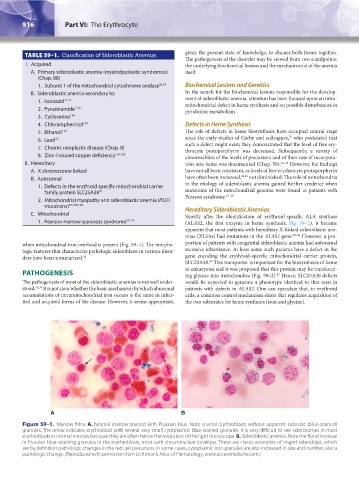
               when mitochondrial iron overload is present (Fig. 59–1). The morpho-  portion of patients with congenital sideroblastic anemia had autosomal
               logic features that characterize pathologic sideroblasts in various disor-  recessive inheritance. At least some such patients have a defect in the
               ders have been summarized. 32                          gene encoding the erythroid-specific mitochondrial carrier protein,
                                                                      SLC25A38.  This transporter is important for the biosynthesis of heme
                                                                              47
               PATHOGENESIS                                           in eukaryotes and it was proposed that this protein may be translocat-
                                                                      ing glycine into mitochondria (Fig. 59–2).  Hence, SLC25A38 defects
                                                                                                     47
               The pathogenesis of most of the sideroblastic anemias is not well under-  would be expected to generate a phenotype identical to that seen in
               stood. 33,34  It is not clear whether the basic mechanism by which abnormal   patients with defects in ALAS2. One can speculate that, in erythroid
               accumulations of intramitochondrial iron occurs is the same in inher-  cells, a common control mechanism exists that regulates acquisition of
               ited and acquired forms of the disease. However, it seems appropriate,   the two substrates for heme synthesis (iron and glycine).


                         A                                           B
               Figure 59–1.  Marrow films. A. Normal marrow stained with Prussian blue. Note several erythroblasts without apparent siderotic (blue-stained)
               granules. The arrow indicates erythroblast with several very small cytoplasmic blue-stained granules. It is very difficult to see siderosomes in most
               erythroblasts in normal marrow because they are often below the resolution of the light microscope. B. Sideroblastic anemia. Note the florid increase
               in Prussian blue–staining granules in the erythroblasts, most with circumnuclear locations. These are classic examples of ringed sideroblast, which
               are by definition pathologic changes in the red cell precursors. In some cases, cytoplasmic iron granules are also increased in size and number, also a
               pathologic change. (Reproduced with permission from Lichtman’s Atlas of Hematology, www.accessmedicine.com.)


          Kaushansky_chapter 59_p0915-0922.indd   916                                                                   9/17/15   3:17 PM

