


Page 942 - Williams Hematology ( PDFDrive )
P. 942
916  Part VI:  The Erythrocyte                 Chapter 59:  Polyclonal and Hereditary Sideroblastic Anemias           917


                                               Diferric
                                               transferrin

                           Apo-
                                            Cell
                         transferrin     membrane


                                                    Transferrin
                                                    receptor
                                                                                STEAP 3
                                                                                       NAD(P)H      Clathrin-coated pit
                                                                                            NAD(P)
                                                               DMT 1
                                                                                                Endocytosis
                                                  Exocytosis
                                                                                                +
                                                                                               H  proton pump
                                   Hgb       globin + heme
                                                                       STEAP 3
                                                      Copro’gen
                                                            ?
                                                                                      ?
                                                             Proto’gen                   Outer membrane
                                              ?
                                                        CPO        PPO                Mitoferrin 1


                                                                           FECH        Inner membrane
                                                               Proto IX

                                                           Heme


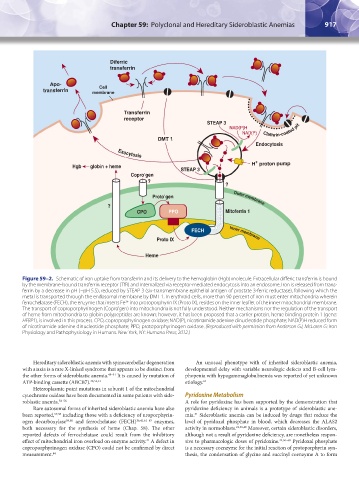
                  Figure 59–2.  Schematic of iron uptake from transferrin and its delivery to the hemoglobin (Hgb) molecule. Extracellular differic transferrin is bound
                  by the membrane-bound transferrin receptor (TfR) and internalized via receptor-mediated endocytosis into an endosome. Iron is released from trans-
                  ferrin by a decrease in pH (~pH 5.5), reduced by STEAP 3 (six-transmembrane epithelial antigen of prostate 3-ferric reductase), following which the
                  metal is transported through the endosomal membrane by DMT 1. In erythroid cells, more than 90 percent of iron must enter mitochondria wherein
                  ferrochelatase (FECH), the enzyme that inserts Fe  into protoporphyrin IX (Proto IX), resides on the inner leaflet of the inner mitochondrial membrane.
                                                    2+
                  The transport of coproporphyrinogen (Copro’gen) into mitochondria is not fully understood. Neither mechanisms nor the regulation of the transport
                  of heme from mitochondria to globin polypeptides are known; however, it has been proposed that a carrier protein, heme binding protein 1 (gene:
                  HEBP1), is involved in this process. CPO, coproporphyrinogen oxidase; NAD(P), nicotinamide adenine dinucleotide phosphate; NAD(P)H reduced form
                  of nicotinamide adenine dinucleotide phosphate; PPO, protoporphyrinogen oxidase. (Reproduced with permission from Anderson GJ, McLaren G: Iron
                  Physiology and Pathophysiology in Humans. New York, NY: Humana Press; 2012.)


                     Hereditary sideroblastic anemia with spinocerebellar degeneration   An unusual phenotype with of inherited sideroblastic anemia,
                  with ataxia is a rare X-linked syndrome that appears to be distinct from   developmental delay with variable neurologic defects and B-cell lym-
                  the other forms of sideroblastic anemia. 48–51  It is caused by mutation of   phopenia with hypogammaglobulinemia was reported of yet unknown
                  ATP-binding cassette (ABCB7). 48,52,53                etiology. 65
                     Heteroplasmic point mutations in subunit 1 of the mitochondrial
                  cytochrome oxidase have been documented in some patients with side-  Pyridoxine Metabolism
                  roblastic anemia. 54–56                               A role for pyridoxine has been supported by the demonstration that
                     Rare autosomal forms of inherited sideroblastic anemia have also   pyridoxine deficiency in animals is a prototype of sideroblastic ane-
                  been reported, 57,58  including those with a deficiency of uroporphyrin-  mia.  Sideroblastic anemia can be induced by drugs that reduce the
                                                                            31
                  ogen decarboxylase 59,60  and ferrochelatase (FECH) 36,41,61–63  enzymes,   level of pyridoxal phosphate in blood, which decreases the ALAS2
                  both necessary for the synthesis of heme (Chap. 58). The other   activity in normoblasts. 22,36,40  Moreover, certain sideroblastic disorders,
                  reported defects of ferrochelatase could result from the inhibitory   although not a result of pyridoxine deficiency, are nonetheless respon-
                  effect of mitochondrial iron overload on enzyme activity.  A defect in   sive to pharmacologic doses of pyridoxine. 44,66–68  Pyridoxal phosphate
                                                           41
                  coproporphyrinogen oxidase (CPO) could not be confirmed by direct   is a necessary coenzyme for the initial reaction of protoporphyrin syn-
                  measurement. 64                                       thesis, the condensation of glycine and succinyl coenzyme A to form


          Kaushansky_chapter 59_p0915-0922.indd   917                                                                   9/17/15   3:17 PM

