


Page 1243 - Clinical Immunology_ Principles and Practice ( PDFDrive )
P. 1243
CHaPTEr 89  Biological Modifiers of Inflammatory Diseases              1205


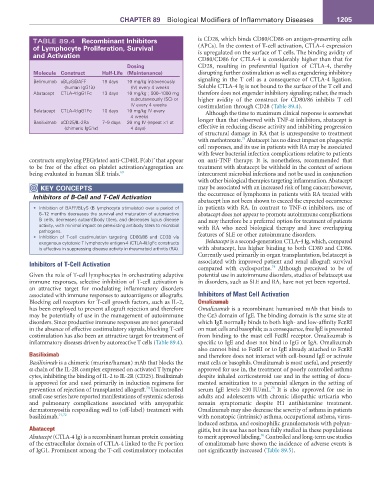
            TABLE 89.4  recombinant Inhibitors                    is CD28, which binds CD80/CD86 on antigen-presenting cells
            of Lymphocyte Proliferation, Survival                 (APCs). In the context of T-cell activation, CTLA-4 expression
            and activation                                        is upregulated on the surface of T cells. The binding avidity of
                                                                  CD80/CD86 for CTLA-4 is considerably higher than that for
                                           Dosing                 CD28, resulting in preferential ligation of CTLA-4, thereby
            Molecule Construct    Half-Life (Maintenance)         disrupting further costimulation as well as engendering inhibitory
            Belimumab aBLyS/BAFF   19 days  10 mg/kg intravenously   signaling in the T cell as a consequence of CTLA-4 ligation.
                      (human IgG1λ)         (IV) every 4 weeks    Soluble CTLA-4 Ig is not bound to the surface of the T cell and
            Abatacept  CTLA-4:IgG1Fc  13 days  10 mg/kg ; 500–1000 mg   therefore does not engender inhibitory signaling; rather, the much
                                            subcutaneously (SC) or   higher avidity of the construct for CD80/86 inhibits T cell
                                            IV every 4 weeks      costimulation through CD28 (Table 89.4).
            Belatacept  CTLA-4:IgG1Fc  10 days  10 mg/kg IV every    Although the time to maximum clinical response is somewhat
                                            4 weeks
            Basiliximab aCD25/IL-2Ra   7–9 days  20 mg IV (repeat ×1 at    longer than that observed with TNF-α inhibitors, abatacept is
                      (chimeric IgG1κ)      4 days)               effective in reducing disease activity and inhibiting progression
                                                                  of structural damage in RA that is unresponsive to treatment
                                                                                73
                                                                  with methotrexate.  Abatacept has no direct impact on phagocytic
                                                                  cell responses, and its use in patients with RA may be associated
                                                                  with fewer bacterial infection complications relative to patients
           constructs employing PEGylated anti-CD40L F(ab)’ that appear   on anti-TNF therapy. It is, nonetheless, recommended that
           to be free of the effect on platelet activation/aggregation are   treatment with abatacept be withheld in the context of serious
           being evaluated in human SLE trials. 69                intercurrent microbial infections and not be used in conjunction
                                                                  with other biological therapies targeting inflammation. Abatacept
               KEY CONCEPTS                                       may be associated with an increased risk of lung cancer; however,
            Inhibitors of B-Cell and T-Cell Activation            the occurrence of lymphoma in patients with RA treated with
                                                                  abatacept has not been shown to exceed the expected occurrence
            •  Inhibition of BAFF/BLyS (B lymphocyte stimulator) over a period of   in patients with RA. In contrast to TNF-α inhibitors, use of
              6–12 months decreases the survival and maturation of autoreactive   abatacept does not appear to promote autoimmune complications
              B cells, decreases autoantibody titers, and decreases lupus disease   and may therefore be a preferred option for treatment of patients
              activity, with minimal impact on preexisting antibody titers to microbial   with RA who need biological therapy and have overlapping
              pathogens.
            •  Inhibition of T-cell costimulation targeting CD80/86 and CD28 via   features of SLE or other autoimmune disorders.
              exogenous cytotoxic T lymphocyte antigen-4 (CTLA-4):IgFc constructs   Belatacept is a second-generation CTLA-4 Ig, which, compared
              is effective in suppressing disease activity in rheumatoid arthritis (RA).  with abatacept, has higher binding to both CD80 and CD86.
                                                                  Currently used primarily in organ transplantation, belatacept is
           Inhibitors of T-Cell Activation                        associated with improved patient and renal allograft survival
                                                                                          74
                                                                  compared with cyclosporine.   Although perceived to be of
           Given the role of T-cell lymphocytes in orchestrating adaptive   potential use in autoimmune disorders, studies of belatacept use
           immune responses, selective inhibition of T-cell activation is   in disorders, such as SLE and RA, have not yet been reported.
           an attractive target for modulating inflammatory disorders
           associated with immune responses to autoantigens or allografts.   Inhibitors of Mast Cell Activation
           Blocking cell receptors for T-cell growth factors, such as IL-2,   Omalizumab
           has been employed to prevent allograft rejection and therefore   Omalizumab is a recombinant humanized mAb that binds to
           may be potentially of use in the management of autoimmune   the Cε3 domain of IgE. The binding domain is the same site at
           disorders. Since productive immune responses are not generated   which IgE normally binds to both high- and low-affinity FcεRI
           in the absence of effective costimulatory signals, blocking T-cell   on mast cells and basophils; as a consequence, free IgE is prevented
           costimulation has also been an attractive target for treatment of   from binding to the mast cell FcεRI receptor. Omalizumab is
           inflammatory diseases driven by autoreactive T cells (Table 89.4).  specific to IgE and does not bind to IgG or IgA. Omalizumab
                                                                  also cannot bind to FcεRI or to IgE already attached to FcεRI
           Basiliximab                                            and therefore does not interact with cell-bound IgE or activate
           Basiliximab is a chimeric (murine/human) mAb that blocks the   mast cells or basophils. Omalizumab is most useful, and presently
           α chain of the IL-2R complex expressed on activated T lympho-  approved for use in, the treatment of poorly controlled asthma
           cytes, inhibiting the binding of IL-2 to IL-2R (CD25). Basiliximab   despite inhaled corticosteroid use and in the setting of docu-
           is approved for and used primarily in induction regimens for   mented sensitization to a perennial allergen in the setting of
                                                                                          75
                                                 70
           prevention of rejection of transplanted allograft.  Uncontrolled   serum IgE levels  ≥30 IU/mL.  It is also approved for use in
           small case series have reported manifestations of systemic sclerosis   adults  and  adolescents  with  chronic  idiopathic  urticaria  who
           and pulmonary complications associated with amyopathic   remain symptomatic despite H1 antihistamine treatment.
           dermatomyositis responding well to (off-label) treatment with   Omalizumab may also decrease the severity of asthma in patients
           basiliximab. 71,72                                     with nonatopic (intrinsic) asthma, occupational asthma, virus-
                                                                  induced asthma, and eosinophilic granulomatosis with polyan-
           Abatacept                                              giitis, but its use has not been fully studied in these populations
                                                                                      76
           Abatacept (CTLA-4 Ig) is a recombinant human protein consisting   to merit approved labeling.  Controlled and long-term use studies
           of the extracellular domain of CTLA-4 linked to the Fc portion   of omalizumab have shown the incidence of adverse events is
           of IgG1. Prominent among the T-cell costimulatory molecules   not significantly increased (Table 89.5).

