


Page 168 - Clinical Immunology_ Principles and Practice ( PDFDrive )
P. 168
150          ParT ONE  Principles of Immune Response


                                                               induction  of  transcription.  The  SMAD  MH1  motif  mediates
                                                               sequence-specific DNA binding, whereas the MH2 domain
             TGF-b     RI
            receptor                                           contains the transcriptional activation domain.
                                                                  SMAD2-null mice lack anterior/posterior specification and
                                                               fail to develop mesoderm. SMAD3-deficient mice have limb
               RII       P  RSmad                              malformations and defective immune function. SMAD3-null
                           P                                   mice exhibit defective TGF-β responses. However, these mice
                  K  K
                                                               also display accelerated wound healing compared with normal
                                                               mice, which seems to contradict the role of SMAD3 as a positive
                                                               regulator of TGF-β in enhancing wound healing.
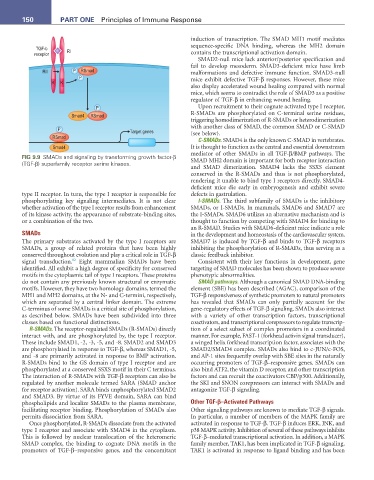
                                P                                 Upon recruitment to their cognate activated type I receptor,
                        Smad4  RSmad                           R-SMADs  are  phosphorylated  on  C-terminal  serine  residues,
                                                               triggering homodimerization of R-SMADs or heterodimerization
                    P                       Target genes       with another class of SMAD, the common SMAD or C-SMAD
                  RSmad                                        (see below).
                                                                  C-SMADs. SMAD4 is the only known C-SMAD in vertebrates.
                  Smad4                                        It is thought to function as the central and essential downstream
                                                               mediator of other SMADs in all TGF-β/BMP pathways. The
        FIG 9.9  SMADs and signaling by transforming growth factor-β
        (TGF-β) superfamily receptor serine kinases.           SMAD MH2 domain is important for both receptor interaction
                                                               and SMAD dimerization. SMAD4 lacks the SSXS element
                                                               conserved in the R-SMADs and thus is not phosphorylated,
                                                               rendering it unable to bind type I receptors directly. SMAD4-
                                                               deficient mice die early in embryogenesis and exhibit severe
        type II receptor. In turn, the type I receptor is responsible for   defects in gastrulation.
        phosphorylating key signaling intermediates. It is not clear   I-SMADs. The third subfamily of SMADs is the inhibitory
        whether activation of the type I receptor results from enhancement   SMADs, or I-SMADs. In mammals, SMAD6 and SMAD7 are
        of its kinase activity, the appearance of substrate-binding sites,   the I-SMADs. SMAD6 utilizes an alternative mechanism and is
        or a combination of the two.                           thought to function by competing with SMAD4 for binding to
                                                               an R-SMAD. Studies with SMAD6-deficient mice indicate a role
        SMADs                                                  in the development and homeostasis of the cardiovascular system.
        The primary substrates activated by the type I receptors are   SMAD7 is induced by TGF-β and binds to TGF-β receptors
        SMADs, a group of related proteins that have been highly   inhibiting the phosphorylation of R-SMADs, thus serving as a
        conserved throughout evolution and play a critical role in TGF-β   classic feedback inhibitor.
                         82
        signal  transduction.  Eight mammalian  SMADs have been   Consistent with their key functions in development, gene
        identified. All exhibit a high degree of specificity for conserved   targeting of SMAD molecules has been shown to produce severe
        motifs in the cytoplasmic tail of type I receptors. These proteins   phenotypic abnormalities.
        do not contain any previously known structural or enzymatic   SMAD pathways. Although a canonical SMAD DNA-binding
        motifs. However, they have two homology domains, termed the   element (SBE) has been described (AGAC), comparison of the
        MH1 and MH2 domains, at the N- and C-termini, respectively,   TGF-β responsiveness of synthetic promoters to natural promoters
        which are separated by a central linker domain. The extreme   has revealed that SMADs can only partially account for the
        C-terminus of some SMADs is a critical site of phosphorylation,   gene-regulatory effects of TGF-β signaling. SMADs also interact
        as described below. SMADs have been subdivided into three   with a variety of other transcription factors, transcriptional
        classes based on functional distinctions.              coactivators, and transcriptional corepressors to regulate transcrip-
           R-SMADs. The receptor-regulated SMADs (R-SMADs) directly   tion of a select subset of complex promoters in a coordinated
        interact with, and are phosphorylated by, the type I receptor.   manner. For example, FAST-1 (forkhead activin signal transducer),
        These include SMAD1, -2, -3, -5, and -8. SMAD2 and SMAD3   a winged helix forkhead transcription factor, associates with the
        are phosphorylated in response to TGF-β, whereas SMAD1, -5,   SMAD2/SMAD4 complex. SMADs also bind to c-JUN/c-FOS,
        and -8 are primarily activated in response to BMP activation.   and AP-1 sites frequently overlap with SBE sites in the naturally
        R-SMADs bind to the GS domain of type I receptor and are   occurring promoters of TGF-β–responsive genes. SMADs can
        phosphorylated at a conserved SSXS motif in their C terminus.   also bind ATF2, the vitamin D receptor, and other transcription
        The interaction of R-SMADs with TGF-β receptors can also be   factors and can recruit the coactivators CBP/p300. Additionally,
        regulated by another molecule termed SARA (SMAD anchor   the SKI and SNON corepressors can interact with SMADs and
        for receptor activation). SARA binds unphosphorylated SMAD2   antagonize TGF-β signaling.
        and SMAD3. By virtue of its FYVE domain, SARA can bind
        phospholipids and localize SMADs to the plasma membrane,   Other TGF-β–Activated Pathways
        facilitating receptor binding. Phosphorylation of SMADs also   Other signaling pathways are known to mediate TGF-β signals.
        permits dissociation from SARA.                        In particular, a number of members of the MAPK family are
           Once phosphorylated, R-SMADs dissociate from the activated   activated in response to TGF-β. TGF-β induces ERK, JNK, and
        type I receptor and associate with SMAD4 in the cytoplasm.   p38 MAPK activity. Inhibition of several of these pathways inhibits
        This is followed by nuclear translocation of the heteromeric   TGF-β–mediated transcriptional activation. In addition, a MAPK
        SMAD  complex,  the  binding  to  cognate  DNA  motifs  in  the   family member, TAK1, has been implicated in TGF-β signaling.
        promoters of TGF-β–responsive genes, and the concomitant   TAK1 is activated in response to ligand binding and has been

