


Page 501 - Clinical Immunology_ Principles and Practice ( PDFDrive )
P. 501
CHAPtER 34  Primary Antibody Deficiencies              481


           concentrations to IgA deficiency to IgA deficiency with IgG
           subclass deficits to frank CVID have been documented in both
           sporadic and familial cases. 2
             CVID is a diagnostic category of primary immunodeficiencies
           that includes a number of immune disorders. Most patients of
           Northern European descent with CVID exhibit a distinctive
           phenotype characterized by a broad deficiency of Ig isotypes in
           spite of the presence of normal numbers of surface Ig bearing
           B-cell precursors in peripheral blood. Almost all of these patients
           are IgA deficient and, by definition, demonstrate total serum
           IgG levels of <500 mg/dL. Some IgG subclasses are more affected
           than others, with the sequential order of involvement being IgG4
           > IgG2 > IgG1 > IgG3. Most patients are also deficient in IgM
           and IgE.
             Patients with uncomplicated conditions demonstrate normal
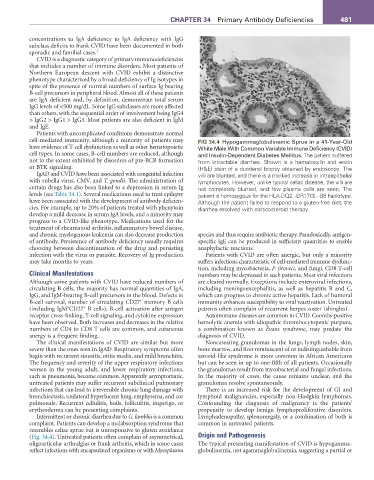
           cell-mediated immunity, although a minority of patients may   fIG 34.4  Hypogammaglobulinemic Sprue in a 41-Year-Old
           have evidence of T-cell dysfunction as well as other hematopoietic   White Male With Common Variable Immune Deficiency (CVID)
           cell types. In some cases, B-cell numbers are reduced, although   and Insulin-Dependent Diabetes Mellitus. The patient suffered
           not to the extent exhibited by disorders of pre-BCR formation   from intractable diarrhea. Shown is a hematoxylin and eosin
           or BTK signaling.                                      (H&E) stain of a duodenal biopsy obtained by endoscopy. The
             IgAD and CVID have been associated with congenital infection   villi are blunted, and there is a marked increase in intraepithelial
           with rubella virus, CMV, and T. gondii. The administration of   lymphocytes. However, unlike typical celiac disease, the villi are
           certain drugs has also been linked to a depression in serum Ig   not completely blunted, and few plasma cells are seen. The
           levels (see Table 34.1). Several medications used to treat epilepsy   patient is homozygous for the HLA-DQ2, -DR17(3), -B8 haplotype.
           have been associated with the development of antibody deficien-  Although the patient failed to respond to a gluten-free diet, the
           cies. For example, up to 20% of patients treated with phenytoin   diarrhea resolved with corticosteroid therapy.
           develop a mild decrease in serum IgA levels, and a minority may
           progress to a CVID-like phenotype. Medications used for the
           treatment of rheumatoid arthritis, inflammatory bowel disease,
           and chronic myelogenous leukemia can also decrease production   species and thus require antibiotic therapy. Paradoxically, antigen-
           of antibody. Persistence of antibody deficiency usually requires   specific IgE can be produced in sufficient quantities to enable
           choosing between discontinuation of the drug and persisting   anaphylactic reactions.
           infection with the virus or parasite. Recovery of Ig production   Patients with CVID are often anergic, but only a minority
           may take months to years.                              suffers infections characteristic of cell-mediated immune dysfunc-
                                                                  tion, including mycobacteria, P. jiroveci, and fungi. CD8 T-cell
           Clinical Manifestations                                numbers may be depressed in such patients. Most viral infections
           Although some patients with CVID have reduced numbers of   are cleared normally. Exceptions include enteroviral infections,
           circulating B cells, the majority has normal quantities of IgA,   including meningoencephalitis, as well as hepatitis B and C,
           IgG, and IgM-bearing B-cell precursors in the blood. Defects in   which can progress to chronic active hepatitis. Lack of humoral
                                               +
           B-cell survival, number of circulating CD27  memory B cells   immunity enhances susceptibility to viral reactivation. Untreated
                            +
                       +
           (including IgM CD27  B cells), B-cell activation after antigen   patients often complain of recurrent herpes zoster (shingles).
           receptor cross-linking, T-cell signaling, and cytokine expression   Autoimmune diseases are common in CVID. Coombs-positive
           have been observed. Both increases and decreases in the relative   hemolytic anemia with idiopathic thrombocytopenic purpura,
           numbers of CD4 to CD8 T cells are common, and cutaneous   a  combination  known  as  Evans  syndrome,  may predate the
           anergy is a frequent finding.                          diagnosis of CVID.
             The clinical manifestations of CVID are similar but more   Noncaseating granulomas in the lungs, lymph nodes, skin,
           severe than the ones seen in IgAD. Respiratory symptoms often   bone marrow, and liver reminiscent of or indistinguishable from
           begin with recurrent sinusitis, otitis media, and mild bronchitis.   sarcoid-like syndrome is more common in African Americans
           The frequency and severity of the upper respiratory infections   but can be seen in up to one-fifth of all patients. Occasionally
           worsen in the young adult, and lower respiratory infections,   the granulomas result from mycobacterial and fungal infections.
           such as pneumonia, become common. Apparently asymptomatic,   In the majority of cases, the cause remains unclear, and the
           untreated patients may suffer recurrent subclinical pulmonary   granulomas resolve spontaneously.
           infections that can lead to irreversible chronic lung damage with   There is an increased risk for the development of GI and
           bronchiectasis, unilateral hyperlucent lung, emphysema, and cor   lymphoid malignancies, especially non-Hodgkin lymphomas.
           pulmonale. Recurrent cellulitis, boils, folliculitis, impetigo, or   Confounding the diagnosis of malignancy is the patients’
           erythroderma can be presenting complaints.             propensity to develop benign lymphoproliferative disorders.
             Intermittent or chronic diarrhea due to G. lamblia is a common   Lymphadenopathy, splenomegaly, or a combination of both is
           complaint. Patients can develop a malabsorption syndrome that   common in untreated patients.
           resembles celiac sprue but is unresponsive to gluten avoidance
           (Fig. 34.4). Untreated patients often complain of asymmetrical,   Origin and Pathogenesis
           oligoarticular arthralgias or frank arthritis, which in some cases   The typical presenting manifestation of CVID is hypogamma-
           reflect infections with encapsulated organisms or with Mycoplasma   globulinemia, not agammaglobulinemia, suggesting a partial or

