


Page 496 - Clinical Immunology_ Principles and Practice ( PDFDrive )
P. 496
476          PARt fouR  Immunological Deficiencies


        Ig replacement therapy has been found to be beneficial in patients
        with a combined deficit of IgA and IgG subclasses who exhibit
        impaired antibody responses to carbohydrate antigens.
           The goal of Ig replacement is to provide sufficient concentra-
        tions of functional antibodies to prevent disease, not to achieve
        a target IgG level in the serum. Specific approaches to and
        protocols for Ig replacement therapy are described in detail in
        Chapter 84. Note: The only indication for immunoglobulin replace-
        ment in a patient with immunodeficiency is severe impairment of
        the ability to produce functional antibody. Such impairment exists
        in primary immunodeficiency diseases associated with low levels
        of all five isotypes of immunoglobulin, such as XLA, CVID,
        HIGM, and severe combined immunodeficiency (SCID) (Chapter
        35). Patients with a documented inability to produce specific
        antibodies  after  immunization  with  a  history  of  significant
        morbidity from infections are also candidates for intravenous
        immunoglobulin (IVIG) therapy even though they may present
                                         8
        with normal or near-normal levels of IgG.  This includes certain
        cases of IgG subclass deficiency, such as those associated with
        compound IgA, IgG2, and IgG4 deficiency, boys with Wiskott-
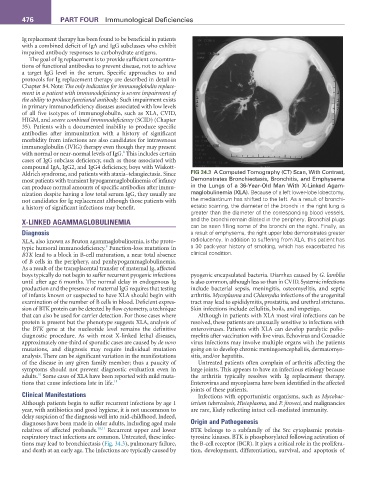
        Aldrich syndrome, and patients with ataxia–telangiectasia. Since   fIG 34.3  A Computed Tomography (CT) Scan, With Contrast,
        most patients with transient hypogammaglobulinemia of infancy   Demonstrates Bronchiectasis, Bronchitis, and Emphysema
        can produce normal amounts of specific antibodies after immu-  in the Lungs of a 36-Year-Old Man With X-Linked Agam-
        nization despite having a low total serum IgG, they usually are   maglobulinemia (XLA). Because of a left lower-lobe lobectomy,
        not candidates for Ig replacement although those patients with   the mediastinum has shifted to the left. As a result of bronchi-
        a history of significant infections may benefit.       ectatic scarring, the diameter of the bronchi in the right lung is
                                                               greater than the diameter of the corresponding blood vessels,
        X-LINKED AGAMMAGLOBULINEMIA                            and the bronchi remain dilated in the periphery. Bronchial plugs
                                                               can be seen filling some of the bronchi on the right. Finally, as
        Diagnosis                                              a result of emphysema, the right upper lobe demonstrates greater
        XLA, also known as Bruton agammaglobulinemia, is the proto-  radiolucency. In addition to suffering from XLA, this patient has
                                    9
        typic humoral immunodeficiency.  Function-loss mutations in   a 30 pack-year history of smoking, which has exacerbated his
        BTK lead to a block in B-cell maturation, a near total absence   clinical condition.
        of B cells in the periphery, and panhypogammaglobulinemia.
        As a result of the transplacental transfer of maternal Ig, affected
        boys typically do not begin to suffer recurrent pyogenic infections   pyogenic encapsulated bacteria. Diarrhea caused by G. lamblia
        until after age 6 months. The normal delay in endogenous Ig   is also common, although less so than in CVID. Systemic infections
        production and the presence of maternal IgG requires that testing   include bacterial sepsis, meningitis, osteomyelitis, and septic
        of infants known or suspected to have XLA should begin with   arthritis. Mycoplasma and Chlamydia infections of the urogenital
        examination of the number of B cells in blood. Deficient expres-  tract may lead to epididymitis, prostatitis, and urethral strictures.
        sion of BTK protein can be detected by flow cytometry, a technique   Skin infections include cellulitis, boils, and impetigo.
        that can also be used for carrier detection. For those cases where   Although in patients with XLA most viral infections can be
        protein is present but the phenotype suggests XLA, analysis of   resolved, these patients are unusually sensitive to infections with
        the  BTK gene at the nucleotide level remains the definitive   enteroviruses. Patients with XLA can develop paralytic polio-
        diagnostic procedure.  As with most X-linked lethal diseases,   myelitis after vaccination with live virus. Echovirus and Coxsackie
        approximately one-third of sporadic cases are caused by de novo   virus infections may involve multiple organs with the patients
        mutations, and diagnosis may require individual mutation   going on to develop chronic meningoencephalitis, dermatomyo-
        analysis. There can be significant variation in the manifestations   sitis, and/or hepatitis.
        of the disease in any given family member; thus a paucity of   Untreated patients often complain of arthritis affecting the
        symptoms should not  prevent diagnostic evaluation even in   large joints. This appears to have an infectious etiology because
             10
        adults.  Some cases of XLA have been reported with mild muta-  the arthritis typically resolves with Ig replacement therapy.
        tions that cause infections late in life. 11           Enterovirus and mycoplasma have been identified in the affected
                                                               joints of these patients.
        Clinical Manifestations                                   Infections with opportunistic organisms, such as Mycobac-
        Although patients begin to suffer recurrent infections by age 1   terium tuberculosis, Histoplasma, and P. jiroveci, and malignancies
        year, with antibiotics and good hygiene, it is not uncommon to   are rare, likely reflecting intact cell-mediated immunity.
        delay suspicion of the diagnosis well into mid-childhood. Indeed,
        diagnoses have been made in older adults, including aged male   Origin and Pathogenesis
        relatives of affected probands. 10,11  Recurrent upper and lower   BTK belongs to a subfamily of the Src cytoplasmic protein-
        respiratory tract infections are common. Untreated, these infec-  tyrosine kinases. BTK is phosphorylated following activation of
        tions may lead to bronchiectasis (Fig. 34.3), pulmonary failure,   the B-cell receptor (BCR). It plays a critical role in the prolifera-
        and death at an early age. The infections are typically caused by   tion, development, differentiation, survival, and apoptosis of

