


Page 1643 - Hall et al (2015) Principles of Critical Care-McGraw-Hill
P. 1643
1162     PART 10: The Surgical Patient


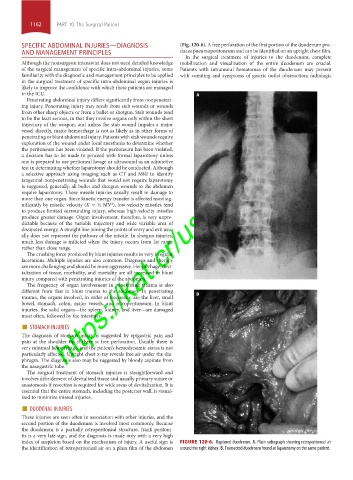
                 SPECIFIC ABDOMINAL INJURIES—DIAGNOSIS                 (Fig. 120-6). A free perforation of the first portion of the duodenum pro-
                 AND MANAGEMENT PRINCIPLES                             duces pneumoperitoneum and can be identified on an upright chest film.
                                                                         In the surgical treatment of injuries to the duodenum, complete
                 Although the nonsurgeon intensivist does not need detailed knowledge   mobilization and visualization of the entire duodenum are crucial.
                 of the surgical management of specific intra-abdominal injuries, some   Patients with intramural hematomas of the duodenum may present
                 familiarity with the diagnostic and management principles to be applied   with vomiting and symptoms of gastric outlet obstruction; radiologic
                 in the surgical treatment of specific intra-abdominal organ injuries is
                 likely to improve the confidence with which these patients are managed
                 in the ICU.
                   Penetrating abdominal injury differs significantly from nonpenetrat-
                 ing injury. Penetrating injury may result from stab wounds or wounds
                                https://kat.cr/user/tahir99/
                 from other sharp objects or from a bullet or shotgun. Stab wounds tend
                 to be the least serious, in that they involve organs only within the short
                 trajectory of the weapon, and unless the stab wound impales a major
                 vessel directly, major hemorrhage is not as likely as in other forms of
                 penetrating or blunt abdominal injury. Patients with stab wounds require
                 exploration of the wound under local anesthesia to determine whether
                 the peritoneum has been violated. If the peritoneum has been violated,
                 a decision has to be made to proceed with formal laparotomy unless
                 one is prepared to use peritoneal lavage or ultrasound as an adjunctive
                 test in determining whether laparotomy should be conducted. Although
                 a selective approach using imaging such as CT and MRI to identify
                 tangential nonpenetrating wounds that would not require laparotomy
                 is suggested, generally, all bullet and shotgun wounds to the abdomen
                 require laparotomy. These missile injuries usually result in damage to
                 more than one organ. Since kinetic energy transfer is affected most sig-
                 nificantly by missile velocity (K = ½ MV ), low-velocity missiles tend
                                                2
                 to produce limited surrounding injury, whereas high-velocity missiles
                 produce greater damage. Organ involvement, therefore, is very unpre-
                 dictable because of the variable trajectory and wide variable area of
                 dissipated energy. A straight line joining the points of entry and exit usu-
                 ally does not represent the pathway of the missile. In shotgun injuries,
                 much less damage is inflicted when the injury occurs from far range
                 rather than close range.
                   The crushing force produced by blunt injuries results in very irregular
                 lacerations. Multiple injuries are also common. Diagnosis and therapy
                 are more challenging and should be more aggressive. Hemorrhage, devi-
                 talization of tissue, morbidity, and mortality are all increased in blunt
                 injury compared with penetrating injuries of the abdomen.
                   The frequency of organ involvement in penetrating trauma is also
                 different from that in blunt trauma to the abdomen. In penetrating
                 trauma, the organs involved, in order of frequency, are the liver, small
                 bowel, stomach, colon, major vessels, and retroperitoneum. In blunt
                 injuries, the solid organs—the spleen, kidney, and liver—are damaged
                 most often, followed by the intestines.
                     ■  STOMACH INJURIES

                 The diagnosis of stomach injury is suggested by epigastric pain and
                 pain at the shoulder tip if there is free perforation. Usually there is
                 very minimal hemorrhage, and the patient’s hemodynamic status is not
                 particularly affected. Upright chest x-ray reveals free air under the dia-
                 phragm. The diagnosis also may be suggested by bloody aspirate from
                 the nasogastric tube.
                   The surgical treatment of stomach injuries is straightforward and
                 involves débridement of devitalized tissue and usually primary suture or
                 anastomosis if resection is required for wide areas of devitalization. It is
                 essential that the entire stomach, including the posterior wall, is visual-
                 ized to minimize missed injuries.
                     ■  DUODENAL INJURIES

                 These injuries are seen often in association with other injuries, and the
                 second portion of the duodenum is involved most commonly. Because
                 the duodenum is a partially retroperitoneal structure, frank peritoni-
                 tis is a very late sign, and the diagnosis is made only with a very high
                 index of suspicion based on the mechanism of injury. A useful sign is   FIGURE 120-6.  Ruptured duodenum. A. Plain radiograph showing retroperitoneal air
                 the identification of retroperitoneal air on a plain film of the abdomen     around the right kidney. B. Transected duodenum found at laparotomy on the same patient.


            section10.indd   1162                                                                                      1/20/2015   9:21:11 AM

