


Page 1640 - Hall et al (2015) Principles of Critical Care-McGraw-Hill
P. 1640
CHAPTER 120: Torso Trauma  1159

                        ■  BLUNT CARDIAC INJURY                           suggestive sign is a widening of the mediastinum on the plain chest film

                    This lesion probably occurs much more commonly than was suspected   (Fig. 120-5). Other suggestive signs are the presence of a thoracic bruit
                                                                          or a discrepancy in blood pressure between the upper and lower limbs or
                    previously because of the subtle nature of its presentation among other
                    associated injuries. It usually results from blunt trauma to the sternum,   between the right and left upper limbs. Placement of a nasogastric tube
                                                                          may highlight the degree of esophageal deviation and hematoma size on
                    most commonly caused by steering wheel impact. In fact, whenever a
                    fractured sternum is diagnosed in chest trauma, one must assume an   the chest film. Since most chest x-rays in traumatized patients are done in
                                                                          the supine position, the size of the mediastinum is exaggerated, and con-
                    underlying myocardial contusion. The patient’s symptoms frequently
                    are clouded by associated chest wall contusion and other causes for   sequently, this diagnosis is considered in a large percentage of patients
                                                                          who do not actually have a traumatic aortic rupture. However, because of
                    chest wall discomfort and cardiorespiratory dysfunction. The diagnosis
                    is suggested by the presence of ECG abnormalities, serial elevations in   the lethal nature of this disease, it seems justified to pursue further imag-
                                                                          ing whenever aortic rupture is seriously suspected.
                    the level of the creatine kinase MB isoenzyme, or abnormalities found
                                                                           Spiral computed tomography (CT) is recommended in the presence
                    by two-dimensional echocardiography. However, myocardial enzymes   of suspected mediastinal widening, and if this is totally normal, then
                    do not contribute significantly to the diagnosis or management in this
                    injury. Although cardiac troponins usually are helpful in the diagnosis   further imaging is not warranted. If the CT scan is questionable or
                                                                          suspicious, then an aortogram should be obtained. In
                                  https://kat.cr/user/tahir99/ any event, most
                    of myocardial infarction, the levels obtained following trauma are too
                    inconclusive to allow a diagnosis of blunt cardiac injury and provide no   surgeons still insist that angiography be performed prior to surgery. The
                                                                          use of transesophageal echocardiography also has given excellent results
                    additional information beyond that available by electrocardiography.
                    ECG  abnormalities  may  vary  from  few  to  multiple  premature  ven-  in the diagnosis of aortic rupture, and in some centers it has virtually
                    tricular contractions, persistent tachycardia, dysrhythmias such as atrial
                    fibrillation, bundle branch block, ST-segment changes, or even changes
                    indistinguishable from those of acute myocardial infarction. None of
                    these tests is specific for blunt cardiac injury.
                     Because of the nature of this entity and its propensity for certain life-
                    threatening dysrhythmias, consideration should be given to monitoring
                    these patients in an ICU environment. Oxygen should be administered,
                    pain should be treated with parenteral analgesics, and the patient should
                    be treated in the same way as for myocardial ischemia, as outlined in
                    other chapters of this book. The indications for inotropic agents, vasoac-
                    tive drugs, and other forms of cardiac support are comparable with those
                    for any patient with myocardial ischemia. Most patients with minor
                    degrees of contusion do not require ICU admission. Based on a review
                    of the literature on this entity, the Eastern Association for the Surgery of
                    Trauma (EAST) has recognized three levels of investigation.
                    Level I:  Admission ECG for all patients suspected of having blunt
                    cardiac injury.

                    Level II
                    a.  An abnormal ECG requires monitoring for 24 to 48 hours.
                    b.  Hemodynamically unstable patients should have an echocardiogram
                      (transthoracic or transesophageal).
                    Level  III:  Elderly patients with a cardiac history, unstable patients,
                    and those with abnormal admitting ECG may undergo surgery with
                    appropriate monitoring including consideration for the placement of
                    pulmonary artery catheter.
                        ■  AORTIC RUPTURE


                    Traumatic disruption of the thoracic aorta frequently is lethal. In patients
                    who reach the hospital alive, the rupture tends to be located at the point
                    of fixation of the aorta just distal to the origin of the left subclavian artery
                    at the ligamentum arteriosum, which represents the junction between a
                    relatively fixed and mobile portion of the vessel. Therefore, the mecha-
                    nism is a shear force, commonly seen with acceleration-deceleration
                    injuries, although a sudden increase in intraluminal hydrostatic pressure
                    may play a role in its pathogenesis. Aortic rupture at other sites near the
                    root of the aorta usually results in death at the scene. In patients who
                    survive the initial injury, the hematoma is contained by an intact adven-
                    titial layer. Because of the possibility of free rupture and exsanguination
                    whenever this diagnosis is suspected, investigations and treatment should
                    be prompt. Although several radiologic signs are described (such as
                    widened mediastinum, fractures of the first and second ribs, obliteration
                    of the aortic knob, deviation of the trachea to the right, presence of a
                    pleural cap, elevation and rightward shift of the right main-stem bron-
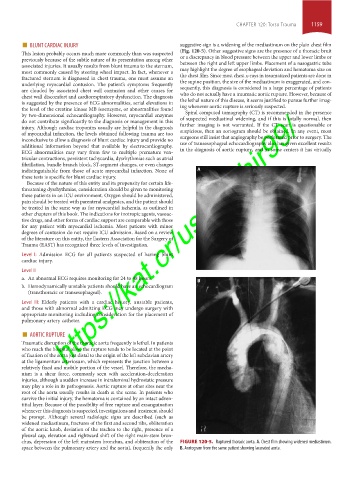
                    chus, depression of the left mainstem bronchus, and obliteration of the   FIGURE 120-5.  Ruptured thoracic aorta. A. Chest film showing widened mediastinum.
                    space between the pulmonary artery and the aorta), frequently the only   B. Aortogram from the same patient showing lacerated aorta.


            section10.indd   1159                                                                                      1/20/2015   9:21:09 AM

