


Page 1666 - Hall et al (2015) Principles of Critical Care-McGraw-Hill
P. 1666
CHAPTER 123: Critical Care of the Burn Patient   1185


                                       B-1c Estimation of Burn & Diagram  Date
                                                                          Hosp No.
                                                                          Name
                                                                          Birthdate
                                                                          Address

                                                                              If not imprinted. Please print date, Hosp no., Name, Unit


                                                                                    Birth  1-4  5-9  10-14  15  Adult  Burn
                                                                                     1 y  Y  Y  Y    Y      size estimate
                                                                          Head       19  17  13  11  9   7
                                                                          Neck       2   2  2   2    2   2
                                                                          Anterior trunk  13  13  13  13  13  13
                                R               L    L               R
                                                                          Posterior trunk  13  13  13  13  13  13
                                                                          Right buttock  2.5  2.5  2.5  2.5  2.5  2.5
                                                                          Left buttock  2.5  2.5  2.5  2.5  2.5  2.5
                                                                          Genitalia  1   1  1   1    1   1
                                                                          Right upper arm  4  4  4  4  4  4
                                                                          Left upper arm  4  4  4  4  4  4
                                                                          Right lower arm  3  3  3  3  3  3
                                                                          Left lower arm  3  3  3  3  3  3
                                                                          Right hand  2.5  2.5  2.5  2.5  2.5  2.5
                                                                          Left hand  2.5  2.5  2.5  2.5  2.5  2.5
                              Patient’s
                                                                          Right thigh  5.5  6.5  8  8.5  9  9.5
                                                                          Left thigh  5.5  6.5  8  8.5  9  9.5
                               Wt.= _________ Ht.= ________ TBSA = _____.____ M 2
                                                                          Right leg  5   5  5.5  6   6.5  7
                                                                          Left leg   5   5  5.5  6   6.5  7
                                           Adult fluid calculation        Right foot  3.5  3.5  3.5  3.5  3.5  3.5
                               Wt. _________ Kg.
                                                                          Left foot  3.5  3.5  3.5  3.5  3.5  3.5
                              × _____________ % BSAB
                                                                                              Total BSAB
                              × 4           = mL = _____________ mL/1st 24 hours
                                                                           Patient arrival time (official) ____________________
                                              /2 = _____________ mL/1st 8 hours
                                              /8 = _____________ mL/hour IV rate  Burn activation only  Page sent at: _________
                                                                           Signature of staff responding:
                              Additional notes:
                                                                           Burn/Trauma faculty on call: _______________________________
                                                                           Burn residents/LIP: ______________________________________
                                                                           ______________________________________________________
                                                                           Trauma/Night float: _____________________________________
                                                                           Anesthesia: ____________________________________________
                                                                           RT: ___________________________________________________
                                                                           Burn charge RN: ________________________________________
                               Signed and dated: _______________________/____/_____  Nursing: ______________________________________________
                               Signed and dated: _______________________/____/_____  ISS nursing supervisor: __________________________________

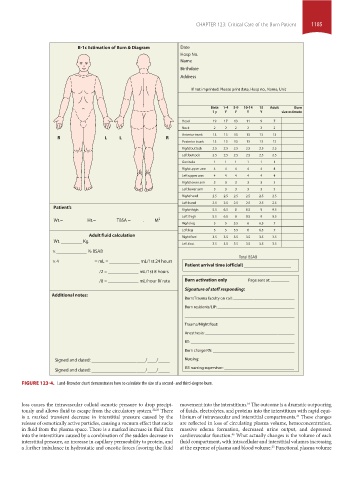
                    FIGURE 123-4.  Lund-Browder chart demonstrates how to calculate the size of a second- and third-degree burn.


                    loss causes the intravascular colloid osmotic pressure to drop precipi-  movement into the interstitium.  The outcome is a dramatic outpouring
                                                                                                16
                    tously and allows fluid to escape from the circulatory system. 22,26  There   of fluids, electrolytes, and proteins into the interstitium with rapid equi-
                    is a marked transient decrease  in interstitial pressure caused by the   librium of intravascular and interstitial compartments.  These changes
                                                                                                                 25
                    release of osmotically active particles, causing a vacuum effect that sucks   are reflected in loss of circulating plasma volume, hemoconcentration,
                    in fluid from the plasma space. There is a marked increase in fluid flux   massive edema formation, decreased urine output, and depressed
                    into the interstitium caused by a combination of the sudden decrease in   cardiovascular function.  What actually changes is the volume of each
                                                                                           46
                    interstitial pressure, an increase in capillary permeability to protein, and   fluid compartment, with intracellular and interstitial volumes increasing
                                                                                                         25
                    a further imbalance in hydrostatic and oncotic forces favoring the fluid   at the expense of plasma and blood volume.  Functional plasma volume


            section10.indd   1185                                                                                      1/20/2015   9:21:35 AM

