


Page 433 - Clinical Hematology_ Theory _ Procedures ( PDFDrive )
P. 433
CHAPTER 22 ■ Lymphoid and Plasma Cell Neoplasms 417
poptosis. T e nti poptotic Bcl2 gene is reporte to be
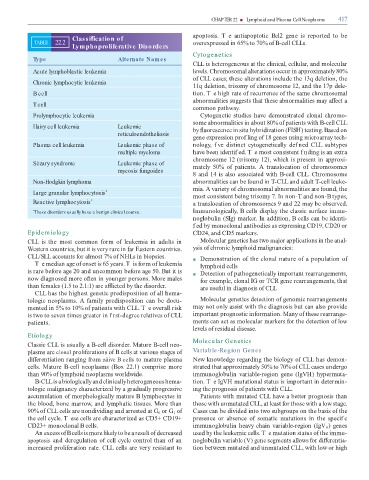
Classi cation of
TABLE 22.2 overexpresse in 65% to 70% o B-cell CLLs.
Lymphoproliferative Disorders
Cytogenetics
Type Alternate Names
CLL is heterogeneous t the clinic l, cellul r, n olecul r
Acute lymphoblastic leukemia levels. Chro oso l lter tions occur in pproxi tely 80%
o CLL c ses; these lter tions inclu e the 13q eletion, the
Chronic lymphocytic leukemia
11q eletion, triso y o chro oso e 12, n the 17p ele-
B cell tion. T e high r te o recurrence o the s e chro oso l
bnor lities suggests th t these bnor lities y ect
T cell
co on p thw y.
Prolymphocytic leukemia Cytogenetic stu ies h ve e onstr te clon l chro o-
so e bnor lities in bout 80% o p tients with B-cell CLL
Hairy cell leukemia Leukemic by uorescence in situ hybri iz tion (FISH) testing. B se on
reticuloendotheliosis
gene expression prof ling o 18 genes using icro rr y tech-
Plasma cell leukemia Leukemic phase of nology, f ve istinct cytogenetic lly ef ne CLL subtypes
multiple myeloma h ve been i entif e . T e ost consistent f n ing is n extr
chro oso e 12 (triso y 12), which is present in pproxi-
Sézary syndrome Leukemic phase of tely 50% o p tients. A tr nsloc tion o chro oso es
mycosis fungoides
8 n 14 is lso ssoci te with B-cell CLL. Chro oso e
Non-Hodgkin lymphoma bnor lities c n be oun in -CLL n ult -cell leuke-
i . A v riety o chro oso l bnor lities re oun , the
Large granular lymphocytosis *
ost consistent being triso y 7. In non- n non-B types,
Reactive lymphocytosis * tr nsloc tion o chro oso es 9 n 22 y be observe .
* These disorders usually have a benign clinical course. I unologic lly, B cells ispl y the cl ssic sur ce i u-
noglobulin (SIg) rker. In ition, B cells c n be i enti-
f e by onoclon l ntibo ies s expressing CD19, CD20 or
Epidem iology CD24, n CD5 rkers.
CLL is the ost co on or o leuke i in ults in Molecul r genetics h s two jor pplic tions in the n l-
Western countries, but it is very r re in r E stern countries. ysis o chronic ly phoi lign ncies:
CLL/SLL ccounts or l ost 7% o NHLs in biopsies. ■ De onstr tion o the clon l n ture o popul tion o
T e e i n ge o onset is 65 ye rs. T is or o leuke i ly phoi cells
is r re be ore ge 20 n unco on be ore ge 50. But it is ■ Detection o p thogenetic lly i port nt re rr nge ents,
now i gnose ore o en in younger persons. More les or ex ple, clon l IG or CR gene re rr nge ents, th t
th n e les (1.5 to 2.1:1) re icte by the isor er. re use ul in i gnosis o CLL
CLL h s the highest genetic pre isposition o ll he -
tologic neopl s s. A ily pre isposition c n be ocu- Molecul r genetics etection o geno ic re rr nge ents
ente in 5% to 10% o p tients with CLL. T e over ll risk y not only ssist with the i gnosis but c n lso provi e
is two to seven ti es gre ter in f rst- egree rel tives o CLL i port nt prognostic in or tion. M ny o these re rr nge-
p tients. ents c n ct s olecul r rkers or the etection o low
levels o resi u l ise se.
Etiology
Molecular Genetics
Cl ssic CLL is usu lly B-cell isor er. M ture B-cell neo-
pl s s re clonal proli er tions o B cells t v rious st ges o Variable-Region Genes
i erenti tion r nging ro näive B cells to ture pl s New knowle ge reg r ing the biology o CLL h s e on-
cells. M ture B-cell neopl s s (Box 22.1) co prise ore str te th t pproxi tely 50% to 70% o CLL c ses un ergo
th n 90% o ly phoi neopl s s worl wi e. i unoglobulin v ri ble-region gene (IgVH) hyper ut -
B-CLL is biologic lly n clinic lly heterogeneous he - tion. T e IgVH ut tion l st tus is i port nt in eter in-
tologic lign ncy ch r cterize by gr u lly progressive ing the prognosis o p tients with CLL.
ccu ul tion o orphologic lly ture B ly phocytes in P tients with ut te CLL h ve better prognosis th n
the bloo , bone rrow, n ly ph tic tissues. More th n those with un ut te CLL, t le st or those with low st ge.
90% o CLL cells re non ivi ing n rreste t G or G o C ses c n be ivi e into two subgroups on the b sis o the
0
1
the cell cycle. T ese cells re ch r cterize s CD5+ CD19+ presence or bsence o so tic ut tions in the specif c
CD23+ onoclon l B cells. i unoglobulin he vy ch in v ri ble-region (IgV ) genes
H
An excess o B cells is ore likely to be result o ecre se use by the leuke ic cells. T e ut tion st tus o the i u-
apoptosis n eregul tion o cell cycle control th n o n noglobulin v ri ble (V) gene seg ents llows or i erenti -
incre se proli er tion r te. CLL cells re very resist nt to tion between ut te n un ut te CLL, with low or high

