


Page 578 - Clinical Hematology_ Theory _ Procedures ( PDFDrive )
P. 578
562 PART 7 ■ Principles and Disorders of Hemostasis and Thrombosis
e en ing on the sa e ti e re ative to the onset o DIC. he orrhagic an thro botic co ications ay acco any
P as a eve s o PC antigen an activity have been oun to DIC, o en being ani este in the sa e atient. T ro bosis
be ecrease in atients with DIC. Whereas three ourths o ay re o inate in chronic or ow-gra e DIC. T ro botic
DIC atients have a ecrease in PC antigen, a ost a DIC co ications can inc u e ee venous thro bosis.
atients have a ecrease eve o PC activity. Monitoring Acute DIC is severe an o en i e threatening. Its onset
atients revea s that PC antigen an activity ecrease ro- is ra i , an both brinogen an ate ets ay be e ete .
gressive y uring the initia stages o DIC an re ain at a ow Patients with chronic DIC ay have i ani estations
eve or 24 to 48 hours be ore gra ua y returning towar o the isor er or be recognizab e on y by aboratory ata.
nor a in non ata cases. He orrhagic co ications are a so seen but are genera y
i er than in acute DIC.
The Role of Throm bin C inica ani estations o DIC inc u e etechiae, ur-
ura, he orrhagic bu ae, surgica woun b ee ing, trau-
Mechanis s invo ve in DIC resu t in the generation o
thro bin in the circu ating b oo . A ong its any ee back atic woun b ee ing, veni uncture site b ee ing, arteria
reactions, thro bin artici ates in irect y in the activation ine oozing, an subcutaneous he ato as.
o the brino ytic syste secon ary to DIC an activates T ro botic thro bocyto enia ur ura ( P) is a con-
rotein C. T e atter reaction is acce erate by the resence ition that is si i ar to DIC ( ab es 28.9 an 28.10). In
o the en othe ia ce co actor, rotein S. a ition, e iatric res iratory istress syn ro e, a u t
In a ition to c eaving brinogen an er or ing its res iratory istress syn ro e (ARDS), he o ytic ure ic
other rocoagu ant unctions, so e o the excess thro bin syn ro e (HUS), reec a sia or rank ec a sia, circu at-
bin s to rotein S on the en othe ia ce sur ace. T is event ing i une co ex, cavernous he angio as, an Rocky
ea s to increase eve s o aPC in the as a. Once the gen- Mountain s otte ever can rese b e DIC.
eration o excess thro bin is ecrease by the action o aPC Laboratory Findings
an other regu atory echanis s, the coagu ation rocess
can return to nor a . T is negative ee back echanis has A though the quantitative easure ent o brin s it ro -
the otentia to s ow the or ation o excess thro bin an ucts (FSPs) cannot istinguish between ri ary an secon -
to sto DIC. ary brino ysis, such easure ent ays the ajor ro e in
iagnosing an onitoring these con itions. Laboratory
iagnosis o DIC requires the avai abi ity o tests that are
Clinical Signs and Sym ptom s
ra i an si e to er or . T ere is no sing e test that con-
T e DIC heno enon has varie c inica an aboratory r s the iagnosis but rather a co bination o tests. Because
ani estations (Box 28.1) owing to the any hysio ogi- DIC is a yna ic rocess, va ues ro tests er or e a
ca abnor a ities associate with the syn ro e. DIC ay sing e ti e, whether nor a or abnor a , cannot be use as
be acute or subacute (chronic). Chronic DIC is ore co - iagnostic in icators. Sequentia testing is necessary to ro-
on than acute DIC but is o en ore i cu t to iagnose. vi e an accurate iagnosis an e ective y anage thera y.
Chronic DIC can convert to acute consu tion i the ba - T e ost i ortant consi eration in the treat ent o DIC is
ance o rocoagu ant-anticoagu ant is ost. the reso ution o the un er ying isease or triggering event.
Either or ay initia y be seen with varying egrees DIC is a isor er o b ee ing an c otting characterize by
o thro bosis an he orrhage, but b ee ing is usu- hy o brinogene ia, a ro onge thro bin ti e ( ), an
a y the ajor sy to , articu ar y in acute cases. Both the resence o d- i ers.
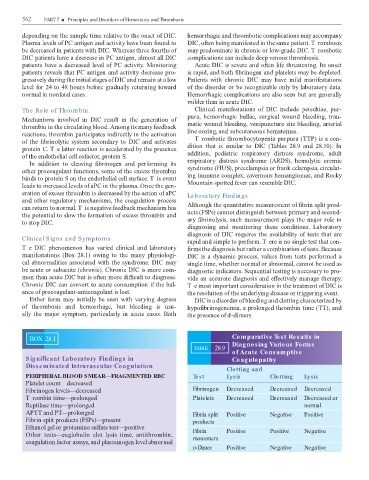
BOX 28.1 Comparative Test Results in
TABLE 28.9 Diagnosing Various Forms
of Acute Consumptive
Signi cant Laboratory Findings in Coagulopathy
Disseminated Intravascular Coagulation
Clotting and
PERIPHERAL BLOOD SMEAR—FRAGMENTED RBC Test Lysis Clotting Lysis
P ate et count— ecrease
Fibrinogen eve s— ecrease Fibrinogen Decreased Decreased Decreased
T ro bin ti e— ro onge Platelets Decreased Decreased Decreased or
Re ti ase ti e— ro onge normal
AP an P — ro onge Fibrin split Positive Negative Positive
Fibrin s it ro ucts (FSPs)— resent products
Ethano ge or rota ine su ate test— ositive Fibrin Positive Positive Negative
Other tests—eug obu in c ot ysis ti e, antithro bin, monomers
coagu ation actor assays, an as inogen eve abnor a
D-Dimer Positive Negative Negative

