


Page 579 - Clinical Hematology_ Theory _ Procedures ( PDFDrive )
P. 579
CHAPTER 28  ■  Disorders of Hemostasis and Thrombosis: Blood Coagulation Factors, Hypercoagulable State, and Anticoagulant Therapy                                                                 563


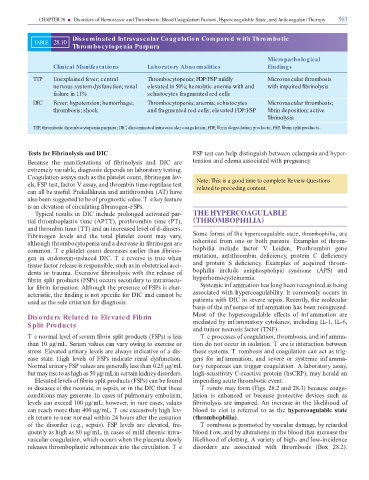
                                                Disseminated Intravascular Coagulation Compared w ith Thrombotic
                       TABLE        28.10
                                                Thrombocytopenia Purpura


                                                                                                                                                                                Micropathological

                                    Clinical Manifestations                                      Laboratory Abnormalities                                                       Findings


                       TTP          Unexplained fever; central                                   Thrombocytopenia; FDP/FSP mildly                                               Microvascular thrombosis

                                      nervous system dysfunction; renal                          elevated in 50%; hemolytic anemia with and                                     with impaired   brinolysis

                                    failure in 11%                                               schistocytes fragmented red cells

                       DIC          Fever; hypotension; hemorrhage;                              Thrombocytopenia; anemia; schistocytes                                         Microvascular thrombosis;


                                    thrombosis; shock                                            and fragmented red cells; elevated FDP/FSP                                       brin deposition; active
                                                                                                                                                                                  brinolysis


                       TTP, thrombotic thrombocytopenia purpura; DIC, disseminated intravascular coagulation; FDP,   brin degradation products; FSP,   brin split products.


                    ests  or Fibrinolysis and DIC                                                                              FSP test can he      istinguish between ec a    sia an   hy  er-


                   Because  the    ani estations  o     brino ysis  an    DIC  are                                             tension an   e  e  a associate   with   regnancy.

                   extre  e y variab e,   iagnosis   e  en  s on  aboratory testing.

                   Coagu ation assays such as the    ate et count,   brinogen  ev-                                               Note: This is a good time to complete Review Questions

                   e s, FSP test,  actor V assay, an   thro  bin ti  e-re  ti ase test                                           related to preceding content.

                   can a   be use u . Preka  ikrein an   antithro  bin (A  ) have

                   a so been suggeste   to be o    rognostic va ue. T e key  eature

                   is an e evation o  circu ating   brinogen-FSPs.

                         y  ica  resu ts in DIC inc u  e   ro onge   activate     ar-                                           HE HYPERCOAGULABLE

                   tia  thro  bo   astin ti  e (AP    ),   rothro  bin ti  e (P  ),                                               HROMBOPHILIA

                   an   thro  bin ti  e (    ) an   an increase    eve  o  d-  i  ers.

                   Fibrinogen   eve s  an    the  tota      ate et  count    ay  vary,                                         So  e  or  s o  the hypercoagulable state, thrombophilia, are

                   a though thro  bocyto  enia an   a   ecrease in   brinogen are                                              inherite    ro   one or both   arents. Exa     es o  thro  -

                   co    on. T e    ate et count   ecreases ear ier than   brino-                                              bo  hi ia  inc u  e   actor  V  Lei  en,  Prothro  bin  gene

                   gen  in  en  otoxin-in  uce    DIC.  T e  reverse  is  true  when                                             utation,  antithro  bin    e  ciency,    rotein  C    e  ciency

                   tissue  actor re ease is res  onsib e, such as in obstetrica  acci-                                         an      rotein  S    e  ciency.  Exa     es  o   acquire    thro  -

                     ents or trau  a. Excessive   brino ysis with the re ease o                                                bo  hi ia  inc u  e  antiphospholipid  syndrome (APS)  an

                    brin s   it   ro  ucts (FSPs) occurs secon  ary to intravascu-                                             hy  erho  ocysteine  ia.

                    ar   brin  or  ation. A though the   resence o  FSPs is char-                                                   Syste  ic inf a    ation has  ong been recognize   as being

                   acteristic, the   n  ing is not s  eci  c  or DIC an   cannot be                                            associate   with hy  ercoagu abi ity. It co    on y occurs in

                   use   as the so e criterion  or   iagnosis.                                                                  atients with DIC in severe se sis. Recent y, the   o ecu ar
                                                                                                                               basis o  the inf uence o  inf a    ation has been recognize  .


                   Disorders Related to Elevated Fibrin                                                                        Most  o   the  hy  ercoagu ab e  e  ects  o   inf a    ation  are

                   Split Products                                                                                                e  iate   by inf a    atory cytokines, inc u  ing IL-1, IL-6,
                                                                                                                               an   tu  or necrosis  actor (  NF).

                   Te nor  a   eve  o  seru     brin s   it   ro  ucts (FSPs) is  ess                                               T e   rocesses o  coagu ation, thro  bosis, an   inf a    a-

                   than 10 µg/  L. Seru   va ues can vary owing to exercise or                                                 tion   o not occur in iso ation. T ere is interaction between

                   stress. E evate   urinary  eve s are a ways in  icative o  a   is-                                          these syste  s. T ro  bosis an   coagu ation can act as trig-

                   ease  state.  High   eve s  o   FSPs  in  icate  rena     ys unction.                                       gers   or  inf a    ation,  an    severe  or  syste  ic  inf a    a-

                   Nor  a  urinary FSP va ues are genera  y  ess than 0.25 µg/  L                                              tory res  onses can trigger coagu ation. A  aboratory assay,

                   but   ay rise to as high as 50 µg/  L in certain ki  ney   isor  ers.                                       high-sensitivity C-reactive   rotein (hsCRP),   ay hera    an

                        E evate    eve s o    brin s   it   ro  ucts (FSPs) can be  oun                                        i    en  ing acute thro  botic event.

                   in   iseases o  the neonate, in se  sis, or in the DIC that these                                                T ro  bi   ay  or   (Figs. 28.2 an   28.3) because coagu-

                   con  itions   ay generate. In cases o    u   onary e  bo is  ,                                               ation  is  enhance    or  because    rotective    evices  such  as

                    eve s can excee   100 µg/  L; however, in rare cases, va ues                                                 brino ysis are i    aire  . An increase in the  ike ihoo   o

                   can reach   ore than 400 µg/  L. T ese excessive y high  ev-                                                b oo    to  c ot  is  re erre    to  as  the  hypercoagulable  state

                   e s return to near nor  a  within 24 hours a  er the cessation                                              (thrombophilia).

                   o   the    isor  er  (e.g.,  se  sis).  FSP   eve s  are  e evate  ,   re-                                       T ro  bosis is   ro  ote   by vascu ar   a  age, by retar  e

                   quent y as high as 80 µg/  L, in cases o    i    chronic intra-                                             b oo   f ow, an   by a terations in the b oo   that increase the

                   vascu ar coagu ation, which occurs when the    acenta s ow y                                                 ike ihoo   o  c otting. A variety o  high- an    ow- inci  ence

                   re eases thro  bo   astic substances into the circu ation. T e                                                isor  ers  are  associate    with  thro  bosis  (Box  28.2).

