


Page 141 - Review of Medical Microbiology and Immunology ( PDFDrive )
P. 141
mebooksfree.com


                                            mebooksfree.com
                                                                                                            mebooksfree.com
            mebooksfree.com
 mebooksfree.com  mebooksfree.com           mebooksfree.com                 mebooksfree.com                 mebooksfree.com                mebooksfree.com
                                                                            mebooksfree.com
                                                                                                                                           mebooksfree.com
                 130
                       PART II  Clinical Bacteriology


 mebooksfree.com  mebooksfree.com           mebooksfree.com          FIGURE 16–5    Oxidase test—A drop of the oxidase reagent             mebooksfree.com
                                                                                                            mebooksfree.com
                                                                            mebooksfree.com


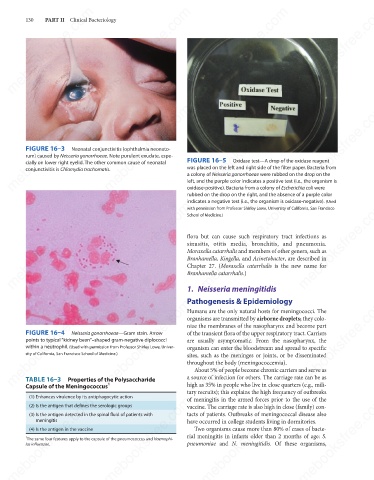
                 FIGURE 16–3
                                Neonatal conjunctivitis (ophthalmia neonato-
                 rum) caused by Neisseria gonorrhoeae. Note purulent exudate, espe-
                 cially on lower right eyelid. The other common cause of neonatal
                                                                     was placed on the left and right side of the filter paper. Bacteria from
                 conjunctivitis is Chlamydia trachomatis.
                                                                     a colony of Neisseria gonorrhoeae were rubbed on the drop on the
                                                                     left, and the purple color indicates a positive test (i.e., the organism is
                                                                     oxidase-positive). Bacteria from a colony of Escherichia coli were
                                                                     rubbed on the drop on the right, and the absence of a purple color
                                                                     indicates a negative test (i.e., the organism is oxidase-negative). (Used
                                                                            mebooksfree.com
 mebooksfree.com  mebooksfree.com           mebooksfree.com          flora but can  cause  such respiratory tract infections  as           mebooksfree.com
                                                                                                            mebooksfree.com
                                                                     with permission from Professor Shirley Lowe, University of California, San Francisco
                                                                     School of Medicine.)

                                                                     sinusitis, otitis media, bronchitis, and pneumonia.
                                                                     Moraxella catarrhalis and members of other genera, such as
                                                                     Branhamella, Kingella, and Acinetobacter, are described in
                                                                     Chapter 27. (Moraxella catarrhalis is the new name for
                                                                     Branhamella catarrhalis.)

                                                                     1.  Neisseria meningitidis

                 Capsule of the Meningococcusmebooksfree.com
                                                                            mebooksfree.com
 mebooksfree.com  mebooksfree.com                                    Pathogenesis & Epidemiology            mebooksfree.com                mebooksfree.com
                                                                     Humans are the only natural hosts for meningococci. The
                                                                     organisms are transmitted by airborne droplets; they colo-
                                                                     nize the membranes of the nasopharynx and become part
                 FIGURE 16–4
                                                                     of the transient flora of the upper respiratory tract. Carriers
                                Neisseria gonorrhoeae—Gram stain. Arrow
                 points to typical “kidney bean”–shaped gram-negative diplococci
                                                                     are usually  asymptomatic. From  the nasopharynx, the
                                                                     organism can enter the bloodstream and spread to specific
                 within a neutrophil. (Used with permission from Professor Shirley Lowe, Univer-
                                                                     sites, such as the meninges or joints, or be disseminated
                 sity of California, San Francisco School of Medicine.)
                                                                     throughout the body (meningococcemia).
                                                                        About 5% of people become chronic carriers and serve as
                                                                     a source of infection for others. The carriage rate can be as
                 TABLE 16–3  Properties of the Polysaccharide
                                                                     high as 35% in people who live in close quarters (e.g., mili-
                                            1
                                                                     tary recruits); this explains the high frequency of outbreaks
                  (1) Enhances virulence by its antiphagocytic action
                                                                                                            mebooksfree.com
 mebooksfree.com  mebooksfree.com           mebooksfree.com          have occurred in college students living in dormitories.              mebooksfree.com
                                                                            mebooksfree.com
                                                                     of meningitis in the armed forces prior to the use of the
                  (2) Is the antigen that defines the serologic groups
                                                                     vaccine. The carriage rate is also high in close (family) con-
                                                                     tacts of patients. Outbreaks of meningococcal disease also
                  (3)  Is the antigen detected in the spinal fluid of patients with
                    meningitis
                                                                        Two organisms cause more than 80% of cases of bacte-
                  (4) Is the antigen in the vaccine
                                                                     rial meningitis in infants older than 2 months of age:  S.
                 1
                 The same four features apply to the capsule of the pneumococcus and Haemophi-
                                                                     pneumoniae and  N. meningitidis. Of these organisms,
                 lus influenzae.
 mebooksfree.com  mebooksfree.com           mebooksfree.com                 mebooksfree.com                 mebooksfree.com                mebooksfree.com

